
Photo by iam hogir from Pexels
Remote work has fundamentally changed how employers evaluate candidates, and your resume needs to reflect that shift. Employers screening for remote positions are looking for signals that you can work independently, communicate effectively across digital channels, and manage your time without direct supervision. If your resume still reads like it was written for an office setting, you're missing critical opportunities to land interviews at companies that have gone fully or partially remote.
TL;DR
Adapting your resume for remote work means emphasizing digital collaboration tools, self-management capabilities, and communication skills alongside your technical expertise. Highlight specific remote work experiences, quantify your ability to deliver independently, and structure your resume to pass ATS filters that screen for remote-friendly keywords. A strong remote-work resume demonstrates not just what you can do, but that you can do it without needing constant supervision or in-person interaction.
Remote work isn't temporary anymore. According to remote work trend data, flexible work arrangements are now table stakes for talent attraction, with companies across every industry hunting for people who can thrive outside a traditional office. The challenge is that most resumes still aren't built for this reality. They focus on projects and roles without ever addressing how you work, whether you're self-directed, or what communication tools you actually know. A generic resume that worked five years ago won't cut it today.
The good news is that adapting your resume for remote opportunities isn't about reinventing your experience. It's about reframing it. You need to surface the skills that remote employers actually filter for, structure your information so applicant tracking systems (ATS) catch the right keywords, and tell a coherent story about your ability to work independently and collaborate at a distance.
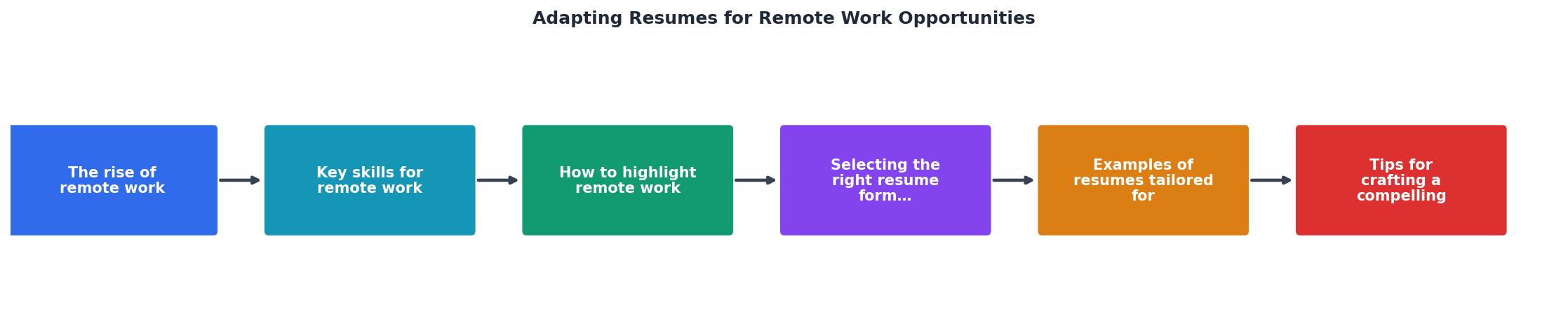
The Rise of Remote Work
Remote work stopped being a perk and became the expectation. What started as temporary pandemic measures evolved into permanent shifts at thousands of companies. Tech firms moved to remote-first or hybrid models. Customer service, marketing, design, and operations roles went fully distributed. Even traditionally office-bound sectors like finance and legal are now hiring remote workers.

This shift matters for your resume because remote employers have different hiring priorities. They're not evaluating whether you look busy or fit a specific office culture. They're screening for self-management, reliability, written communication, and the ability to solve problems without tapping someone on the shoulder. Your resume needs to make those qualities visible.
Key Skills for Remote Work
Employers hiring for remote roles scan for specific competencies. Some are technical; most are behavioral and communication-based. If your resume doesn't surface these, you won't make it past the ATS, let alone to a recruiter's desk.
Digital collaboration and tools are table stakes. Remote teams don't gather in conference rooms. They coordinate via Slack, Teams, Zoom, Asana, Monday.com, Notion, and dozens of other platforms. If you've used these tools professionally, say so. Don't just list them as a skill; embed them into your experience descriptions. Instead of "Managed team projects," write "Managed 15+ concurrent team projects using Asana, coordinating async updates across 4 time zones."
Written communication is non-negotiable. Remote work forces clarity into writing. Emails, Slack messages, documentation, and async status updates carry weight because they're the primary way information flows. Resumes should highlight experiences where you've communicated at scale, documentation you've written, training materials you've created, or processes you've documented.
Self-management and accountability are what every remote employer wants to see. They need people who deliver without hand-holding. Highlight outcomes you've achieved independently. Use language like "Independently launched," "Self-directed," "Owned end-to-end delivery," and "Managed own workload and deadlines."
Time zone flexibility and availability matters more than you think. If you've worked across time zones, handled asynchronous communication, or managed schedules in global teams, that's a selling point. Remote companies often have distributed teams spanning continents.
Other high-value skills include problem-solving (showing you can troubleshoot without escalation), initiative-taking, reliability, and proactive communication. These aren't abstract. They need to show up in your job descriptions and achievements.
How to Highlight Remote Work Experiences
If you've worked remotely before, that's gold. But you need to frame it correctly. Don't just mention the location or that you were remote. Show how you worked.
Be specific about what you delivered remotely. Instead of:- "Worked remotely for 3 years"
- "Worked fully remote for 3 years while managing end-to-end client relationships, responding to 50+ weekly inquiries across email and Slack, and maintaining a 48-hour response SLA"
- "Independently managed $500K annual budget with zero oversight"
- "Owned quarterly planning and execution without direct manager involvement"
- "Led 12-person distributed team with asynchronous decision-making"
- "Created internal wiki with 50+ process documents, reducing onboarding time from 3 weeks to 1"
- "Designed and maintained async communication standards for 8-person engineering team"
- "Coordinated daily standups across APAC, EMEA, and Americas time zones, ensuring zero delays in delivery"
- "Coordinated cross-functional projects using Asana, managing 40+ tasks monthly for 5 stakeholders"
- "Documented all processes in Notion, creating searchable reference library used by 20+ team members"
Selecting the Right Resume Format
Format matters for remote jobs more than you might think because remote employers rely heavily on ATS systems to filter resumes. A badly formatted resume can disappear before a human ever sees it.

Chronological format is usually safest for remote roles because it clearly shows your work history and progression. Remote employers want to see stability and growth. A chronological format tells that story cleanly.
Combination or hybrid formats work well if you're switching into remote work or industries. They let you emphasize skills alongside experience, which helps when your background isn't a perfect fit.
Avoid creative formats. Infographic resumes, artistic layouts, and non-standard designs often break ATS parsing. Your beautiful resume becomes unreadable text in the system. Keep it clean: standard fonts, clear sections, consistent formatting.
Use ATS-friendly structure:- Standard headings: Contact, Summary/Professional Overview, Experience, Education, Skills
- Bullet points for achievements (ATS loves parsing bullets)
- No tables, images, or columns
- Save as PDF to preserve formatting across systems
- Use standard fonts (Arial, Calibri, Times New Roman)
- Put keywords in job titles and descriptions where natural
Creating a Remote-Ready Resume Structure
The way you organize your resume signals whether you understand remote work. Here's the structure that works:
Professional Summary or Overview (2-3 lines): Lead with remote-relevant strengths.- "Self-directed marketing professional with 5 years remote experience managing campaigns, teams, and client relationships across distributed teams. Skilled in async communication, Slack, HubSpot, and cross-timezone collaboration."
Key here: Each bullet should answer "So what?" and emphasize independent delivery or remote capabilities.
Bad:- "Worked on marketing campaigns"
- "Independently developed and executed 8 campaign cycles generating $2.3M in revenue, managing timeline, budget, and stakeholder communication across 3 teams in async environment"
- Communication & Collaboration: Slack, Microsoft Teams, Asana, Notion, Zoom
- Project Management: Monday.com, Jira, Monday
- Technical: [Your relevant skills]
- Languages: [If applicable]
Examples and Templates
Let's look at how to rewrite experience for remote roles.
Before (generic):- Managed customer support team
- Handled email inquiries
- Improved customer satisfaction
- Managed 8-person remote customer support team across 3 time zones, implementing async escalation process that reduced response time from 6 hours to 2 hours while maintaining 95% satisfaction rating
- Processed 50+ daily customer inquiries via email and Slack in fully remote environment, maintaining SLA compliance 100% of quarters
"After: Successfully handled 50+ daily customer inquiries through phone and email while working in a fully remote, fast-paced environment, maintaining a 95% customer satisfaction rating.">, How to Tailor Your Resume for Remote Jobs Another example, Before:
- Led design projects
- Collaborated with team
- Led 12 concurrent design projects using Figma and async feedback workflows, delivering 100% on-time through self-managed schedule and proactive stakeholder communication
- Established design review process on Slack reducing feedback loops from 5 days to 2 days, enabling team of 6 to operate fully remote with zero delays
Tips for Crafting a Compelling Remote Work Resume
Here are tactical moves that work:
Use power words that signal remote capability: Independently, self-directed, owned, drove, established, initiated, pioneered, delivered, managed, coordinated, scaled.
Avoid office-specific language: "Face-to-face collaboration," "in-person meetings," "desk-based," "on-site." These make you sound office-dependent.
Front-load achievement. Lead each bullet with the outcome, not the task.- Weak: "Used Asana to track projects"
- Strong: "Reduced project delays 40% by implementing Asana tracking system for 5-person team"
- "Maintained 100% on-time delivery across 40 projects over 18 months"
- "Zero missed deadlines in 3-year tenure managing distributed team"
- "Managed asynchronous communication during pandemic, coordinating 6-person team remotely for 6 months"
- "Completed certification in X tool while working full-time"
- Any freelance, open-source, or side project where you worked independently
Tailor each resume to the job posting. This is critical. Remote employers screen heavily with ATS. If the posting mentions "Slack," and you know Slack, make sure your resume says "Slack." If they want "async communication," use that phrase. Mirror their language.
Process for Adapting Your Resume
Here's how to systematically update your resume for remote opportunities:
Start by auditing your current resume. Read through it and ask: Would a hiring manager reading this know I can work independently? Would they know I've used remote tools? If the answer is no, you need to rewrite.
Review job postings for roles you want. Copy keywords you see repeated. Remote roles often mention specific tools, communication styles, or capabilities. If "Asana" appears in 8 job descriptions, it matters. Make sure it's in your resume if you know it.
Rewrite each bullet to emphasize independent delivery and remote collaboration. Use the before/after examples above as templates. Think about what a remote employer cares about, not what you did, but how you did it independently.
Add a skills section if you don't have one. Front-load remote-relevant tools: Slack, Teams, Zoom, Asana, etc.
Optimize for ATS. Use standard formatting, no graphics, clear section headings, and keywords from job postings.
Test your resume. Paste it into an ATS checker (some are free online). Does it parse cleanly? Are your sections recognizable? If it comes out garbled, reformat.
Finally, tailor each application. Every time you apply, review the job description and adjust your resume to match their keywords and priorities. Generic is invisible. Specific gets interviews.
Remote Resume Readiness Score
When you're adapting your resume for remote work, think of it as translation. You're taking your actual experience and translating it into the language remote employers understand. That language emphasizes independence, clear communication, tool proficiency, and proven delivery without supervision.
FAQ
Frequently Asked Questions
Adapting Your Resume for Remote Work Opportunities
Your progress is saved automatically in your browser.
The difference between getting ignored and getting interviews often comes down to whether your resume speaks the language of remote work. Employers hiring for remote roles are looking for signals that you work differently than traditional office workers do. They're screening for independence, communication proficiency, and proven delivery at a distance. If your resume doesn't make those qualities visible, you're competing with your hands tied behind your back.
Start by auditing what you have. Read through your current resume. Would someone hiring for a fully remote role know you could handle it? If the answer is uncertain, rewrite those sections. Use the examples in this article as templates. Be specific about tools, outcomes, and how you've worked independently. Mirror the language in job postings. Format for ATS compatibility. Then apply with confidence knowing your resume speaks directly to what remote employers actually care about.
Additional Resources
- How to Tailor Your Resume for Remote Jobs - “So, how do I tailor my resume for a remote job?” · 1. List your past remote experience · 2. Include remote-related keywords · 3. Describe how you ...
- Adapting Resume Summaries for Remote Roles - Adapting resume summaries for remote roles means updating your resume to highlight skills, achievements, and experiences that prove you can succeed in a ...
- Tailor Your Resume for Remote Work Opportunities - Learn how to craft a standout remote work resume. Highlight key skills, optimize formatting, and secure your dream work-from-home job.
