
Employment gaps worry most job seekers. You took time off for personal reasons, went back to school, or dealt with a health issue. Now your resume shows blank months, and you're convinced recruiters will toss it before reading a single line. The truth is, gaps don't automatically disqualify you, but how you frame them determines whether they help or hurt. The strategy is to present what you gained during those periods, use your cover letter as context, and structure your resume so the focus lands on your skills and achievements, not the missing years.
Photo by Armin Rimoldi from Pexels
TL;DR
- Frame employment gaps as deliberate career decisions by highlighting skills and growth gained during downtime.
- Use a functional or hybrid resume format to emphasize skills over chronological employment.
- Explain context briefly in your cover letter without over-apologizing or dwelling on personal details.
- Consider education, volunteer work, freelance projects, or caregiving as legitimate resume entries that reduce perceived gaps.
- Most hiring managers care about what you can do now, not the months you were away; focus the conversation there.
How to frame employment gaps positively
The first instinct when addressing an employment gap is to minimize it. Stop. Minimizing draws attention to the gap itself. Instead, reframe the period as an intentional decision that produced measurable results.
If you took time off for caregiving, don't leave those years blank and hope no one notices. Instead, list caregiving as a role. Under it, describe what you managed: schedules, budgets, logistics, care coordination. These are real, transferable skills. If you left work to pursue education, your resume should show the degree, certification, or course completion date. If you freelanced or contracted during a gap, list those projects with deliverables and outcomes.
The reframing works because it answers the implicit question recruiters ask: "What were you doing?" When you have an answer, the gap stops feeling like an unexplained absence and starts feeling like a chapter in your career story.
Consider adding a brief note in your cover letter or professional summary if the gap is longer than six months. Keep it factual and forward-looking: "I stepped back from full-time work in 2023 to pursue [specific reason], during which I completed [skill/certification/project]. I'm now ready to apply those learnings in a full-time role." That's honest, direct, and doesn't dwell on what you were away from.

What skills can you highlight from education or caregiving?
Employment gaps often coincide with periods where you developed valuable skills that your previous roles didn't showcase. The trick is identifying those skills and giving them weight on your resume.
If you went back to school, you didn't just earn a degree. You likely developed research, project management, written communication, and technical skills specific to your field. A Data Analytics certificate from Google? That's on your resume as a credential. Self-taught Python through online courses? Add it to your skills section or create a "Professional Development" entry listing the course, platform, and completion date.
Caregiving roles hide significant organizational and people-management experience. You managed schedules, coordinated medical appointments, balanced household budgets, and made critical decisions under pressure. These translate directly into workplace competencies. List caregiving under a "Career Break" or custom heading, then bullet-point the transferable skills: "Managed household operations and care coordination for dependent family member, overseeing medical appointments, budgeting, and daily logistics."
Volunteer work is gold for gap coverage. Food bank shifts, community organizing, mentoring, coaching, board work, these all count as legitimate experience. Create an "Volunteer Experience" section if your gap includes volunteer work. Treat it like a paid role: include the organization, date range, title, and 2-3 bullets describing your contributions and impact.
Freelance or contract work during a gap carries weight too. If you took on short-term projects, built a portfolio, or provided services as an independent contractor, list those projects on your resume. Include the client name (or "Independent Client" if confidentiality applies), project scope, deliverables, and outcomes. Hiring managers see freelance work as proof you can stay productive and self-directed, qualities every employer values.
How to use cover letters to provide context
Your cover letter is where the gap gets its real explanation. Your resume doesn't need to answer "why", that's the cover letter's job.
Use one or two sentences in your cover letter to address the gap directly, then pivot to your value. Here's the formula: acknowledge the gap, explain it briefly without over-sharing, and redirect to what makes you a strong fit for the role.
Example: "After five years in marketing roles, I took eighteen months to pursue a professional certification in UX design, which deepened my understanding of user-centered product strategy. That combination of marketing and UX expertise makes me well-suited to this Product Manager role."
Or for a caregiving gap: "I took time to focus on family responsibilities from 2022 to 2023, during which I managed complex logistics and developed stronger project coordination skills. I'm now excited to bring that operational mindset and discipline back to a full-time role as an Operations Coordinator."
The key moves: be honest, keep it brief, emphasize what you gained, and show enthusiasm for the role you're applying to. Avoid apologizing, over-explaining personal details, or lengthy justifications. > "The most important aspect in this conversation is to emphasize that you are ready and excited to get back to work."
>, How to Explain Employment Gaps
Most hiring managers care about fit and capability in the present moment. They don't need a detailed personal history. A one-sentence acknowledgment followed by a forward-looking statement keeps the focus where it belongs: on you as a candidate now.
What resume structures downplay employment gaps?
Your resume format is a strategic choice. A chronological resume (the traditional "start with most recent job" format) puts dates in the spotlight. Gaps are harder to hide. A functional resume emphasizes skills and accomplishments over dates. A hybrid format balances both. For candidates with gaps, a functional or hybrid format is typically smarter.
Functional resume format
A functional resume organizes content by skill categories rather than chronological work history. You might have sections like "Project Management," "Data Analysis," "Client Relations," and "Technical Skills," with bullet points under each showing specific accomplishments, regardless of when they happened. At the bottom, you list your work history dates without detailed descriptions.
The advantage: gaps become less noticeable. The employer sees your capabilities first; your employment timeline is secondary information.
The drawback: some recruiters prefer chronological formats and view functional resumes with suspicion. Use it strategically when you have strong skills to lead with.
Hybrid resume format
A hybrid resume leads with a strong professional summary or skills section, then lists your employment history in reverse chronological order with accomplishments. It combines the clarity of chronological order with the skills emphasis of a functional format.
For employment gaps, the hybrid format works well. You highlight relevant skills upfront, which means the reader sees your value before diving into the timeline. When they reach the employment history, they already have context for why you matter.
Chronological resume format with strategic spacing
If you stick with a chronological format, you can minimize gap visibility through spacing and layout. Use years only (not months) for job dates. Combine short-term roles into a single entry if the gap between them is small. Add entries for education, volunteer work, or freelance projects that fill the gap. The employment section should read as one continuous flow of productive activity, even if some entries aren't paid employment.

How successful resumes address employment gaps
Real examples show how to do this right. The strongest resumes treat gaps as normal chapters in a career, not anomalies.
Consider a resume with a two-year gap for graduate school. Rather than leaving a blank space, the resume includes an "Education" entry with the degree name, institution, graduation date, and a two-bullet description of key projects or research that shows applied skills. The gap is accounted for; the resume reads as continuous professional development.
Another example: a candidate took eight months off after leaving a corporate job. During those months, they freelanced for three clients, built a portfolio website, and completed a Google Analytics certification. Their resume includes a "Freelance Consulting" section with the three client projects listed (anonymized as needed) with deliverables and outcomes, plus a "Professional Development" entry for the certification. The employment timeline shows no gap; instead, it shows a period of focused, productive work.
A third example: a career returner after a three-year caregiving gap. The resume includes a "Caregiver" entry (2021–2024) with bullets like "Managed household budget and medical care coordination," "Organized and led volunteer committee for community center," and "Completed Google Project Management Certificate." Below caregiving, the resume lists her previous role and returns to employment history. The gap is addressed directly; nothing is hidden.
The pattern in all three: gaps are filled with legitimate activities that demonstrate capability and forward momentum. The resume reader doesn't need to guess what the candidate was doing during those months.
Checklist: Addressing your employment gaps
Before you submit your resume, work through this checklist to ensure you've addressed gaps effectively:
Your progress is saved automatically in your browser.
Process for addressing employment gaps
Here's a step-by-step approach to tackle gaps on your resume:
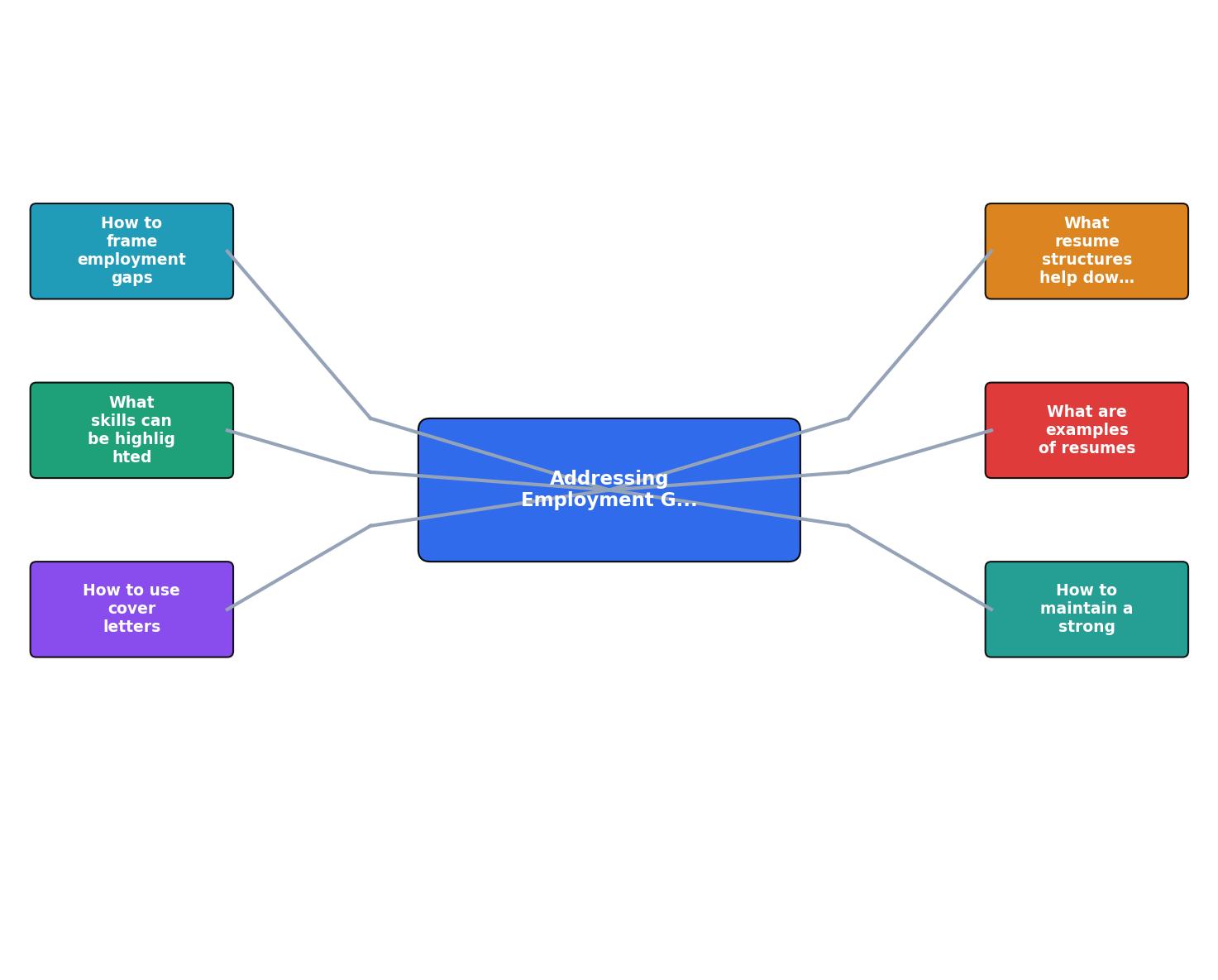
Your Gap Strategy Checklist
This visual breakdown shows the five key moves: inventory what happened during your gap, get it on your resume, choose the right format, explain briefly in your cover letter, and then tailor aggressively for each application. Resume Hedgehog can help you test whether your gap-addressed resume speaks the language of each job posting, the tool spots keywords you might have missed and suggests phrasing that amplifies your fit despite the gap.
Maintaining a strong job application despite employment gaps
Employment gaps don't sink applications; weak applications do. Here's what separates candidates who move forward from those who don't.
First, tailor aggressively. Employment gaps make it even more critical that you match your resume and cover letter to each job description. Use specific keywords from the posting. Highlight the skills they're looking for, whether you developed them three months ago or three years ago. The fresher and more aligned your application, the less a gap matters.
Second, lead with strength. Put your strongest accomplishments and most relevant skills at the top of your resume. If you have a gap, don't apologize or downplay your experience. Showcase the best version of your background immediately. A hiring manager should see value before they ever notice the gap.
Third, follow up thoughtfully. After applying, wait five to seven business days, then send a brief follow-up email to the hiring manager or recruiter (if you can identify them). Mention the specific role and remind them of one key reason you're a strong fit. This follow-up signals initiative and keeps your application top-of-mind. Employment gaps fade when the candidate is actively engaged.
Fourth, prepare to discuss the gap confidently. In interviews, if the gap comes up, be ready with a two-sentence answer that shows what you learned. Don't volunteer a long explanation; answer the question directly, then redirect to the role and your fit for it. Confidence and directness matter more than detail. You're signaling that the gap is handled history, not current baggage.
FAQ
Frequently Asked Questions
Additional Resources
- How To Explain Employment Gaps on Your Resume - How to explain employment gaps on your resume · 1. Include relevant activities from your gap · 2. Include only relevant roles · 3. Simplify dates ...
- How to Explain Employment Gaps | Columbia Career Education - Drop the months from your employment dates on your resume and just use years: Example: 2014–2016 instead of May 2014 to February 2016
- 8 Tips for Explaining Employment Gaps on Your Résumé - List anything you did to add or update your skills or stay engaged in the workforce during an employment gap, but make sure the activities you ...
