

You spent five years building expertise in one field, and now you want to move into something completely different. The problem is your resume still reads like a love letter to your old career. Hiring managers in your target industry scan it for ten seconds, see unfamiliar job titles, and move on. The fix is straightforward but requires deliberate work: you need to decode the job description, extract the language your new industry actually uses, and rewrite your experience so it speaks directly to what they need.
Photo by Anna Shvets from Pexels
TL;DR:- Treat every job description as a keyword map: pull out required skills, industry terms, and action verbs before you write a single bullet point.
- Reframe your past accomplishments using the vocabulary of your target field, focusing on transferable skills like project management, data analysis, stakeholder communication, and process improvement.
- Avoid the two biggest career-changer mistakes: leading with your old job title and burying relevant skills under irrelevant details.
How to Analyze a Job Description

Most people read a job description once, decide they are "close enough," and hit apply. That is a mistake. A job description is a cheat sheet. It tells you exactly what the hiring team values, what the ATS is scanning for, and what language to mirror back.
Here is a concrete method:
- Copy the full job description into a plain text document.
- Highlight hard skills in one color: specific tools, certifications, platforms, and technical abilities (e.g., "Salesforce," "SQL," "Google Analytics," "PMP certification").
- Highlight soft skills and responsibilities in a second color: phrases like "cross-functional collaboration," "stakeholder management," "process optimization."
- Circle repeated terms. If "data-driven" appears three times, that is a priority keyword.
- Note the verbs. "Led," "designed," "implemented," and "analyzed" tell you what kind of action the employer expects.
This is not about stuffing keywords. It is about understanding what the new industry calls the work you already know how to do.
What Are Transferable Skills?
Transferable skills are abilities that apply across industries and roles. They are the bridge between your old career and your new one.
Common transferable skills include:
- Project management: Planning timelines, coordinating teams, delivering results on deadline.
- Data analysis: Interpreting numbers to make decisions, whether that was student test scores, patient outcomes, or sales figures.
- Communication: Writing reports, presenting to groups, training new team members.
- Problem-solving: Diagnosing issues and creating solutions under constraints.
- Budget management: Controlling costs, allocating resources, tracking spending.
- Stakeholder management: Working with clients, parents, patients, vendors, or executives.
Here is a quick translation example. A nurse moving into healthcare project management might rewrite:
Provided patient care and documented medical records- Managed concurrent care plans for 15+ patients daily, maintaining 99.8% documentation accuracy in electronic health record systems
How to Reframe Past Experience

Reframing is the core skill of a career-switch resume. You are not lying about what you did. You are describing it through a different lens.
"Research and Align Your Resume to the Target Job>
Study the job posting.">, Making a career change?
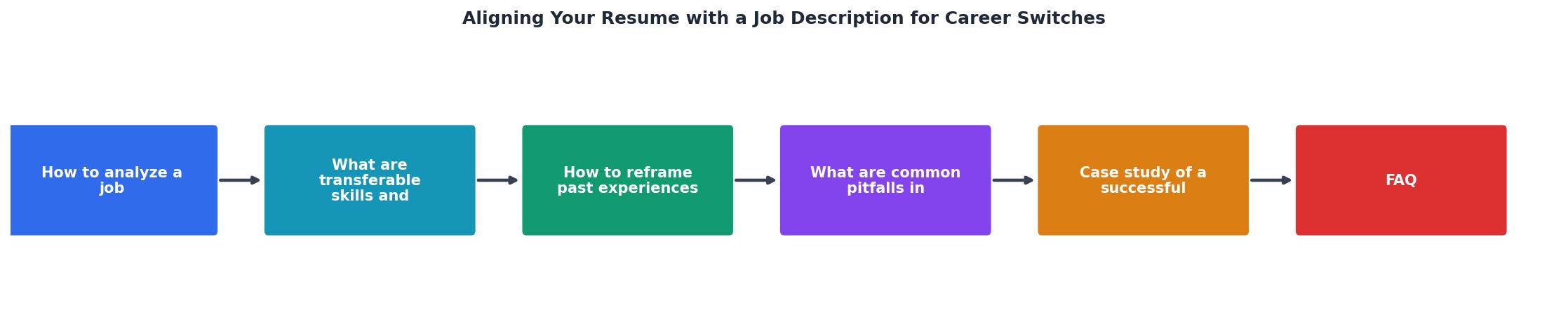
The process diagram below shows the full alignment workflow at a glance:
Follow these steps for each bullet point on your resume:
- Start with the job description keyword. If the posting says "stakeholder engagement," your bullet starts with a verb tied to that concept.
- Describe the action using the new industry's vocabulary. Replace old-career jargon with target-career equivalents. "Lesson planning" becomes "curriculum development" or "instructional design." "Patient intake" becomes "client onboarding."
- Quantify the result. Numbers translate across every industry. Revenue generated, time saved, error rates reduced, people managed, projects completed.
- Cut irrelevant details. If you are moving from retail management to operations, nobody needs to know you "maintained visual merchandising standards." They need to know you "reduced inventory shrinkage by 18% through process redesign."
- Match the job title language in your summary. If the posting says "Operations Analyst," your summary should reference operations and analysis, not your old title.
- Use the same acronyms. If the posting mentions KPIs, use KPIs, not "performance metrics."
- Mirror the structure. If the job description lists responsibilities as "Manage X, Develop Y, Analyze Z," structure your bullets the same way.
- Lead with relevance. Put the most transferable experience first, even if it was not your primary responsibility.
- Add a "Relevant Skills" section above your work history that maps directly to the job requirements.
| Old-Career Bullet | Reframed for New Industry |
|---|---|
| Taught 120 students across 4 class sections | Delivered training programs to 120+ participants across 4 cohorts |
| Managed restaurant staff of 15 | Supervised cross-functional team of 15, handling scheduling, performance reviews, and conflict resolution |
| Processed insurance claims | Analyzed and resolved 200+ client cases monthly, ensuring regulatory compliance |
| Organized church fundraising events | Planned and executed community engagement events with budgets up to $25,000 |
Common Career-Switch Resume Pitfalls

Career changers make predictable mistakes. Knowing them in advance saves you from the rejection pile.
Pitfall 1: Leading with your old job title. If your resume summary says "Experienced High School Teacher seeking new opportunities," a tech recruiter stops reading. Instead: "Instructional design professional with 8 years of experience developing curriculum, analyzing learner performance data, and managing multi-stakeholder programs."
Pitfall 2: Using old-industry jargon. Every field has its own language. "IEP compliance" means nothing to a product manager. Translate it: "Developed individualized plans meeting federal regulatory requirements, coordinating across 5 departments."
Pitfall 3: Listing duties instead of achievements. "Responsible for managing a team" is a duty. "Grew team from 4 to 12 members while reducing turnover by 30%" is an achievement. Achievements transfer. Duties do not.
Pitfall 4: Ignoring the skills section. Many career changers leave their skills section unchanged. This is the easiest section to align with a job description. Pull the exact skill names from the posting and list them.
Pitfall 5: Not addressing the switch. A brief line in your summary acknowledging the transition shows self-awareness: "Operations professional transitioning from healthcare administration, bringing 6 years of process optimization and team leadership experience." Silence about the switch makes recruiters wonder if you applied to the wrong job.
A Career Switch in Practice
Consider a real-world scenario. A retail store manager with 7 years of experience wants to move into supply chain operations. The target job description for a Supply Chain Coordinator lists these requirements:
- Inventory management and demand forecasting
- Vendor relationship management
- ERP system proficiency (SAP preferred)
- Cross-functional team coordination
- Cost reduction initiatives
The original resume bullet read: "Managed daily store operations including staffing, inventory, and customer service for a location generating $4.2M annually."
The reframed version: "Oversaw inventory management and demand planning for a $4.2M retail operation, coordinating with 8 vendors and reducing stock-outs by 22% through improved forecasting processes."
Same job. Same person. Completely different signal to the hiring manager. The reframed version hits four of the five job description requirements in a single bullet.
This is where a tool like Resume Hedgehog becomes useful. You upload your existing resume, paste the target job description, and the AI identifies exactly which terms to incorporate and where your experience maps to the new role's requirements.
The following interactive card shows how a typical career changer's resume alignment score improves after systematic reframing:
Resume Alignment Score
Resume Alignment Template for Career Changers
Your progress is saved automatically in your browser.
FAQ
Frequently Asked Questions
Additional Resources
- Making a career change? | Adrienne Tom - Here are 3 strategies for a career change resume that gets attention: 1. Research and Align Your Resume to the Target Job Study the job posting.
- Updating Your Resume for a Career Change - When switching careers, you need to make sure your resume highlights the skills that will help you break into your new career or industry. · At ...
- How to Write a Career Change Resume - Template - Wharton - When you're changing careers, your resume needs to emphasize relevant skills. Learn how to write a career change resume & download our example template.
