

You took time off work. Maybe you raised kids, cared for a parent, traveled, dealt with burnout, or switched gears entirely. Now you are staring at your resume wondering how to explain that gap without torpedoing your chances. The good news is that career breaks are far less damaging than most job seekers believe, and the strategies for presenting them are straightforward once you drop the outdated assumptions.
Photo by Vitaly Gariev from Pexels
TL;DR:- Career breaks do not need to be hidden or disguised on your resume.
- Employers increasingly view gaps as normal, especially post-pandemic.
- Framing a break around skills gained, volunteer work, or personal development turns a perceived weakness into a genuine talking point.
The gap is not the problem
A two-year break on a resume does not automatically land your application in the reject pile. What actually hurts candidates is how they handle the gap: leaving it unexplained, apologizing for it, or pretending it never happened. Recruiters notice gaps regardless of formatting tricks. They care far more about what you did during that time and whether you can still perform the role.
Surveys from LinkedIn and other hiring platforms consistently show that a majority of hiring managers have become more accepting of resume gaps since 2020. The shift happened because millions of workers experienced involuntary breaks during the pandemic, and the stigma simply could not survive at that scale.
If you are returning to the workforce or pivoting to a new field, the break itself is not your obstacle. The obstacle is outdated advice telling you to hide it.
Six myths that need to go

Let's walk through the most common myths about career breaks and why each one falls apart under scrutiny.
Myth 1: Any gap longer than six months is a red flag.
Gaps happen for dozens of legitimate reasons. Parental leave, caregiving, health recovery, education, relocation, and voluntary sabbaticals are all common. A six-month or even two-year break tells a recruiter nothing negative on its own.
Myth 2: You should use a functional resume to hide the gap.
Functional resumes (skills-based, no chronological timeline) raise more suspicion than they solve. Recruiters know exactly why candidates use them, and many ATS systems struggle to parse them correctly. A chronological or hybrid format with the break addressed directly works better.
Myth 3: Employers will assume you were fired or unemployable.
This assumption belongs to a different era. With remote work, gig economies, and widespread layoffs, hiring managers have seen every type of gap. They will ask about it in an interview, but the question is routine, not accusatory.
Myth 4: You need to fill the gap with fake freelance work.
Inventing a consulting business you never ran is risky and unnecessary. If a reference check or a simple LinkedIn search contradicts your claim, you lose credibility entirely. Honesty paired with a clear narrative beats fabrication every time.
Myth 5: Career breaks make you less competitive than continuous candidates.
Someone who took a year off to earn a certification, learn a new language, or volunteer in a relevant field can be more competitive. Skills decay is real, but it is slower than people think, and fresh learning signals motivation.
Myth 6: You should never bring up the break unless asked.
Proactively addressing the gap in a brief resume entry or cover letter shows confidence. Waiting for the interviewer to ask can make the conversation feel defensive.
How to frame breaks as strengths

Framing is everything. The same 18-month break can read as "unemployed" or "invested in professional development" depending on how you present it. Here is the approach that works:
- Name the break directly. Add a line in your experience section: "Career Break | Jan 2024 - Jun 2025." No need to over-explain.
- Attach outcomes. Under that line, list what you accomplished. Completed a Google Data Analytics certificate. Volunteered as a project coordinator for a local nonprofit. Studied Spanish to a B2 level.
- Connect to the target role. Every bullet should tie back to the job you want. If you are applying for a marketing role and you ran social media for a community organization during your break, that is directly relevant experience.
- Use the language of the new field. This matters especially if you are changing careers. The terminology on your resume should match the job description, not your old industry.
"Mental health break↳ Taking care of your mind is crucial ↳ Shows self-awareness and resilience" >, Common Misconceptions About Resume Gaps
Taking a break for mental health is not a liability. It demonstrates self-awareness, and framing it around resilience and recovery shows maturity that many employers genuinely value.
What value do breaks actually add?
Career breaks can contribute real, measurable value to your professional profile. Here are concrete examples:
- Caregiving develops project management, scheduling, budgeting, crisis response, and empathy. These are transferable skills with direct workplace applications.
- Travel builds cultural competence, adaptability, language skills, and independent problem-solving.
- Volunteering provides hands-on experience, often in leadership or coordination roles, that translates directly to paid work.
- Education and certification fills skill gaps and shows initiative. A candidate who earned an AWS certification during a break is demonstrably more qualified than before the break started.
- Personal projects like launching a blog, building an app, or writing a book demonstrate creativity, discipline, and follow-through.
Integrating breaks into your resume
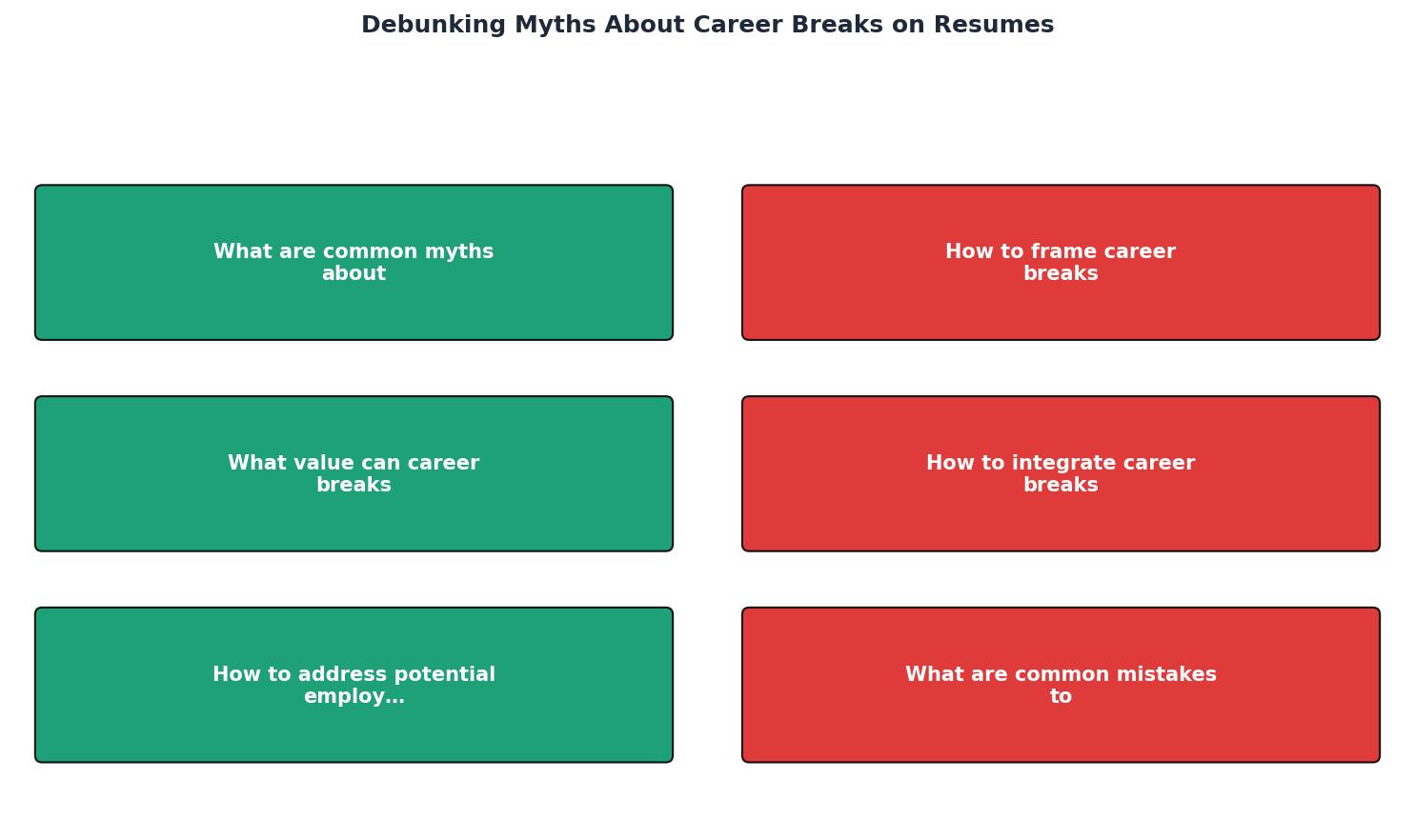
The diagram above shows the process at a high level: Identify Break, List Activities, Match to Role, Write Bullets, Review and Tailor. Each step builds on the previous one.
Here is a practical example of how a career break entry looks on a resume:
Career Break | March 2023 - September 2024- Earned Google Project Management Professional Certificate (6-course program)
- Coordinated volunteer logistics for Habitat for Humanity, managing teams of 15+ volunteers
- Completed intensive Spanish language program (DELE B2 certified)
- Developed personal finance blog with 2,000+ monthly readers
The following interactive card shows how employer perception shifts when a career break is framed with specific accomplishments versus left unexplained.
Unexplained Gap
- No context provided
- "Personal reasons" only
- Recruiter assumes the worst
- Interview callback rate drops
Framed Break
- Activities listed clearly
- Skills tied to target role
- Shows initiative and growth
- Interview callback rate rises
The difference is stark. Candidates who frame their breaks with specific activities and outcomes see dramatically higher callback rates compared to those who leave gaps unexplained.
Addressing employer concerns

Even with a well-crafted resume, you will likely face questions about your break in interviews. Here is how to handle them:
- Prepare a 30-second explanation. Keep it factual and forward-looking. "I took 18 months to care for a family member. During that time, I also completed a data analytics certification to prepare for this career transition."
- Do not over-share. You owe the interviewer a professional explanation, not a personal diary entry. One or two sentences covering the reason and what you gained is enough.
- Pivot to readiness. After the brief explanation, steer the conversation toward what you bring to the role right now. "I'm excited to apply the project management skills I developed during my volunteer work to this position."
- Show current engagement. Mention recent courses, industry events, or projects that prove you are up to speed. Employers worry about skill decay, so evidence of recent activity eliminates that concern.
Common mistakes to avoid
Even well-intentioned candidates make errors when presenting career breaks. Watch out for these:
- Apologizing for the break. Phrases like "Unfortunately, I had to take time off" signal shame. Replace them with neutral, confident language.
- Leaving the gap completely blank. A gap with zero explanation invites speculation. Even a single line is better than silence.
- Overcompensating with irrelevant filler. Listing every hobby and side activity dilutes your message. Include only what connects to the target role.
- Using dates strategically to hide gaps. Listing only years instead of months might seem clever, but recruiters notice and it can feel evasive.
- Ignoring the cover letter. Your cover letter is the perfect place to briefly contextualize the break and express enthusiasm for the role. Skipping it wastes an opportunity.
| Weak Approach | Strong Approach |
|---|---|
| Leave gap unexplained | Add a "Career Break" entry with bullets |
| Use functional resume to hide dates | Use hybrid format with clear timeline |
| Apologize: "Unfortunately I was out of work" | State facts: "Career break for caregiving" |
| List every hobby during the break | Highlight 2-3 activities relevant to target role |
| Avoid the topic in interviews | Prepare a confident 30-second explanation |
Career Break Resume Integration Checklist
Your progress is saved automatically in your browser.
FAQ
Frequently Asked Questions
What is the biggest myth about career breaks that held you back, and how did you overcome it? Share your experience in the comments.
Additional Resources
- Common Misconceptions About Resume Gaps - Recruiters don't reject you because of a career break. They reject you because your resume makes it look like you disappeared. If your break looks like a blank ...
- How to describe a career break on your resume & not be ... - Feeling worried about explaining career breaks in your resume? You're not alone. We debunk the myth that work history gaps are a red flag.
- Debunking Resume Myths - Myth #1: A Gap in Employment Means a Bad Candidate Reality: Career gaps can result from caregiving, education, relocation, or even ...
