Switching careers feels like showing up to a costume party in the wrong outfit. Your resume screams "teacher" when you want it to whisper "UX designer." The good news is that dozens of career changers have cracked this exact problem by rebuilding their resumes around transferable skills and targeted keywords. This article walks through real transition strategies, from classroom to codebase and from military base to corporate office, showing exactly how a tailored resume opens doors that a generic one keeps shut.
Photo by Vitaly Gariev from Pexels
TL;DR:- Tailored resumes bridge the gap between your old career and your new target by translating experience into the language hiring managers expect.
- Transferable skills like project management, communication, and data analysis carry across industries when framed correctly.
- Industry-specific keywords get you past applicant tracking systems (ATS), which filter out resumes that don't match the job posting's terminology.
Why Tailored Resumes Matter for Career Changers
A generic resume lists what you did. A tailored resume shows why it matters to the person reading it. That distinction is the difference between a callback and silence.
When you change careers, the hiring manager scanning your resume has one question: "Can this person do the job I need filled?" Your five years of classroom management experience won't answer that question on its own. But reframe it as "led daily sessions for 30+ participants, tracked individual progress metrics, and adapted curriculum based on performance data," and suddenly you sound like someone who could run a training program at a tech company.
"By some estimates, 70 percent of large businesses, and 99 percent of Fortune 500 companies, use applicant tracking systems to perform an initial review of applications.">, Career Change Resume & Cover Letter Writing Guide
That statistic means your resume hits software before it hits a human. If the keywords don't match, you're filtered out before anyone reads your carefully crafted summary. Career changers face this problem at double intensity because their natural vocabulary comes from a different field entirely.
How to Spot Transferable Skills

Transferable skills are capabilities that work across industries. They're the connective tissue between your past and your future role. Here's how to identify yours:
- List your daily tasks from your current or most recent role. Not job titles or responsibilities from a description. What you actually did, hour by hour.
- Group them by category. Communication, analysis, leadership, technical tools, process improvement, client management.
- Match categories to the target job posting. Read five to ten job descriptions in your target field. Highlight the skills they mention repeatedly.
- Translate the language. "Parent-teacher conferences" becomes "stakeholder communication." "Lesson planning" becomes "content development and scheduling." "Grading rubrics" becomes "performance evaluation frameworks."
Research from LinkedIn consistently shows that the majority of skills listed in job postings are not industry-specific. Communication, problem-solving, project coordination, and data literacy appear in job descriptions from healthcare to fintech to nonprofit management. You already have more transferable skills than you think.
Keywords: Your ATS Passport
Applicant tracking systems scan for specific terms. If a job posting mentions "Agile methodology" twelve times and your resume says "flexible project approach," the ATS doesn't make the connection. You need the exact words.
Here's a practical approach to keyword research for career changers:
- Copy the job description into a word frequency tool (free ones exist online).
- Identify the top 15-20 repeated terms. These are your target keywords.
- Separate hard skills from soft skills. Hard skills (specific tools, certifications, methodologies) carry more ATS weight.
- Map your experience to those keywords. For each keyword, write one bullet point that demonstrates you've done something equivalent.
The career change resume strategy below shows how these pieces fit together:
The flow is straightforward: Identify Target Role, then Analyze Job Postings, then Map Transferable Skills, then Translate Keywords, then Tailor Resume, and finally Apply and Iterate. Each step feeds the next. Skip one and the whole chain weakens.
Case Study: Teaching to Tech

Consider a high school science teacher with eight years of experience who wanted to move into a product management role at a SaaS company. The original resume led with "Educator" and listed accomplishments like "Improved AP Biology pass rates by 22%."
Here's what the tailored version changed:
- Summary section shifted from "Dedicated educator" to "Product-minded professional with 8 years of experience designing user-centered learning experiences, analyzing performance data, and iterating on content based on user feedback."
- Bullet points were rewritten. "Created differentiated lesson plans for 150 students" became "Developed segmented content strategies for 150+ users with varying skill levels, increasing engagement metrics by 22%."
- Skills section added terms from product management postings: "user research," "A/B testing" (she had compared two teaching methods and measured results), "stakeholder management," "roadmap planning" (she had planned semester-long curricula with milestones).
- A short "Relevant Projects" section highlighted a side project where she built a student feedback app using no-code tools.
The key insight here is that the experience didn't change. The framing did.
Case Study: Military to Civilian

Military-to-civilian transitions come with a unique challenge: the vocabulary gap is enormous. "Platoon leader responsible for 40 personnel and $2M in equipment" is impressive, but a hiring manager at a logistics company might not parse it correctly.
A former Army logistics officer targeting supply chain management roles restructured his resume with these changes:
- Replaced military jargon with civilian equivalents. "Battalion S4" became "Senior Logistics Manager." "CONOP" became "operational plan." "AAR" became "post-project review."
- Quantified everything. "Managed supply chain operations for 500+ personnel across 3 locations, coordinating $4.2M in inventory with 99.1% accountability rate."
- Added a "Civilian Equivalency" line under each role title. Example: Army Logistics Officer (equivalent to Supply Chain Manager).
- Earned one civilian certification before applying. A Lean Six Sigma Green Belt gave his resume a keyword that appeared in 80% of target job postings.
He received five interview invitations in his first month of applying with the tailored resume. The previous version, heavy with military acronyms, had generated zero responses over three months.
Expert Advice on Resume Tailoring
Career coaches who specialize in transitions consistently emphasize three principles:
- Lead with relevance, not chronology. A functional or hybrid resume format lets you group experience by skill category rather than by date. This puts your transferable skills front and center.
- Use the job posting as a blueprint. Every bullet point on your resume should connect to something the employer asked for. If it doesn't connect, cut it or rewrite it.
- Show, don't tell. "Strong communicator" means nothing. "Presented quarterly results to C-suite stakeholders and secured $500K budget increase" means everything.
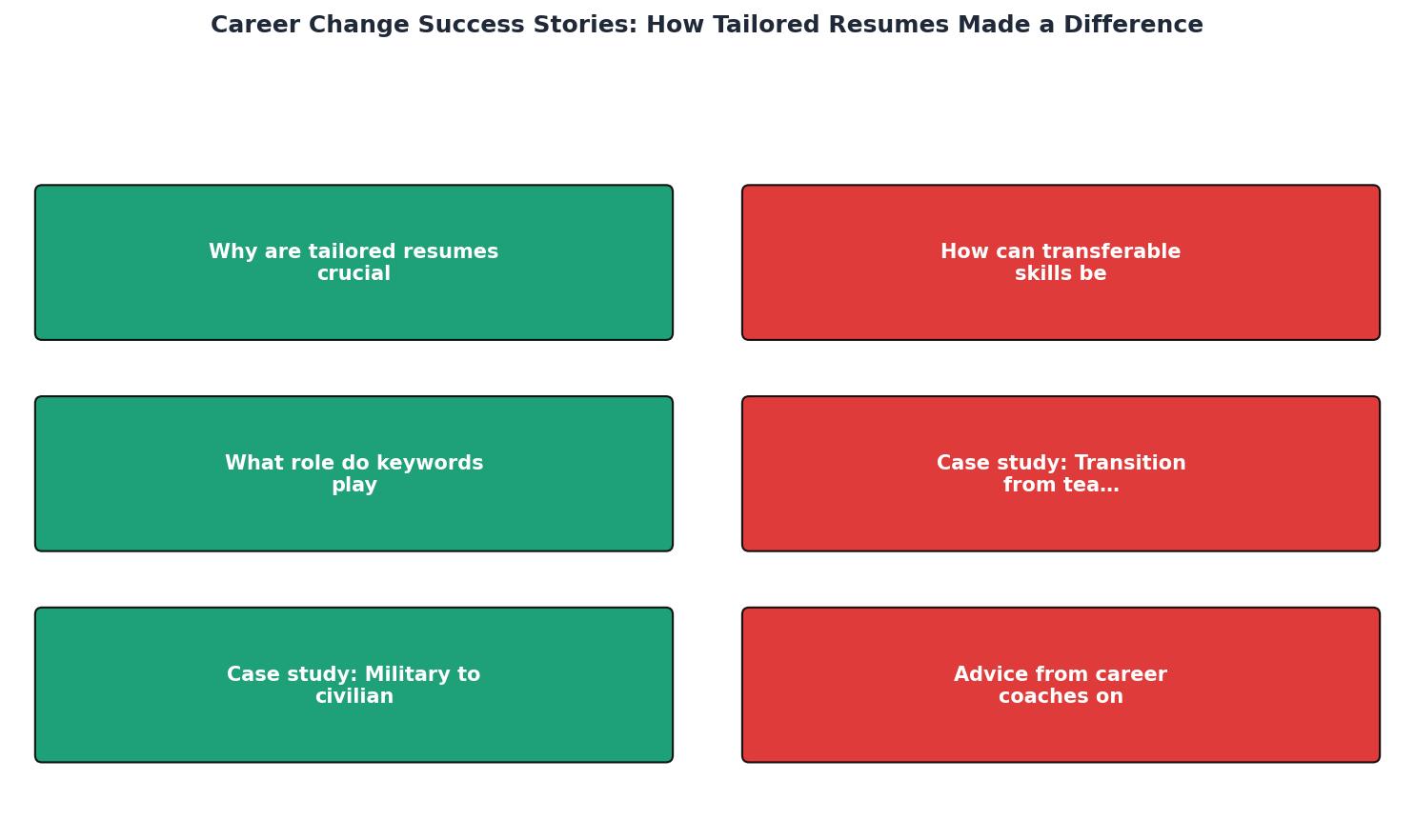
Teacher → PM
Military → Supply Chain
Retail → Account Mgmt
Nurse → Health Tech
Each card above shows the same experience described two ways. The crossed-out version is how most career changers write their first draft. The bold version is what gets interviews.
Tips for Reframing Experience
Here are concrete tips for translating your background into a new industry's language:
- Study LinkedIn profiles of people who already hold your target role. Note how they describe similar backgrounds.
- Use the "So what?" test. After each bullet point, ask "So what does this mean for the hiring manager?" If you can't answer, rewrite.
- Mirror the job posting's structure. If the posting lists responsibilities in a certain order, arrange your bullets to match that flow.
- Remove industry-specific jargon from your old field unless it overlaps with the new one.
- Add a "Career Summary" section at the top that explicitly states your transition: "Operations professional transitioning into data analytics, bringing 6 years of process optimization and reporting experience."
- Include relevant coursework, certifications, or side projects that demonstrate commitment to the new field. Even a completed online course signals intent.
Career Change Resume Tailoring Checklist
Your progress is saved automatically in your browser.
FAQ
Frequently Asked Questions
Additional Resources
- Career Change Resume & Cover Letter Writing Guide - Making a career change? Discover resume tips for career changers, how to highlight transferable skills, and ways to stand out in today's job ...
- Making a career change? | Adrienne Tom - Here's what really works when writing a career change resume 1. Use a hybrid or functional format—highlight your skills first, then your work ...
- How to Write a Career Change Resume — with Examples - A career change resume reframes your experience around transferable skills, not job titles. By leading with a motivation-driven summary, ...