

You've optimized your resume to pass the ATS, loaded it with keywords, and cleaned up the formatting. But here's the gap most candidates miss: a machine reads your resume, but a human reads your cover letter. While ATS-friendly resumes get you in the door, cover letters turn gatekeepers into advocates. They're the place where your resume's structured facts become a compelling reason to hire you.
TL;DR:- ATS-friendly resumes pass automated screening but can feel impersonal and robotic.
- Cover letters add context, personality, and proof of genuine interest that resumes cannot convey.
- Together, they create a complete application: one optimized for machines, one written for humans.
- Effective cover letters highlight specific achievements, reference the company directly, and show how your skills match the role.
What is an ATS-friendly resume?
An ATS (Applicant Tracking System) is the software that most mid-to-large companies use to filter incoming job applications. It scans resumes for keywords, formats, and structural signals before a recruiter ever sees your application.
An ATS-friendly resume is built to pass that scan. It uses:
- Straightforward formatting (no columns, tables, or graphics that break parsing)
- Keywords from the job description (skills, certifications, industry terms)
- Standard section headings (Work Experience, Skills, Education)
- Recognizable date formats and consistent bullet points
- Readable fonts (Arial, Calibri, Helvetica) and simple structure
The problem: When you optimize for the ATS, your resume can read like a list of keywords and dates. It hits the checkboxes the algorithm is looking for, but it doesn't convey your actual value or enthusiasm. That's where the cover letter steps in.
Why cover letters still matter
The cover letter is the human counterpart to the ATS-optimized resume. It's one of the few places in a job application where personality, storytelling, and genuine interest matter.
Recruiters read thousands of resumes. Most blur together. A standout cover letter breaks through the noise because it:
- Shows you researched the company. You reference something specific about their mission, recent news, or culture. This proves you didn't spray and pray.
- Explains why you want this role. Not just why you need a job, but why this particular one. That context almost never fits in a resume.
- Highlights achievements a resume can't. Your resume lists duties; your cover letter shows impact. You can tell the story of how you saved time, grew revenue, or solved a problem.
- Addresses gaps or career shifts. If you're changing industries or have an unconventional path, the cover letter lets you explain it before skepticism sets in.
The data backs this up. While not every recruiter reads every cover letter, when one is present and well-written, it significantly improves your odds. Hiring managers use it to decide between candidates who pass the ATS filter.
How cover letters complement ATS-friendly resumes
Think of your ATS-friendly resume and cover letter as a two-act application:
Act 1: The Resume (ATS screening)
Your resume passes the algorithm. It has the keywords, structure, and format that the system expects. The goal is simple: get past the bot.
Act 2: The Cover Letter (Human screening)
Your cover letter lands in front of a real person. Now the goal shifts. You're not scanning for keywords anymore. You're showing fit, enthusiasm, and evidence that you've thought about this role and company specifically.

The two aren't in tension. They work together. Your resume gets you screened in. Your cover letter keeps you screened in and moves you toward the interview.
Here's the interaction: A recruiter sees your resume has the right keywords and experience level. But so do 40 other candidates. The cover letter tells them why you're the one to interview. You didn't just land at this job posting by accident. You're there because you understand what the company does and you have something to contribute.
Key elements of an effective cover letter
A strong cover letter follows a simple structure. It's not a novel. Three to four paragraphs, each with a clear job:
- Opening: State the role and company. Reference something specific about why you're interested (a product feature, recent company news, a value you share). One or two sentences.
- Why you: Connect your experience directly to the job description. Use keywords from the posting, but in natural sentences. Pick one or two big achievements that prove you can do this job. Show, don't just tell.
- Why this company: Demonstrate that you've researched them. Reference their mission, a challenge they're solving, or how your values align. This is your chance to show genuine interest, not just that you're applying to every opening.
- Closing: A clear call to action. Thank them for their time. Reiterate your enthusiasm. Keep it short.
"Here's what matters:>
• Use keywords from the job description to pass the ATS scan>, How to Write an ATS
• Keep formatting clean."
Real-world examples of effective cover letters
Let's walk through what works:
Example 1: The Direct Connection
A candidate applying for a Product Manager role at a mid-stage SaaS company wrote: "When I used [Company Name]'s scheduling tool last month, I noticed a gap in the mobile flow that your roadmap addresses in Q2. I've spent three years closing exactly these types of gaps at [Current Company], where I shipped a mobile redesign that reduced support tickets by 35%."
Why it works: They didn't just say "I'm interested." They showed they use the product, they know the roadmap, and they've done related work with a concrete metric.
Example 2: The Career Bridge
A career-changer wrote: "I'm transitioning from teaching to instructional design. My five years in the classroom taught me how people learn. Your onboarding program reaches thousands of customers. I want to bring that same rigor and empathy I used to craft lesson plans into making your product intuitive for new users."
Why it works: They acknowledged the transition. They didn't pretend teaching and instructional design were the same thing. They showed how teaching experience translates into a relevant skill for the role.
Example 3: The Problem Solver
An operations candidate wrote: "Your company is expanding into three new markets. I led the operations infrastructure for [Company Name]'s expansion into two markets in 18 months. I built the processes that scaled customer support from 50 to 2,000 accounts without hiring proportionally."
Why it works: They identified a specific business problem from the job posting. They presented relevant experience with measurable proof that they'd succeeded at that exact thing before.

Tips for writing a standout cover letter
1. Customize it for the role and company. Generic cover letters are obvious and worthless. Spend 10 minutes researching the company. Reference something real. A templated letter tells the recruiter you're blasting out applications.
2. Lead with specifics, not enthusiasm. Don't open with "I'm excited about this opportunity." Open with "I've built three product integrations with APIs similar to the one your platform relies on."
3. Use keywords from the job description, naturally. If the posting says "experience with Salesforce and customer segmentation," and you have that experience, work it in. But don't jam keywords unnaturally. Recruiters can tell when you're trying to game it.
4. Show impact, not activity. Resumes list what you did. Cover letters show what changed because you did it. Instead of "Managed a team of five engineers," try "Led a team of five engineers through a technical migration that cut infrastructure costs by 40%."
5. Keep it short. Three to four paragraphs. Under 250 words. Recruiters don't read. They scan. Make it scannable.
6. Address a person if possible. "Dear Hiring Manager" is fine. But if you can find the recruiter's or hiring manager's name, use it. Shows effort.
7. Match the company tone. A startup's cover letter can be a bit more casual. A corporate finance firm should be more formal. Read the job posting and website to get a sense of voice.
8. Proofread twice. A typo in your cover letter when you're applying to a copywriting role is a killer. One small error and you're out.

How to structure the application process
Most applications ask for a resume and often include a field for a cover letter. Some companies use a cover letter plus additional custom questions. Some skip the cover letter entirely.
Here's how to navigate it:
If a cover letter is requested: Always provide one. Leaving the field blank sends a message. Filling it out shows respect for the process and gives you an edge.
If a cover letter is optional: Still write one and attach it. The fact that it's optional means most candidates won't do it. That's your advantage.
If there's a custom question field: That's a cover letter in disguise. Use it to tell the story your resume can't. "Why do you want to work here?" or "Tell us about a challenge you've overcome" are chances to connect emotionally and specifically.
If the application doesn't allow a cover letter: Add one anyway as an attachment or mention it in a follow-up email if you can find a contact. Be creative, but respect the process.
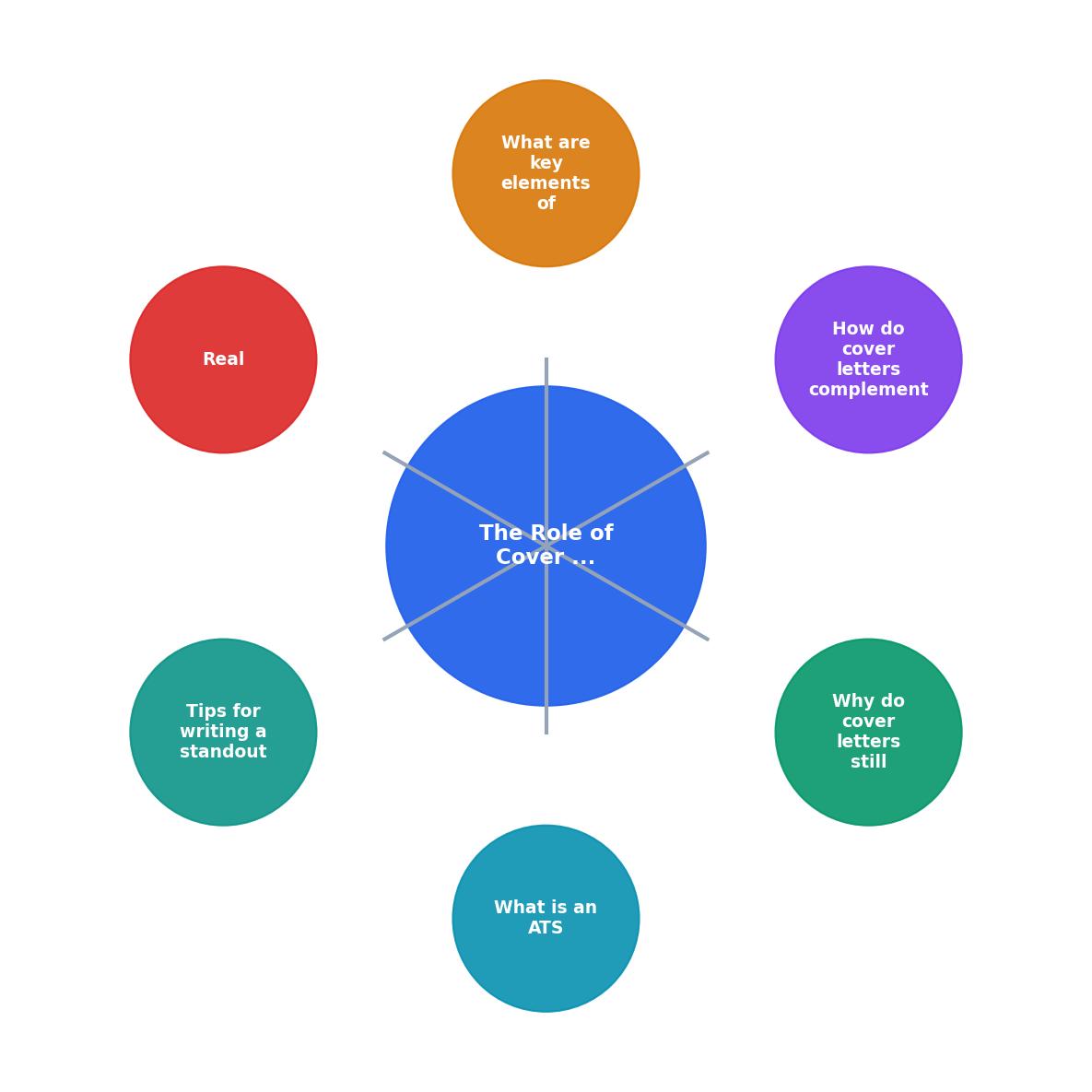
The interaction between ATS and human reviewers
Here's what actually happens behind the scenes:
Step 1: Resume enters the ATS. The system parses your resume and scores it based on keywords, format, and required qualifications. If you don't hit a minimum threshold, you never get seen by a person. That's why ATS optimization matters.
Step 2: Resume passes to human screening. If the ATS score is high enough, a recruiter gets a notification. They see your resume in the system.
Step 3: Recruiter decides whether to engage. Here's where the cover letter helps. They see your resume on screen. They see your cover letter in the email or application. The combination of the two determines if they move you forward or pass.
Step 4: Second-round decision. If you advance, the hiring manager reviews both your resume and cover letter. The cover letter helps them understand your motivation and fit, not just your qualifications.
This is why optimization at every stage matters. Your resume needs to pass the ATS. Your cover letter needs to convince the human.
The competitive advantage
Most candidates spend time on the resume and skip the cover letter or write a generic one. That's a missed opportunity. A tailored, specific, well-written cover letter in a sea of generic applications is a signal that you're serious and thoughtful.
It doesn't guarantee you'll get an interview. But it significantly raises your odds. Combined with an ATS-optimized resume, a strong cover letter is the difference between getting ghosted and getting a call.
When cover letters make the biggest difference
Cover letters matter most in these situations:
- You're changing careers. The cover letter is where you explain the transition and bridge the gap between past and future work.
- You have a gap in your resume. You can address it directly and explain what you were doing during that time.
- You're overqualified or underqualified. You get to explain why you're still a fit despite the mismatch on paper.
- You're applying to a company that values culture fit. Smaller companies, startups, and mission-driven organizations often weigh cover letters more heavily because they're judging whether you share their values.
- You're a strong candidate but not perfect on paper. The cover letter helps you persuade despite the imperfect match.
Cover Letter Quality Checklist
Your progress is saved automatically in your browser.
FAQ
Frequently Asked Questions
The gap between resumes and cover letters is where most candidates lose opportunities. Your ATS-friendly resume gets you past the algorithm. Your cover letter gets you past the skepticism. Together, they form a complete application that works at every stage of screening.
When you sit down to apply, spend the time on both. Optimize your resume for keywords and format. Then spend another 15–20 minutes on a cover letter that proves you've researched the company and understand what makes you the right fit. That combination is your best shot at moving from the application pile to the interview calendar.
Additional Resources
- ATS resume templates and cover letters in Word - Find ATS-friendly resume templates and matching cover letters in Microsoft Word. Customize, save, and print documents for job applications.
- How to Write an ATS-Friendly Cover Letter - A cover letter must be short, if possible one page with three to four paragraphs, and must be tailored to the specific role applied to.
- How to Write an ATS Resume (With Template and Tips) - Write an ATS resume by using standard fonts, labeling sections clearly, avoiding tables or graphics and adding keywords that match the job ...
