
Your accounting resume isn't just a list of jobs. It's a targeted document designed to prove financial competence to both automated screening systems and hiring managers who've seen hundreds of similar applications. The difference between getting buried in an ATS filter and landing an interview often comes down to whether you've included the right certifications, software skills, and quantifiable achievements in the right format.
Photo by Jakub Zerdzicki from Pexels
TL;DR:- Lead with relevant certifications (CPA, CMA, CIA) and highlight accounting software expertise (QuickBooks, SAP, Excel).
- Use quantifiable financial metrics in every achievement: budget sizes, percentages, dollar amounts recovered or saved.
- Structure your resume for ATS optimization by matching job description keywords and using clear section headers.
- Tailor your resume to each position instead of sending the same generic version to every employer.
What Certifications Matter Most

Certifications are your credential badges in accounting. They're often non-negotiable for certain roles and signal that you've passed rigorous exam standards. The most recognized credentials include:
CPA (Certified Public Accountant), The gold standard. If you hold a CPA, lead with it. Firms hiring for controller, senior accountant, or audit positions almost always prefer or require it. List it prominently near your name or in a dedicated "Certifications" section at the top of your resume.
CMA (Certified Management Accountant), Valuable if you're pursuing management accounting, cost accounting, or internal audit roles. It signals expertise in decision-making and financial planning for organizations.
CIA (Certified Internal Auditor), Necessary if you're applying for internal audit positions. Increasingly required by larger corporations and compliance-heavy industries like finance and healthcare.
CFA (Chartered Financial Analyst), Less common in accounting but highly respected in financial analysis, investment management, and corporate finance roles.
EA (Enrolled Agent), For tax accounting and tax preparation roles, this IRS credential is often required or strongly preferred.
If you're working toward a certification, don't hide it. Write "CPA (in progress)" or "CPA eligible, exam scheduled Q2 2026" on your resume. Employers respect the trajectory.
Beyond the acronyms, include the issuing body (AICPA for CPA, IMA for CMA) and the year earned. This detail matters for ATS scanning and shows credibility.
Demonstrating Software Proficiency

Accounting software is the accountant's toolkit. The specific tools vary by industry and company size, but certain platforms dominate the field:
QuickBooks, Used by small to mid-sized businesses for bookkeeping, payroll, and tax prep. If you list QuickBooks, specify the version: Desktop, Online, or Enterprise. Add what you did with it: "Reconciled monthly bank accounts in QuickBooks Online, processed A/P and A/R."
SAP, Enterprise resource planning system used by large corporations. SAP experience makes you valuable to Fortune 500 companies and carries weight on any resume. If you've used SAP, mention the modules you know (FI for Financial, CO for Controlling).
NetSuite, Cloud-based ERP adopted by growing mid-market and enterprise companies. NetSuite skills are increasingly in demand.
Excel, Never skip this. Even if you're fluent in enterprise systems, Excel proficiency matters. Highlight specific skills: pivot tables, VLOOKUP, advanced formulas, data analysis. Hiring managers still test Excel skills in interviews.
Tax software, Intuit ProSeries, Intuit TaxWise, Thomson Reuters GoSystem, or similar platforms. Crucial for tax accounting roles.
ADP or Workday, Payroll and HCM systems. If you've managed payroll processing in these platforms, include it.
The best approach: Match the job description. If the posting says "QuickBooks experience required," put QuickBooks on your resume. If they mention SAP, emphasize your SAP experience even if you also know smaller systems.
Create a dedicated "Technical Skills" or "Systems" section and list tools with proficiency levels when possible:- QuickBooks Online (Advanced)
- SAP FI Module (Intermediate)
- Excel (Advanced, pivot tables, VLOOKUP, forecasting models)
- Tableau (Intermediate)
Building Your Achievement Section with Metrics
The difference between a bland resume and one that lands interviews is quantification. Instead of "Responsible for financial reporting," write something specific:
"Managed financial reporting for a $10M+ budget, ensuring 100% compliance with GAAP.">, Professional Accounting Resume Tips to Make a Great Impression
Notice what makes this strong: a dollar figure ($10M+), a measurable outcome (100% compliance), and a relevant standard (GAAP). Hiring managers immediately understand the scale and impact.
Here are real metrics that work in accounting resumes:
- Budget sizes managed or reviewed: "Oversaw $5.2M operating budget"
- Accuracy rates: "Achieved 99.8% reconciliation accuracy across 47 monthly accounts"
- Time savings: "Automated month-end close process, reducing timeline by 8 days"
- Cost reductions: "Identified and corrected billing discrepancies, recovering $340K in overpayments"
- Variance improvements: "Reduced budget variance from 12% to 2% through improved forecasting"
- Transaction volumes: "Processed 2,500+ accounts payable transactions monthly with zero errors"
- Compliance achievements: "Maintained 100% audit pass rate across four consecutive external audits"
Track these numbers while you're still in your role. Take screenshots of budget reports, note the month-end close timeline before and after process improvements, ask your manager for compliance records. When you start a job search, you'll have real numbers to work with.
Structuring for ATS Optimization
Applicant Tracking Systems scan for keywords and formatting consistency before a human ever sees your resume. Poor structure kills your chances.
Use clear section headers: The ATS recognizes "Experience," "Education," "Certifications," "Skills." Use these standard headers exactly. Don't get creative with "What I've Done" or "My Strengths", it confuses the scanner.
Mirror job description language: If the job posting says "GAAP compliance," use that exact phrase somewhere on your resume. If they list "accounts reconciliation," don't just write "reconcile accounts." Match their terminology. The ATS is looking for exact or near-exact matches.
Use a simple format: Stick to standard fonts (Arial, Calibri, Times New Roman). Avoid fancy graphics, two-column layouts, or colored headers. These often don't parse correctly in ATS systems. Your resume should be readable as plain text.
Bullet points over paragraphs: The ATS processes bullets better than prose. Each bullet should be one clear achievement or responsibility.
Include a skills section: List 15-25 relevant skills. Include certifications, software tools, accounting methods (GAAP, IFRS, tax preparation), and compliance areas (SOX, HIPAA if relevant). The ATS uses this section heavily for keyword matching.
Avoid headers like "Objective" or "Summary": Many companies now remove these altogether. If you include a brief professional summary, keep it to two sentences and front-load keywords. "Experienced CPA with 8 years in financial reporting and SOX compliance" works. "Dedicated professional seeking a challenging role" doesn't.
Save as PDF (but check the job posting). Most ATS systems handle PDF well now, but a few older systems prefer .docx. If the posting doesn't specify, PDF is safer because it preserves formatting.
Tailoring Your Resume to Each Position
Your resume isn't a one-size-fits-all document. You should have a template, but each application warrants tailoring.
Start by extracting 15-20 keywords from the job posting. Look for:- Specific accounting methods or standards (GAAP, IFRS, tax code sections)
- Software or tools mentioned
- Industry jargon (healthcare accounting, manufacturing cost accounting, non-profit accounting)
- Compliance or regulatory keywords (SOX, HIPAA, audit)
- Soft skills tied to accounting (attention to detail, communication, problem-solving)
Let's say you're applying to two different jobs:
Job A: Senior Accountant at a manufacturing firm, emphasizes cost accounting and inventory management.
Job B: Audit Accountant at a mid-size firm, emphasizes financial statement audits and controls testing.
For Job A, you'd emphasize: "Analyzed cost variances and inventory valuation under FIFO method, supporting manufacturing margin improvements."
For Job B, the same person would emphasize: "Conducted controls testing on revenue and expense cycles, identified process gaps, and documented SOX compliance."
It's the same person, different resume emphasis. This isn't dishonest; it's strategic communication.
Creating Your Accountant Resume Template

Here's the structure that works for accounting positions:
Header (Your Name and Contact)
Your full name, phone number, professional email, and LinkedIn URL. Optional: location city (but not your full address, recruiters don't need it).
Certifications (if applicable)
CPA, CMA, CIA, etc., with the year earned. Put this near the top if you hold a credential.
Professional Summary (optional, 2 sentences)
"Certified Public Accountant with 6 years of financial reporting and tax compliance experience. Proven track record managing $8M+ in annual budgets and maintaining zero audit findings."
- Company name, location, dates
- Job title
- 4-6 bullets per role, each starting with an action verb and ending with a measurable outcome
Certifications and Licenses
CPA, CMA, CIA, EA, etc., with issuing organization and year earned.
Technical Skills
Accounting software, spreadsheet proficiency, tax software, ERP systems, etc. Organized by category if you have 20+ skills.
Optional: Relevant Projects or Volunteer Experience
If you're early-career, include non-profit bookkeeping, pro bono tax prep, or relevant school projects.
Using Keywords Strategically
Certain keywords appear in nearly every accounting job posting. If your experience matches these terms, use them.
Technical keywords: GAAP, IFRS, QuickBooks, SAP, NetSuite, Excel, journal entries, general ledger, accounts receivable, accounts payable, bank reconciliation, payroll, tax return preparation, audit, financial analysis, forecasting, variance analysis, internal controls, SOX compliance, month-end close, balance sheet, income statement, cash flow analysis.
Soft skills in accounting context: Attention to detail, communication, time management, problem-solving, documentation, process improvement, collaboration, training.
Industry-specific keywords: If you're applying to healthcare accounting, include "Medicare billing," "CPT codes," "HIPAA compliance." For non-profit roles, add "Form 990," "grant accounting," "fund accounting."
Place keywords naturally throughout your resume. Don't stuff them unnaturally into every bullet point, hiring managers and ATS systems both flag keyword stuffing as a red flag.
A simple strategy: Reserve one bullet point per role for a keyword-rich achievement. "Implemented new cost allocation model using SAP FI, reducing reporting cycle time by 5 days and improving management visibility into departmental P&L." This sentence includes SAP, financial reporting, process improvement, and measurable output, and it reads naturally.
Accounting Resume Essentials
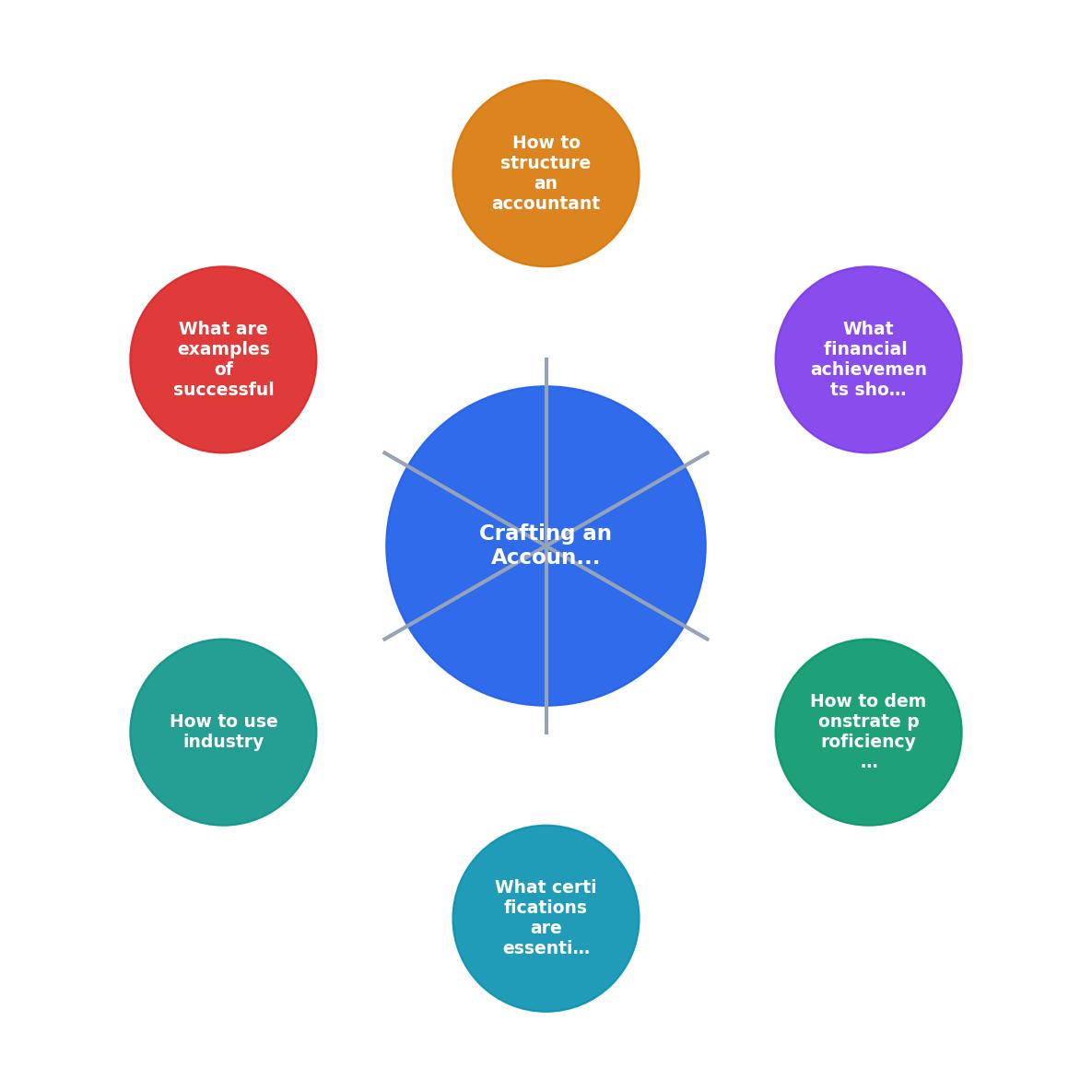
This visual dashboard shows you the hierarchy of what matters most when building your accounting resume. Certifications, software proficiency, and quantified results are non-negotiable. ATS optimization and keyword matching elevate your chances significantly.
Example Resumes and Templates
An example accounting resume built on these principles might look like this for an experience section:
Senior Accountant | Harrison Manufacturing Co. | 2022–Present- Managed month-end close process for general ledger with 150+ accounts, reducing close timeline from 12 days to 7 days through improved journal entry procedures and reconciliation automation in Excel.
- Prepared and reviewed consolidated financial statements and footnotes in compliance with GAAP, ensuring zero audit findings in external review.
- Analyzed budget variances across six business units totaling $22M in annual spending, identified root causes of 8% unfavorable variance in Year 1, implemented corrective actions reducing variance to 2% in Year 2.
- Trained three junior accountants on month-end close procedures and internal reconciliation standards, improving process consistency and reducing errors by 60%.
- Numbers throughout: 150 accounts, 12 to 7 days, $22M, 8%, 2%, three people, 60%.
- Action verbs: Managed, Prepared, Analyzed, Trained.
- Technical terms: General ledger, journal entries, reconciliation, consolidated financial statements, GAAP, budget variance.
- Business context: Why each achievement matters.
- Responsible for month-end close process.
- Prepared financial statements.
- Helped with budget analysis.
- Trained new staff.
Accountant Resume Checklist
Your progress is saved automatically in your browser.
FAQ
Frequently Asked Questions
An accounting resume is your first pitch. Before an interviewer hears your voice or a hiring manager reads your cover letter, your resume has already made a decision point: pass through the ATS or get filtered out. Build it around certifications that matter, software skills that solve real problems, and achievements expressed in numbers that finance leaders understand. Then tailor it for each opportunity. Do that, and you've eliminated the biggest reason accounting resumes fail.
Additional Resources
- Professional Accounting Resume Tips to Make a Great ... - Clearly defined skills and competencies: Work experience with quantifiable achievements: Certifications and continuing education: must ...
- Accountant Resume Examples and Template - Here are the key elements to include in an accountant's resume: Contact information: Education: Accountants need a bachelor's degree,
- 34 Accountant Resume Examples for 2026 - 1. Include your name, email, and phone number Your header should prominently feature your full name at the top, followed by your email address and phone number.
