
The AI job market is growing faster than candidates can fill it, but recruiters are screening thousands of applications, and most never reach human eyes. Your resume has seconds to prove you belong in an AI specialist role, and generic language won't cut it. The key is showing concrete technical depth, real project wins, and the exact skills the hiring team is looking for, all filtered through language they recognize.
Photo by Pavel Danilyuk from Pexels
TL;DR
- Highlight technical depth: machine learning frameworks (PyTorch, TensorFlow), programming languages (Python, Java), and specialized skills like NLP, computer vision, or reinforcement learning.
- Use industry terminology and quantified achievements, model accuracy improvements, latency reductions, cost savings, not just job duties.
- Include certifications (Google Cloud AI, AWS Machine Learning, Andrew Ng courses) and published work or open-source contributions.
- Tailor every resume to the job description by matching keywords and emphasizing relevant projects.
AI specialist roles span from machine learning engineers and data scientists to AI researchers and prompt engineers. These positions demand not just coding ability but demonstrable mastery of modern AI tools, frameworks, and real-world problem-solving. Hiring teams expect to see proof of technical chops, and they're using ATS systems that scan for specific frameworks, libraries, and methodologies. A resume that sounds like a general software engineer won't survive the filter.
What Are AI Specialist Roles?

AI specialist positions come in several flavors, each with distinct expectations. Machine Learning Engineers build and deploy models at scale, often owning the full pipeline from data pipeline to production monitoring. Data Scientists focus on exploration, experimentation, and insights, turning raw data into actionable intelligence. AI Researchers push the boundaries of what's possible, publishing papers and prototyping novel architectures. NLP Specialists work specifically with language models and text processing. Computer Vision Engineers handle image and video analysis. Prompt Engineers optimize interactions with large language models like GPT-4.
The common thread: every AI role requires you to think algorithmically, debug complex systems, and prove your work with metrics. Hiring managers want evidence you've actually shipped AI, not just studied it.
Essential Technical Skills for AI Roles
The technical bar is non-negotiable. Here are the skills every AI specialist resume must showcase:
Core programming languages:- Python (near-universal; list specific libraries)
- Java, C++, or Go (for production systems)
- SQL (for data queries and ETL pipelines)
- PyTorch or TensorFlow (deep learning)
- Scikit-learn (classical ML)
- Hugging Face Transformers (language models)
- XGBoost or LightGBM (gradient boosting)
- NLP: BERT, GPT models, spaCy, tokenization, embedding spaces
- Computer Vision: CNNs, YOLO, OpenCV, image preprocessing
- Reinforcement Learning: Q-learning, policy gradients, Gym environments
- Time series: forecasting, LSTM, temporal convolutions
- Recommender systems: collaborative filtering, matrix factorization
- Data pipeline tools: Apache Spark, Airflow, Kafka
- Cloud platforms: AWS SageMaker, Google Cloud AI Platform, Azure ML
- Version control: Git, DVC (data version control)
- Model management: MLflow, Weights & Biases, Neptune
Bold each framework and tool the moment you mention it. Don't list them in a vacuum, attach them to real projects where you used them.
How to Present AI-Related Achievements
This is where most resumes fail. Listing "built machine learning models" tells the recruiter nothing. Specificity and metrics are everything.
Weak: "Developed a recommendation system using Python and machine learning."
Strong: "Engineered collaborative filtering recommender system in Python using Scikit-learn; improved click-through rate by 24% and reduced inference latency from 800ms to 120ms through model quantization."
The strong version answers: What did you build? What technology? What measurable impact? Every achievement should follow this structure:
- Action verb + specific technology: "Implemented transformer-based NLP pipeline using Hugging Face"
- Problem solved: "to extract intent from unstructured support tickets"
- Quantified result: "reducing manual review time by 60% and improving classification accuracy from 78% to 94%"
- Model accuracy, F1 score, or precision/recall improvements
- Latency reductions (inference time, training time)
- Cost savings (compute, infrastructure, labor)
- Business impact (revenue, user engagement, retention)
- Scale (dataset size, requests per second, number of users)
- Training efficiency (time to convergence, memory usage)
"Engineered transformer-based language model that generated product descriptions, increasing click-through rates by 30%.">, Artificial Intelligence Specialist Resume Examples for 2026
When describing a project, go beyond the tech stack. Include the outcome. Did it ship to production? How many people use it? What's the business or technical impact? AI specialists are hired to deliver value, not to run experiments in a vacuum.
Using Industry-Specific Language Effectively
The language you choose signals whether you understand AI work at a professional level.
Avoid vague phrases:"Used AI to improve things"→ "Implemented BERT fine-tuning on domain-specific corpus to improve semantic similarity matching by 18%""Worked with data"→ "Built end-to-end ETL pipeline ingesting 500M events daily into distributed feature store using Spark and Delta Lake""Optimized a model"→ "Reduced model inference latency by 65% through quantization and ONNX optimization"
- Say "fine-tuned" not "trained"
- Say "inference" not "running the model"
- Say "feature engineering" not "data processing"
- Say "hyperparameter tuning" not "adjustment"
- Say "AUC" or "F1 score" not "performance"
Sample Sections of an AI Specialist Resume
Here's what each major section should contain:
Professional Summary (4–5 lines):
"Machine learning engineer with 4+ years building production NLP systems at scale. Expertise in PyTorch, Hugging Face, and distributed training. Shipped models to 10M+ users. Improved inference latency by 40% through quantization and ONNX optimization."
- Languages: Python, Java, SQL
- ML Frameworks: PyTorch, TensorFlow, Scikit-learn, XGBoost
- NLP: BERT, GPT, spaCy, Hugging Face Transformers
- Cloud & Infra: AWS (SageMaker, Lambda), Kubernetes, Docker
- Tools: Git, MLflow, Weights & Biases, Jupyter
- "Reduced model serving cost by 35% by migrating inference pipeline from GPU-based serving to CPU with INT8 quantization and ONNX optimization"
- "Trained ensemble of BERT models on domain corpus and deployed A/B test; improved search relevance by 12% as measured by click-through rate"
- "Designed feature pipeline ingesting 200M events daily; reduced feature computation latency from 45 minutes to 8 minutes via Spark optimization"
- Name the project, tech stack, and outcome
- Link to GitHub or published results
- Example: "Spam Classification Model (PyTorch, FastAPI) - Trained CNN ensemble on 500K labeled emails; deployed as microservice achieving 99.2% precision and 94% recall in production"
- Degree with GPA (if strong)
- Relevant certifications: Google Cloud AI Engineer, AWS Machine Learning, Andrew Ng ML Specialization, Fast.ai courses
- Publications or open-source contributions

Tips for Breaking Into the AI Field
If you're transitioning into AI or are early in your career, you're competing on potential and proof, not pure experience.
Build visible projects: Create a GitHub portfolio with 2–3 complete AI projects. Pick real problems, a recommender system, NLP classifier, or computer vision detector. Make code clean and well-documented. Hiring teams will look.
Contribute to open source: Even small contributions to PyTorch, Hugging Face, or scikit-learn signal you can read and write production code. List it on your resume.
Take structured courses: Certifications from Google Cloud, AWS, or Andrew Ng carry weight. Finish the course, build the capstone, get the certificate. List it under Education.
Write about what you learn: Blog posts or Medium articles on AI topics show communication skills and depth. Link them from your resume.
Participate in Kaggle competitions: Ranking high on a Kaggle competition is concrete proof of your skill. Include it.
Highlight transferable skills: If you're coming from software engineering, emphasize systems thinking, debugging, and production experience. If you're coming from data analysis, emphasize statistical rigor and experimentation.
The resume pitch: "I've shipped [project]. I learned [framework]. Here's the code. Here's the proof. I'm ready to do it at your company."
AI Resume Structure
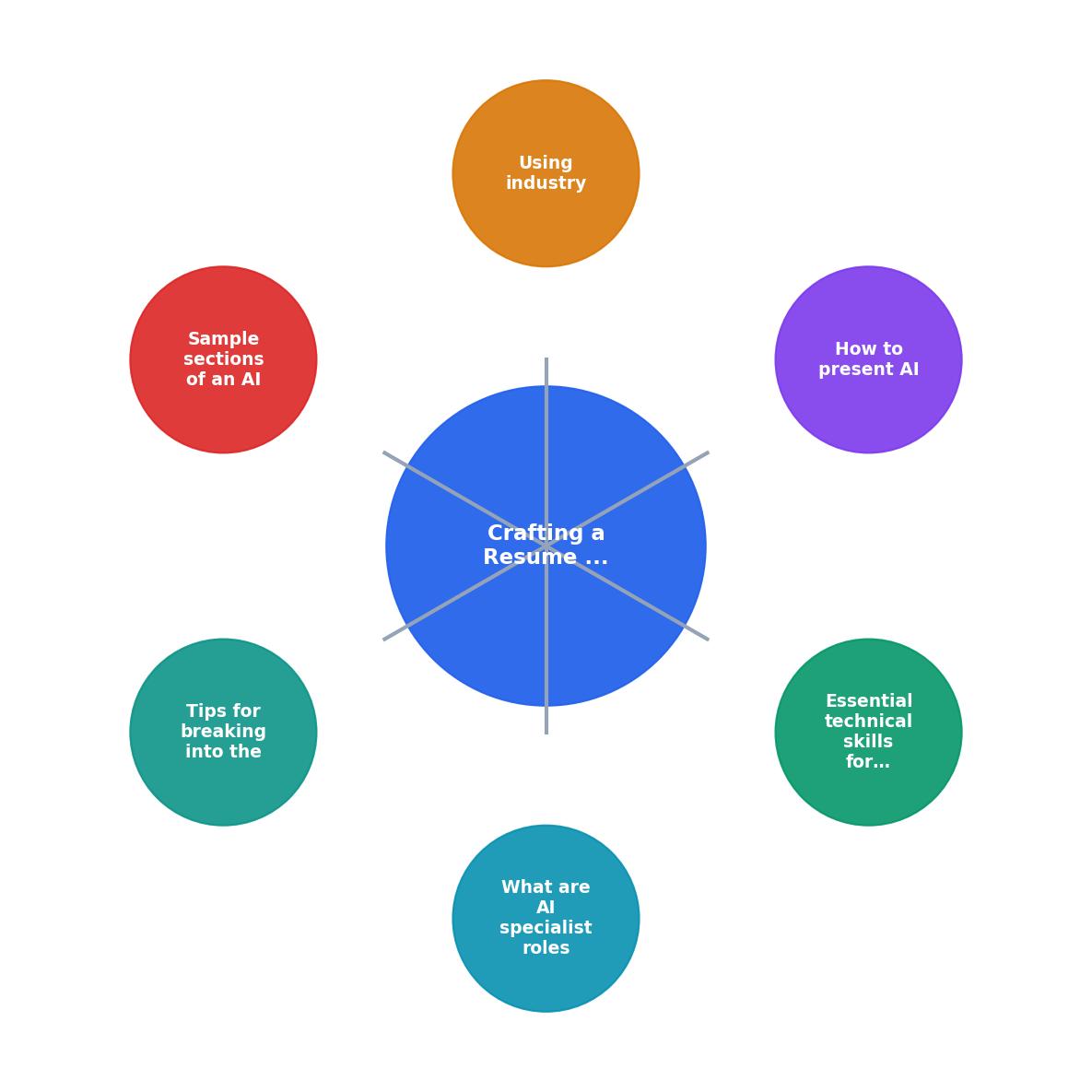
This visual shows the typical structure of a competitive AI specialist resume. Each section serves a specific purpose in proving your capability to the hiring team and surviving the ATS filter.

Tailor to Every Job
A generic resume gets rejected by the ATS before any human sees it. Here's how to tailor without lying:
- Copy frameworks and tools from the job description. If they want "PyTorch" and "ONNX," and you've used both, make sure those exact words appear in your resume.
- Match keywords for specializations. If the posting emphasizes "NLP" or "computer vision," surface your relevant projects in those areas.
- Reorder your experience bullets to highlight what matches the role, not chronology.
- Use their language. If the job says "scalable ML systems," don't say "machine learning platforms." Match their phrasing.
- Add context to projects. If they're hiring for a real-time recommendation system and you built one, lead with that project.
Common Pitfalls to Avoid
Too generic: "Worked with data and machine learning technologies." Too vague. Name the framework, the problem, the metric.
No numbers: "Improved model performance" doesn't tell the recruiter anything. Say "improved AUC from 0.76 to 0.89" or "reduced latency by 55%."
Outdated skills: If you list TensorFlow 1.x or old libraries, it signals you're behind. Update your stack.
No proof: "Expert in deep learning" requires evidence. Point to a shipped model, a published paper, or open-source work.
Buried the lead: Put your strongest AI achievement first, not at the bottom of a bullet list.
Wrong format: Use a clean, ATS-friendly format. Avoid fancy graphics, columns, or tables that break in parsing. Stick to standard sections with clear headings.
AI Specialist Resume Checklist
Your progress is saved automatically in your browser.
FAQ
Frequently Asked Questions
Additional Resources
- Artificial Intelligence Specialist Resume Examples for 2026 - 1. Tailor your summary to the AI specialist role. When writing your summary for an AI specialist position, it's crucial to customize it to the specific job ...
- 14 AI Specialist Resume Examples & Guide for 2026 - Highlight Relevant Skills: Emphasize key AI skills such as LLMs, RAG, MLOps, Python, and responsible AI. •Showcase Your Projects: Include specific AI projects ...
- AI for Resumes and Cover Letters – Harvard FAS - Insert the full job description in the generative AI tool and prompt it for a list of top skills and expertise needed for the position. Include specific ...
