

Photo by Mikhail Nilov from Pexels
Your resume gets screened by an ATS (Applicant Tracking System) before a human ever sees it. Most customer service resumes fail this filter because they miss critical keywords and fail to quantify impact. You can fix that by strategically matching job description language, highlighting measurable achievements, and formatting for ATS compatibility. The difference between a generic resume and an optimized one often determines whether you land the interview.
TL;DR
- Focus on communication and problem-solving skills first, these are the non-negotiable requirements for any customer service role.
- Use exact keywords from the job posting to pass ATS screening and show you're a genuine match.
- Quantify your achievements with metrics like customer satisfaction scores, resolution times, and churn reduction percentages.
- Avoid formatting tricks that confuse ATS systems, stick to simple fonts, standard headers, and clean bullet points.
- Tailor your experience descriptions to emphasize customer-facing impact, not just daily tasks.
A customer service role is fundamentally about solving problems under pressure while keeping customers satisfied. Your resume needs to prove you've done exactly that. Generic descriptions like "handled customer inquiries" don't convince anyone. Employers want specifics: the volume you managed, the satisfaction rates you achieved, the situations you de-escalated, the systems you mastered. An optimized resume shows this evidence early and uses language that both the ATS and hiring managers recognize.
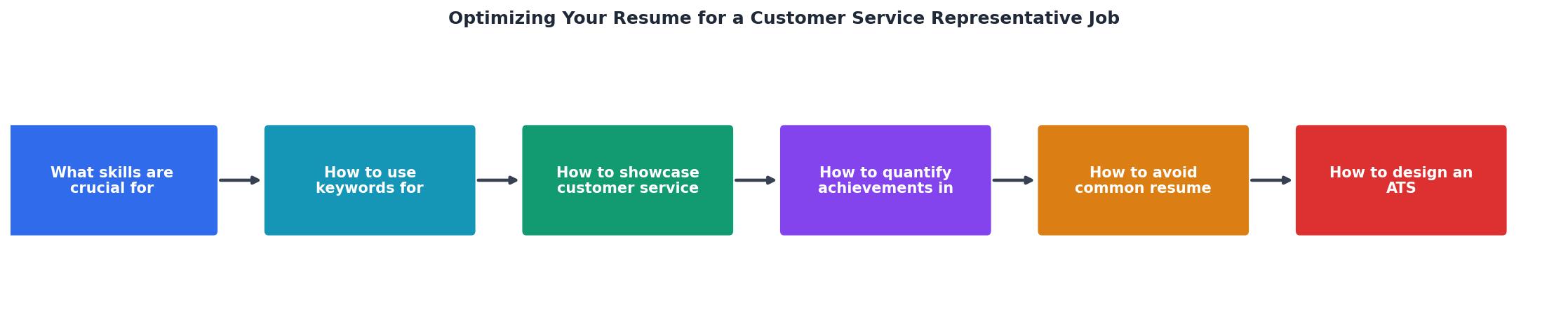
What Skills Matter Most?

Customer service resumes live or die on a handful of core competencies. The job description will list these skills, and your resume must reflect them, not just in a skills section, but woven into your experience bullets.
Communication tops the list. This means clarity in writing, tone awareness over the phone, and the ability to explain complex information simply. When you describe a past role, show that you communicated effectively: "Responded to 50+ customer emails daily with 96% first-contact resolution rate" beats "answered customer communications."
Problem-solving is the second pillar. Customer service isn't about following a script; it's about figuring out what a frustrated person actually needs and delivering it. Examples matter: "Diagnosed billing issues for enterprise accounts and implemented 12 process improvements that reduced dispute resolution time by 30%."
Empathy and patience matter, but they're harder to quantify. Show them instead: "De-escalated 200+ angry customer calls monthly, resulting in 8.5/10 satisfaction rating" demonstrates both. You're not saying you're patient, you're proving it through outcomes.
Product knowledge is role-specific. If you've used Zendesk, Intercom, Salesforce Service Cloud, or similar platforms, say so. These systems appear in job postings. Having hands-on experience with the right tools moves you higher in the ranking.
CRM proficiency, ticketing systems, knowledge bases, and phone systems are technical skills that shouldn't hide in a vague "computer skills" line. Call them out.
Here's a quick reference for skills to highlight:
- Active listening and empathy
- Written and verbal communication
- Problem-solving and critical thinking
- Conflict resolution and de-escalation
- Product and technical knowledge
- CRM and ticketing systems (Zendesk, Salesforce, HubSpot, etc.)
- Multitasking and time management
- Patience and emotional resilience
- Follow-up and attention to detail
- Sales upselling (if relevant to the role)
How to Use Keywords for ATS Optimization

The ATS scans your resume for exact matches to words in the job posting. If the posting says "Zendesk" and your resume says "ticketing software," the system won't flag you as a match.
Start by copying the job posting text and highlighting every skill, tool, and qualification mentioned. Then do a cold audit of your resume: Do those same terms appear? If not, add them where honest.
Here's the process:
- Open the job posting in one window, your resume in another.
- Scan the posting for technical tools (Slack, Teams, Jira, specific CRM names).
- Scan for soft skills listed (communication, problem-solving, patience).
- Scan for industry terms or certifications (Lean, Six Sigma, customer retention metrics).
- Search your resume for each one. If it's missing and you have that skill, rewrite a bullet to include it.
Weak resume bullet: "Managed customer accounts and handled support tickets."
Strong resume bullet: "Managed 150+ customer accounts in Salesforce Service Cloud, implementing retention strategies that reduced churn by 8% annually."
The strong version includes "Salesforce Service Cloud," "retention strategies," and a quantified result. The ATS flags it as relevant, and a human sees concrete impact.
Common customer service keywords to scan for:
- Customer acquisition cost (CAC)
- Customer lifetime value (LTV)
- Net Promoter Score (NPS)
- First-contact resolution (FCR)
- Average handle time (AHT)
- Customer retention rate
- Escalation management
- Multi-channel support (phone, email, chat, social media)
- Omnichannel support
- Customer feedback and surveys
- Complaint resolution
How to Showcase Customer Service Experience
Your experience section is where you prove you've done this work. The format matters enormously. Hiring managers spend 6-7 seconds skimming each resume, so every bullet must be scannable and high-impact.
Use this structure for each job:
Company Name | Title | Dates- Opened with the metric or outcome (not the task)
- Action verb + specific responsibility + quantified result
Strong bullet: "Resolved 95+ customer issues monthly across phone, email, and chat channels with 92% satisfaction rating and zero escalations."
The strong version has action, scale, channels, outcome, and a quality indicator.
Here are realistic customer service experience bullets:
- "Handled 40-50 customer calls daily, maintaining 4.8/5 satisfaction rating while meeting 95% first-call resolution target."
- "Reduced average resolution time from 8 minutes to 4.5 minutes through process optimization and product knowledge development."
- "Processed refunds, replacements, and account corrections for 100+ transactions weekly with zero compliance errors."
- "Identified and escalated 12 critical product bugs reported by customers, leading to patches that improved platform stability."
- "Trained 8 new support team members on company processes, reducing onboarding time by 40% and improving team retention."
- "Maintained knowledge base with 200+ articles covering product features, troubleshooting, and billing, reducing repeat inquiries by 22%."
Quantify Your Achievements

"Quantifies accomplishments: Using measurable achievements like reducing customer churn by 15%, the applicant illustrates their tangible impact in client management.">, Customer Service Representative Resume Examples & Templates
This is the biggest difference between a forgettable resume and one that gets calls. Numbers are credible. They're also concrete enough for an ATS to pick up.
If you handled 50 customer interactions per day, say so. If your satisfaction rating was 4.7/5, include it. If you reduced issue resolution time from 10 hours to 2 hours, that's a 80% improvement, write it down.
Metrics to track and use:
- Volume: calls handled, tickets closed, emails answered per day/week/month
- Quality: satisfaction ratings (NPS, CSAT), survey scores
- Speed: average handle time, resolution time, time-to-first-response
- Accuracy: error rate, compliance score, percentage of issues resolved on first contact
- Impact: churn reduction, upsells completed, training delivered, process improvements implemented
- Scope: number of customers managed, account sizes, revenue supported
When describing team accomplishments, clarify your role. "Led team that achieved 94% customer satisfaction" is weaker than "Personally maintained 94% satisfaction rating across 50+ weekly customer interactions and mentored 3 junior agents on de-escalation techniques."
Common Resume Mistakes in Customer Service
Customer service resumes tend to fail in predictable ways. Avoid these:
1. Passive language. "Was responsible for" and "handled" sound weak. Use active verbs: resolved, implemented, reduced, improved, identified, trained, optimized.
2. Vague achievements. "Provided excellent customer service" says nothing. "Maintained 96% customer satisfaction rating across 200 weekly interactions" proves it.
3. Jargon without context. "CRM management" means nothing without a platform name. "Managed customer lifecycle in Salesforce Service Cloud" is clear.
4. Long paragraphs in bullets. Each bullet should be 1-2 lines. If it wraps to three, cut it down or split it.
5. Irrelevant soft skills. A customer service resume doesn't need "team player" or "hard worker", everyone claims that. Show it through outcomes instead.
6. No metrics. Avoid "responsible for customer satisfaction" without a number. Include the actual rating.
7. Outdated tools only. If you've only used legacy systems, that's fine, mention them. But if you learned modern platforms (Zendesk, Intercom, Slack), highlight those too.
8. Missing the most recent wins. Your last role should have more detail than a job from five years ago.
Design for ATS Compatibility
The formatting of your resume matters as much as the content. ATS systems parse resumes as plain text, and unusual formatting breaks that parsing.
ATS-friendly formatting:
- Font: Stick to standard fonts (Arial, Calibri, Times New Roman). Avoid decorative fonts, columns, and text boxes.
- Headers: Use simple text headers like "Experience," "Skills," "Education", not graphic elements or sidebars.
- Bullets: Use standard bullet points (•, -, *). Avoid dashes, boxes, or emoji.
- File format: Save as .pdf or .docx, not as an image or complex Word template. Check the job posting for preference.
- Line spacing: Single or 1.15 spacing. Too tight is hard to read; too loose wastes space.
- Margins: 0.5 to 1 inch on all sides. Don't squeeze text to fit.
- Length: One page for entry-level or under 5 years; two pages max for 5+ years of experience.
- Dates: Use consistent formatting (Jan 2023 - Dec 2024, not 1/2023-12/2024 mixed with other styles).
- No graphics: Avoid infographics, charts, and colored sections. ATS systems can't read them, and they waste space.
Example: Customer Service Representative Resume Template
Here's a practical checklist to build and optimize your customer service resume:
Customer Service Resume Optimization Checklist
Your progress is saved automatically in your browser.
Interactive Resume Optimization Tracker
Use this interactive tool to track how well your current resume aligns with best practices. This example shows a typical customer service resume's alignment:
Resume Optimization Score
FAQ
Frequently Asked Questions
Additional Resources
- Customer Service Representative Resume Examples & ... - Advice for Writing Your Customer Service Representative Resume · Write a strong professional summary · Include relevant certifications and ...
- 21 Important Customer Service Skills (With Resume ... - Add relevant customer service skills to your resume by scanning keywords in job listings and weaving them into the skills and job experience ...
- 11+ Customer service representative resume examples & ... - Explore these top customer service representative resume examples and templates to build the perfectly ATS-optimized resume.
