
You send out resumes. Silence follows. Weeks pass. The job posting gets filled. You never hear back. The culprit isn't your experience, it's that your resume never reaches a human recruiter. It stops at the applicant tracking system (ATS), filtered out by the exact keywords that posting was screening for. Data Analyst roles are among the most keyword-sensitive in tech and business: recruiters hunt for SQL, dashboards, and specific methodologies. Without them phrased right, your resume gets ghosted by automation before anyone reads it.
TL;DR
- SQL is the most-searched keyword for Data Analyst roles. Include it with specific databases you've used (PostgreSQL, MySQL, SQL Server).
- Add dashboard tools and visualization platforms like Tableau, Power BI, or Looker, these appear in most job postings and ATS scans.
- Use employer language, not your own, copy exact phrases from the job posting (stakeholder impact, data-driven decisions, ETL workflows, data quality).
- Quantify every achievement, "increased reporting efficiency by 30%" beats "improved reporting" every time.
- Include technical process keywords: ETL, data modeling, A/B testing, statistical analysis, data cleaning, and the specific tools your target role lists.
The good news is simple. You don't need to reinvent anything. You need to speak the language recruiters are listening for.
Why Keywords Matter for Data Analysts

Data Analyst job postings are dense with technical requirements. Unlike some roles where soft skills carry weight, Data Analyst positions screen hard on concrete tools and methodologies. A recruiter looking to fill a Data Analyst position isn't searching for "good at analysis." They're searching for "SQL," "Tableau," "ETL," and "statistical analysis." If your resume doesn't contain those exact strings, the ATS never passes it forward.
Here's the disconnect: You might be excellent at SQL. You might build dashboards every day in Tableau. But if you labeled your work experience as "created data insights using various tools," the system won't find you. The recruiter moves to the next candidate, one whose resume says "developed SQL queries across PostgreSQL databases and built interactive Tableau dashboards."
This is why keyword strategy matters. It's not about padding your resume with buzzwords. It's about translating your real experience into the vocabulary the hiring process uses. Every skill you actually have needs to be named in the language that hiring managers and ATS systems recognize.
Common Mistakes That Kill Your Resume
The biggest mistake is treating your resume as a narrative of your career instead of a searchable document. Here's what breaks most Data Analyst resumes:
Generic tool mentions. You wrote "used analytics software" when the posting asked for "Tableau and Power BI." You listed "database experience" instead of naming "PostgreSQL, MySQL, and SQL Server." Generics don't trigger ATS matches.
Buried technical details. You have SQL experience but it's hidden in a paragraph under "Responsibilities." It should be explicit: "SQL Query Development" as its own bullet, or "SQL" listed in a skills section. Keywords need visibility, not depth.
Mismatched terminology. The job posting says "ETL pipeline development" but your resume says "data import and transformation." Both mean the same thing, but ATS doesn't know that. Use the exact phrase from the posting.
Numbers without context. "Improved performance by 40%" sounds good but doesn't tell a recruiter what you did. Pair it with the technical method: "Optimized SQL queries, reducing dashboard load time by 40%." Now the resume says "SQL" and "optimization" and delivers a measurable result.
Missing the business angle. Recruiters want to see impact. "Analyzed customer data" is forgettable. "Analyzed customer segmentation data, enabling marketing team to increase campaign conversion by 18%" shows business value and uses keywords like "segmentation" and "campaign analysis."
Vague skills section. If you have a skills section, it's either too broad ("Data," "Analysis") or missing critical tools. List specific technologies you've actually used: "SQL (PostgreSQL, MySQL)," "Tableau," "Python," "Excel (VBA)," "Google Analytics," depending on your experience.
The Keywords Data Analysts Actually Need

Every Data Analyst role hunts for a core set of keywords. These aren't optional. If you've done this work, your resume must name these tools and methods explicitly.
SQL and databases. This is non-negotiable.
"SQL is asked for in 71% of Data Analyst jobs, and most resumes already have it (64%).">, Data Analyst Resume Keywords (2026)
If you write SQL, your resume needs to say "SQL" and the specific databases you've used: PostgreSQL, MySQL, SQL Server, Oracle, Snowflake, BigQuery. Don't bury it. Put it in a skills section. Name it in your job descriptions: "wrote SQL queries to extract customer behavior data from PostgreSQL databases."
Dashboard and visualization tools. Tableau and Power BI dominate here, but Looker, Google Data Studio, and Qlik are also common.
Use the exact tool name: not "created dashboards" but "developed interactive Tableau dashboards" or "built Power BI reports." If you've used multiple tools, list them all: "Proficient in Tableau, Power BI, and Looker."
Data methodology keywords. These appear across most postings:
- ETL (Extract, Transform, Load) or data pipeline development
- Data modeling and schema design
- A/B testing and experimental design
- Statistical analysis or statistical testing
- Data cleaning and quality assurance
- Data warehousing
Business and stakeholder language. Recruiters love seeing technical skills paired with business context.
Use these phrases if they match your work:- Stakeholder communication
- Data-driven decision making
- KPI development and tracking
- Business intelligence
- Reporting automation
- Predictive analytics (if relevant)
- Data storytelling
Step-by-Step: How to Find Your Keywords

Don't guess what keywords matter. Find them where they actually live: the job postings you're applying to.
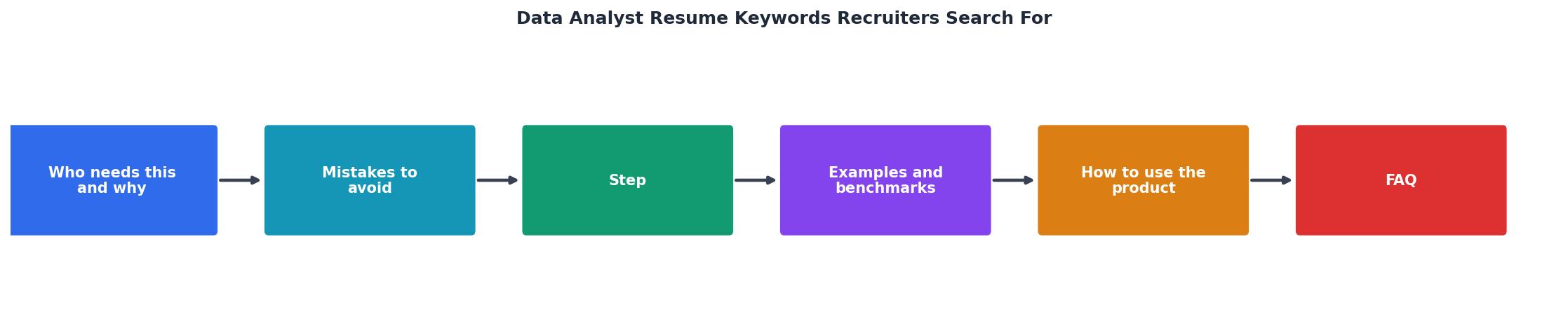
Step 1: Copy the job posting. Select the full text of a Data Analyst role you want to apply for. Paste it into a document.
Step 2: Highlight technical keywords. Look for:- Tools mentioned (SQL, Tableau, Python, etc.)
- Methodologies (ETL, A/B testing, data modeling)
- Specific responsibilities that repeat (dashboard development, data validation, etc.)
- Any skills listed in a requirements section
Step 4: Update your resume. For each match, find where you describe that work on your resume. Rewrite it using the exact language from the job posting. If the posting says "ETL pipeline development," don't say "data transformation." Say "ETL pipeline development."
Step 5: Add them to a skills section. Create a dedicated skills area listing technologies and methodologies. Order by relevance to the role (SQL first if it's central to the role, Tableau second if dashboarding is key).
Step 6: Repeat for every application. Yes, this means each resume should be slightly different. Each role emphasizes different tools or methodologies. A BI-heavy role needs Tableau and Power BI up front. A data engineering role needs Snowflake and pipeline tools highlighted. The ATS expects this. Recruiters do too.
This isn't cheating. It's translation. You're expressing your real skills in the language each employer uses.
Real Examples: Before and After
Example 1: Generic to Specific
Before:
"Analyzed business data to improve performance and created reports for management."
After:
"Analyzed customer transaction data using SQL queries (PostgreSQL) to identify spending patterns. Created automated Tableau dashboards tracking KPIs, reducing manual reporting time by 8 hours per month."
Keywords added: SQL, PostgreSQL, Tableau, KPI, automated reporting.
Example 2: Hidden Skills to Visible
Before:
"Responsibilities: reporting, analysis, data management"
After:
"Designed data models and ETL workflows to consolidate data from multiple sources. Performed statistical analysis on A/B test results, communicating findings to stakeholders. Developed Power BI dashboards for real-time business intelligence monitoring."
Keywords added: data modeling, ETL, statistical analysis, A/B testing, stakeholder communication, Power BI, business intelligence.
Example 3: Results Without Method
Before:
"Increased efficiency by 25%"
After:
"Optimized SQL queries and data indexing strategy, reducing dashboard refresh time from 45 minutes to 11 minutes, increasing analyst productivity by 25%."
Keywords added: SQL optimization, data indexing, dashboard, analytics.
An Interactive Look at Your Resume Strength
Before you rewrite, check where your resume stands. This example shows how keywords distribute across a typical Data Analyst resume. If your resume is light on blue (SQL/tools) or red (methodology), you're missing matches.
Example Resume Keyword Strength
This visualization shows a typical resume strength distribution. Notice the blue and teal (SQL and tools) are solid, that's the baseline. But orange and green (methodology and business language) lag behind. Most Data Analyst resumes lead with tools but forget to name the process and impact. Fixing that gap is where interviews come from.
Tailoring Your Resume to Each Job
Generic Data Analyst resumes fail because the role itself is specific. A role focused on business intelligence needs Power BI and stakeholder reporting. One built for data engineering needs Snowflake and pipeline architecture. One in finance needs SQL, Excel modeling, and regulatory compliance language.
Copy the exact job title language. If the posting says "Data Analyst II" and emphasizes "dashboard development," your resume should use those words. If it says "Analytics Engineer," your focus shifts to pipeline and infrastructure language.
Match tool emphasis to the role. A posting that mentions Tableau three times? Your Tableau experience needs to be visible and specific. One that mentions Python but not Tableau? Python moves to the front of your skills section.
Use their business context. If they're a SaaS company, talk about "customer analytics" and "product metrics." If they're retail, say "sales data" and "inventory optimization." If they're healthcare, mention "patient data" and "compliance."
This isn't dishonest. It's not faking skills you don't have. It's choosing which true skills to emphasize based on what each role prioritizes.
Avoid Keyword Stuffing
There's a line between optimizing and overstuffing. Recruiters notice when a resume suddenly sprouts keywords everywhere but the work doesn't match. An entry-level analyst shouldn't claim "advanced machine learning pipeline architecture" if they've never built one. An analyst who's used SQL for one month shouldn't lead with it as a core competency.
The rule: Only use keywords that describe work you've actually done. If you haven't written ETL workflows, don't list ETL. If you've only used Excel (no SQL), say so. Honesty is faster than getting caught in an interview pretending you know something you don't.
Be specific about your level. "SQL (intermediate)" or "Tableau (expert)" tells more than just listing the tool. "Proficient in SQL queries and basic stored procedures" is more credible than "Advanced SQL" if you haven't written complex functions.
Quantity, not depth. You need enough keywords to pass the ATS (typically 8–12 unique technical terms for a Data Analyst resume), but you don't need 30. A focused, relevant list beats a bloated one every time.
Where Keywords Go on Your Resume
Keywords need to appear in specific places to register with ATS and recruiters:
1. Skills section (highest impact). List tools, languages, and methodologies explicitly. Order by relevance to the role. Example:- SQL (PostgreSQL, MySQL, Snowflake)
- Tableau, Power BI
- Python, R (if applicable)
- ETL, data modeling, A/B testing
- Excel, Google Sheets
3. Professional summary or headline (if present). "Data Analyst with expertise in SQL, Tableau, and ETL pipeline development" beats "Experienced Data Analyst."
4. Education section (lower priority, but still counts). If you took relevant courses or certifications, name them: "Advanced SQL for Data Analysis," "Tableau Desktop Specialist," etc.
5. Avoid keyword stuffing in sentences. Don't write "I used SQL and Tableau and Python and Power BI and statistics to perform data analysis with SQL and Tableau." One keyword per concept. Natural sentences.
The Resume Hedgehog Approach
Building a resume from scratch for each application is tedious. But there's a faster way. Take your base Data Analyst resume, the one with your real skills and experience, and create 3–4 versions:
- Version 1: SQL + Data Engineering focus (for pipeline roles)
- Version 2: Dashboard + BI focus (for reporting roles)
- Version 3: Analysis + insights focus (for analyst roles)
When you apply, pick the closest version. Spend 10 minutes tailoring it to the specific posting. Swap out the job title in your summary. Reorder bullets so your most relevant work appears first. Update the skills section to reflect the posting's emphasis.
This approach passes ATS checks, speaks recruiter language, and gets you in front of humans.
The Resume Optimization Checklist
Resume Keyword Optimization Checklist
Your progress is saved automatically in your browser.
FAQ
Frequently Asked Questions
The difference between a resume that gets ghosted and one that lands interviews often comes down to a handful of keywords. Not fluff. Not exaggeration. Just the right words, in the right places, matching the language your target employer uses every day. Start with one job posting you care about. Extract its keywords. Update your resume to match. Watch what happens. Once you see the pattern, it becomes automatic. You're not reinventing your experience. You're just translating it into the language hiring managers and ATS systems actually speak.
Additional Resources
- Data Analyst Resume Keywords (2026) - Data Analyst job postings ask for most: SQL, Business Intelligence and Dashboarding. 71% of Data Analyst jobs,
- The Data Analyst Resume That Lands Interviews - The resume had a skills section loaded with what the recruiter was looking for: Power BI, Excel, SQL, R, Python, Databricks, AWS. Keyword = a ...
- 19 Data Analyst Resume Examples for 2026 - Real examples and templates of Data Analyst resumes, updated for your 2026 job search. Download them for free, plus learn how to update your resume for 2026 ...