
Employment gaps feel like resume landmines. You're missing six months between jobs, took time off to care for family, or switched careers and now there's a blank space screaming at recruiters. The truth: gaps don't disqualify you, but how you frame them does. Recruiters see gaps all the time, and most don't panic. What they do notice is silence, evasion, or a resume that skips over reality. In this guide, you'll learn exactly what to write, what to avoid, and how to turn a gap from liability into a non-issue.
TL;DR
- Address gaps directly and honestly; silence creates more suspicion than transparency.
- Use month/year format (
Month 20XX – Month 20XX) so gaps are visible and measurable, not hidden. - For gaps under 6 months, a brief one-line explanation in parentheses works; for longer gaps, add a standalone entry (education, volunteer work, freelance projects).
- Reframe the gap as growth, learning, or strategic career planning rather than a void.
- Let Resume Hedgehog match your gap explanation to the job description so it sounds relevant and forward-looking.
Why gaps matter (and why they don't)
Recruiters expect career disruption. Job changes, family obligations, health issues, sabbaticals, relocations, these are normal life events. The Bureau of Labor Statistics reports that the average worker stays at a job for around 4 years, and most people have multiple employers across their career. Gaps are statistical reality.
What recruiters actually worry about is not the gap itself, but what the gap signals. A gap with no context looks like a red flag: Were you fired? Did you quit without a plan? Are you unstable? That ambiguity is the real problem. When you leave the gap empty or gloss over it, you force recruiters to guess, and they'll guess badly.
The fix is simple: be honest and specific. A gap explained is a gap defused. You take control of the narrative instead of letting recruiters fill in the blanks with worst-case scenarios.
Common mistakes that backfire

Before we get to what works, here's what doesn't.
Leaving the gap blank. Some people hide gaps by listing only years, no months (2022–2024). This backfires. Recruiters see the resume, notice the missing months, and assume you're hiding something. Better to be transparent: months make the gap visible and show you're not dodging the issue.
Over-explaining or getting defensive. Long, emotional explanations ("I was dealing with personal issues that I'd rather not discuss") sound evasive and waste space. Recruiters don't need your therapy notes. They need a brief, factual statement and then to move on.
Lying or exaggerating. Never claim you were working when you weren't. Never invent freelance projects you never did. Background checks happen, LinkedIn history is public, and references will correct the record. The lie always comes out, and it ends the conversation immediately.
Apologizing for the gap. Phrases like "I regret the break in my career" or "I was unfortunately let go" signal shame or weakness. A gap is not a moral failure. Own it, explain it, move forward.
Leaving a gap with zero context in a cover letter or interview. If you have a significant gap (8+ months), mention it briefly in your cover letter and be ready to discuss it briefly in the interview. You don't need to volunteer shame; you just need to show it's resolved and you're ready to work.
Step-by-step approach to handling gaps

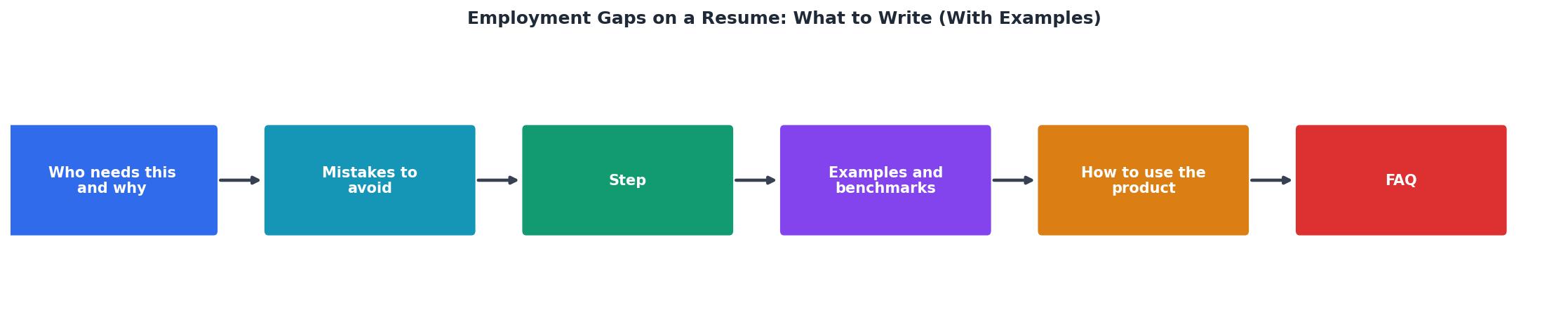
Here's the workflow to address employment gaps with confidence.
Step 1: Decide if the gap needs explanation
Not all gaps do. A one-week break between jobs? No explanation needed. A two-month gap after a job ended and before the next one started? That's normal job-search time and requires no comment. A five-month gap with no work activity? That deserves a line.
The rule of thumb: gaps of 6 months or longer, or any gap that appears unusual in context (e.g., you left a stable job with no obvious next role), need a brief explanation.
Step 2: Use month-year format throughout
Always use month and year, never just years alone. This forces transparency and removes ambiguity.
Instead of: 2022–2024
Write: January 2022–August 2024
When you list months, the gap becomes measurable and honest. Recruiters see exactly how long it was. You're not hiding; you're clarifying.
Step 3: Categorize the gap
What was happening during the gap? Pick one primary reason:
- Job searching / transition – You were between roles, applying and interviewing.
- Freelance / contract work – You took on independent projects or gigs.
- Education or skills development – You completed a certification, bootcamp, or course.
- Family or personal care – You needed time to handle family obligations, health, or caregiving.
- Health leave – You dealt with a personal health challenge (you can be vague: "personal health" is sufficient).
- Sabbatical or time off – You took intentional time to rest, travel, or reflect.
- Entrepreneurship – You started or worked on your own venture.
Step 4: Write a one-line explanation or create an entry
For gaps under 6 months, add a parenthetical note next to the previous job end date or before the next job start date:
Example (short gap):- Acme Corp | Product Manager | January 2021–May 2022 (left to relocate and explore new opportunities)
- BuildCo | Senior Product Manager | August 2022–Present
- Acme Corp | Product Manager | January 2021–May 2022
- Freelance Product Consultant | May 2022–December 2022 (managed product strategy projects for 3 SaaS clients)
- BuildCo | Senior Product Manager | January 2023–Present
- TechStart Inc | Full-Stack Engineer | June 2021–November 2022
- Google Career Certificates | UX Design Specialization | December 2022–June 2023
- DesignPro | UX Designer | July 2023–Present
Real examples by gap reason
Gap 1: Career transition (8 months)
Situation: You left marketing to study data science; you want to reframe the gap as skill-building, not aimlessness.
Resume entry:- SalesGrow Inc | Marketing Manager | March 2022–August 2022
- Data Science Bootcamp | Springboard | September 2022–April 2023 (completed 200+ hours; capstone project: predictive churn model for SaaS)
- DataFlow Labs | Junior Data Analyst | May 2023–Present
Gap 2: Freelance / gig work (5 months)
Situation: You did freelance work but it felt scattered. You want to present it as intentional.
Resume entry:- BigTech | Product Manager | January 2022–April 2022
- Freelance Product Strategy Consultant | May 2022–September 2022 (led product discovery for 4 early-stage startups; advised on GTM and feature prioritization)
- FutureScale | Senior PM | October 2022–Present
Gap 3: Family care or personal health (6 months)
Situation: You needed time to care for a parent; you want to acknowledge the gap without oversharing.
Resume entry (option A – brief):- BrightCorp | Senior Designer | June 2021–December 2021
- Personal / Family Obligations | January 2022–June 2022
- BrightCorp | Senior Designer | June 2021–December 2021
- Career Break | January 2022–June 2022 (managed family priorities; full focus on work from July onward)
Gap 4: Intentional sabbatical (3 months)
Situation: You took planned time off to travel and recharge after a demanding role.
Resume entry:- Marathon Corp | VP of Operations | August 2019–July 2022
- (Sabbatical: August 2022–October 2022)
- Steady Growth Inc | Operations Director | November 2022–Present
How to explain gaps in your cover letter and interview
On the resume, you have 1-2 lines max. In the cover letter or interview, you might elaborate slightly, but stay brief and forward-looking.
Cover letter sample:
I left my role at Acme in May 2022 to pursue a career transition into product management. I completed a rigorous 6-month bootcamp, built several projects from scratch, and I'm now ready to apply those skills in a full-time role where I can drive product strategy and user impact.
Interview sample:
I took about 6 months off after my last role to study data science. I realized I wanted to work more closely with data and analytics, so I did a bootcamp, built a few projects, and I've been in my current role for a year now. I'm energized by the work and ready to take on more complex projects.
The key: name what happened, show it was resolved or intentional, and point forward to your current readiness. Don't dwell on it, don't apologize, and don't over-explain.
Creating a resume that downplays gaps visually
Even with honest explanations, you can reduce the visual impact of a gap using smart formatting.
Use a skills section prominently. Put your top skills near the top of your resume, under your name. This draws focus away from employment history.
Group related work. If you have freelance projects, bundle them under a category header ("Consulting Projects", "Independent Work") to look more consolidated.
Use a summary or professional statement. A 2-3 sentence headline at the top (e.g., "Product Manager with 8 years of SaaS experience, specializing in onboarding and retention") anchors recruiters to your value before they scan employment history.
Lead with impact, not tenure. In each job, lead with what you shipped or achieved, not how long you stayed. This shifts focus from timeline to contribution.
Interactive gap-assessment tool
To help you determine exactly what to say, use this visual guide to assess your gap and get a suggested framing:
What Should You Write?
Use this tool to get a quick recommendation for your exact situation. The more specific you are, the better the guidance.
How Resume Hedgehog helps
You've written your gap explanation, and now you need to tailor your entire resume to a specific job. This is where Resume Hedgehog fits in. When you upload your resume and paste a job description, the tool scans for keyword alignment and flags gaps or weak spots.
But here's the power move: use Resume Hedgehog to rewrite your gap explanation in language that mirrors the job posting. If the job emphasizes "continuous learning" and "agility," frame your education gap as a strategic upskilling. If the role values "entrepreneurial thinking," reword your sabbatical as a time of strategic planning and reflection. The tool generates outcome-focused bullets so your gap reads as growth, not downtime.
Your Employment Gap Resume Checklist
Your progress is saved automatically in your browser.
FAQ
Frequently Asked Questions
2021–2023) looks like you're dodging transparency, and recruiterswill notice the missing months anyway. Months make the gap visible and honest, which actually reduces suspicion. Recruiters respect honesty more than they penalize gaps. When you list months clearly, you signal confidence and integrity.Employment gaps are a normal part of every career. The difference between a gap that hurts your chances and one that doesn't is simple: honesty, clarity, and forward momentum. Tell the truth about what happened, explain what you did during the gap, and show why you're ready to move forward. Recruiters will believe you because your resume stops hiding and starts owning.
Additional Resources
- How to answer "Explain the career gap in your resume"? - Step 1: Be Transparent About the Gap's Reason Begin with brief, honest context without oversharing personal details. Step 2: Highlight Skills ...
- How to Explain Gaps in Employment: A Strategic Guide for ... - An expert guide on how to explain gaps in employment. Learn strategic resume formatting and interview scripts to turn career breaks into ...
- Gap in Employment Resume: How to Turn Career Breaks ... - Include a brief, factual explanation directly on your resume without oversharing personal details.