
You spent four years earning a degree, completed two internships, and built a portfolio project you are genuinely proud of. Then you open a job listing, paste your one-page resume into the application form, and realize it looks almost identical to every other new graduate applying for the same role. A cover letter is the one document that lets you step out of that crowd, connect your thin experience to the specific job, and show a hiring manager the person behind the bullet points.
Photo by Tristan Wilson from Pexels
TL;DR:- Cover letters give entry-level candidates space to explain motivation, relevant coursework, and transferable skills that a resume alone cannot convey.
- A well-structured cover letter turns a "thin" resume into a compelling narrative by connecting academic and volunteer experiences directly to the job description.
- Pairing a tailored resume with a targeted cover letter significantly increases your chances of landing an interview.
Why Cover Letters Matter for New Grads
Most entry-level applicants skip the cover letter. They assume nobody reads it, or they copy a generic template that starts with "I am writing to express my interest in..." and adds nothing. That is exactly why writing a real one gives you an edge.
When your resume has limited work history, the cover letter becomes your primary storytelling tool. It answers the question every recruiter silently asks: "Why should I interview someone with almost no experience?" A resume lists facts. A cover letter explains why those facts matter for this specific role.
For a recent graduate, the cover letter does three things a resume cannot:
- Demonstrates genuine interest in the company, not just the job title.
- Contextualizes academic work by linking a capstone project or relevant coursework to the employer's needs.
- Shows communication skills in real time, proving you can write clearly and persuasively.
Highlight Skills and Enthusiasm
Your resume says "Proficient in Python." Your cover letter explains that you built an automated data pipeline for a nonprofit during a semester-long service project, reducing their manual reporting time by 60%. That is the difference between a keyword and a story.
Here is how to surface skills and enthusiasm without sounding desperate:
- Name the company's product or mission. "I have been following Acme's expansion into renewable energy logistics since your 2025 Q3 report" beats "I admire your company."
- Quantify volunteer and academic work. Led a team of five students, managed a $2,000 event budget, increased club membership by 40%. Numbers work at every experience level.
- Connect soft skills to outcomes. Instead of "I am a team player," write "Coordinating a four-person capstone team taught me to resolve scope disagreements early, which kept us two weeks ahead of deadline."
- Mirror the job description's language. If the listing says "cross-functional collaboration," use that exact phrase when describing your group project experience.
Enthusiasm is not about exclamation marks. It is about specificity. The more precisely you reference the company's work, the more genuine your interest appears.
Structure a Cover Letter for a Thin Resume

A strong entry-level cover letter follows a clear four-part structure. Each section has a job to do, and none of them should repeat your resume verbatim.
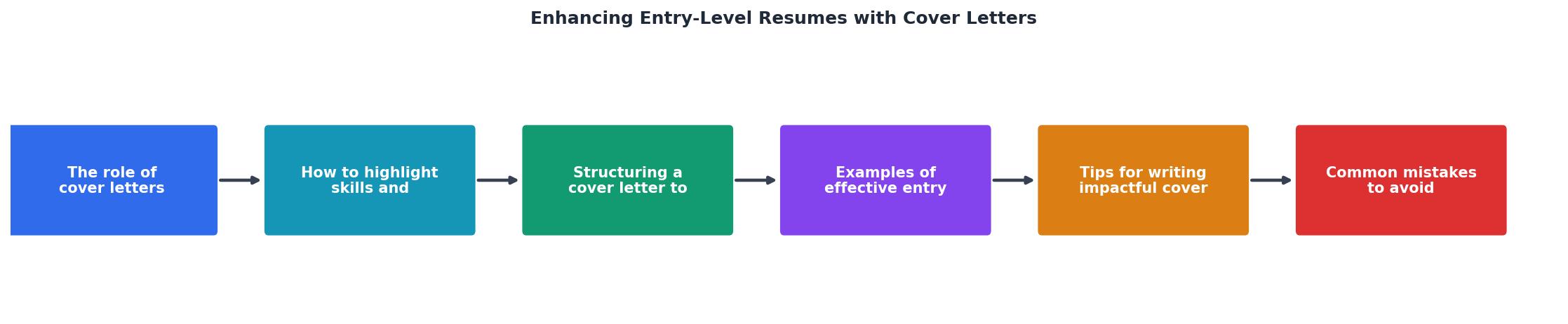
- Opening Hook - One or two sentences that name the role, mention how you found it, and include one specific reason you are excited about this company.
- Skills Bridge - The core paragraph. Pick two or three requirements from the job description and match each one to a concrete experience (internship, coursework, project, volunteer work).
- Value Proposition - A short paragraph explaining what you bring beyond the minimum qualifications. This is where personality, initiative, and cultural fit live.
- Confident Close - Thank the reader, restate your interest, and include a clear call to action ("I would welcome the opportunity to discuss how my data analysis background fits your analytics team").
"Research the company to help you determine your approach.">, How to write an effective cover letter (with samples)
Keep the entire letter under 400 words. Hiring managers spend seconds on initial screening. A concise, well-organized letter respects their time and proves you can communicate efficiently.
Examples That Landed Interviews
Here is a condensed example for a Marketing Coordinator position at a mid-size SaaS company:
"During my internship at BrightPath Media, I managed social media calendars for three client accounts, growing combined engagement by 28% over four months. Your job listing emphasizes content scheduling and analytics reporting. At BrightPath, I built weekly performance dashboards in Google Sheets that the account managers still use today. I would love to bring that same data-driven approach to Acme's growing content team."
Notice what this does: it names a real task, quantifies a result, mirrors the job listing's language, and ends with a forward-looking statement. No fluff, no filler.
Here is another example for a Junior Software Developer role:
"My senior capstone project involved building a REST API for a campus event management system using Node.js and PostgreSQL. Our four-person team followed agile sprints, conducted code reviews, and deployed to AWS. Your listing mentions Node.js, relational databases, and agile methodology. I have used all three in a production-like environment and I am eager to apply that foundation at scale."
The pattern is the same: specific experience, quantified or contextualized, mapped directly to the job requirements.
Tips for Impactful Cover Letters

Here is what separates a forgettable cover letter from one that gets you into the interview pile:
- Customize every letter. A generic cover letter is worse than no cover letter. Change at least the company name, the role title, and the Skills Bridge paragraph for each application.
- Lead with the company, not yourself. Open with what interests you about them, not a summary of your resume.
- Use the same header and formatting as your resume. Consistent branding signals professionalism.
- Proofread out loud. Reading your letter aloud catches awkward phrasing and run-on sentences that silent reading misses.
- Ask someone in the industry to review it. A five-minute read from a working professional catches blind spots you cannot see.
Common Mistakes to Avoid
These errors show up in entry-level cover letters constantly:
"To Whom It May Concern"- Find the hiring manager's name. Check LinkedIn, the company website, or call the front desk.Restating your resume line by line- The cover letter adds context, not repetition.Writing more than one page- 250 to 400 words is the sweet spot.Using a casual tone- Conversational is fine. Texting language is not.Focusing on what you want- "I want to grow my skills" is about you. "I can help your team streamline onboarding documentation" is about them.Forgetting to attach it- Upload the cover letter as a separate PDF, clearly labeled with your name and "Cover Letter."
Entry-Level Cover Letter Elements
| Generic Cover Letter | Tailored Cover Letter |
|---|---|
| "I am writing to apply for..." | Names the company's recent project or mission |
| Lists skills without context | Maps each skill to a job requirement |
| Same letter for every application | Customized Skills Bridge paragraph |
| No metrics or results | Quantified outcomes from projects/internships |
| Vague closing | Specific call to action referencing the role |
Entry-Level Cover Letter Checklist
Your progress is saved automatically in your browser.
FAQ
Frequently Asked Questions
What is the one thing you wish someone had told you about cover letters before your first job application? Share your experience below.
Additional Resources
- Cover Letter Resources - University Career Center - Cover letters introduce your story and create a first impression for employers. They link your resume to the position, showcasing your knowledge of the ...
- How to Write a Cover Letter (With Examples and Tips) - Format your cover letter like a business letter and include relevant achievements and skills that show the value you bring to the organization.
- How to write an effective cover letter (with samples) - An effective cover letter is directed towards a specific position or company, and describes examples from your experience that highlight your skills related to ...
