
Your resume is already being screened by algorithms before a human ever sees it. By 2026, that reality won't just be true, it will be the default expectation. The job application landscape is shifting fast, driven by AI, digital portfolios, and personalized resume formats tailored to specific roles. If you're still using the same one-size-fits-all resume you sent out last year, you're already behind. The good news is that understanding these changes now gives you a real competitive edge.
TL;DR:- AI will dominate resume screening, requiring keyword optimization and ATS-friendly formatting as table stakes.
- Digital portfolios and linked work samples will become expected for most roles, especially in creative and technical fields.
- Personalized resume formats tailored to specific jobs will outperform generic templates.
- Job seekers must balance human-readable clarity with machine-readable structure to succeed in 2026.
What's changing, and why it matters
Resume writing in 2026 won't look dramatically different on the surface, but the process of getting your resume in front of the right person will be transformed. The shift is driven by three converging forces: volume explosion (companies receive more applications than ever), AI adoption (algorithms are now standard gatekeepers), and remote work normalization (geographical constraints are gone, so competition is fiercer). Together, these forces mean your resume isn't just a document anymore, it's a machine-readable data source that must also tell a compelling human story.
The old resume advice, "one page for entry-level, two for mid-career", is becoming obsolete. The new advice is about strategic clarity: every word must serve a purpose, every format choice must pass both human and AI filters, and your resume must be flexible enough to adapt to different jobs without looking dishonest.
How AI is reshaping resume screening

AI resume screening isn't new, but it's getting smarter. By 2026, most mid-size and large companies will use AI-powered Applicant Tracking Systems (ATS) that don't just parse resumes, they rank candidates by cultural fit, skill trajectory, and role-specific keyword density. Some systems can even predict job performance based on past role transitions and tenure patterns.
Here's what this means for you: the resume that looks great to your friend's human eye might score zero points with an ATS because it's missing keywords the algorithm is weighted to find. That's not a flaw in the system; it's the new reality of hiring.
Key ways AI is changing resume screening:
- Semantic keyword matching: Instead of exact-match searches, algorithms understand synonyms and related terms. "Led a team of five" and "Managed five direct reports" both signal leadership capability, but "Led a team" alone might miss the mark for a role requiring explicit management experience.
- Skill trajectory analysis: AI increasingly looks at your progression, not just your current skills. Jumping from junior to senior too fast triggers skepticism; steady growth signals reliability.
- Role fit prediction: Algorithms now compare your past roles to the target role and score likelihood of success. If you've never worked in a similar industry, that's a data point the algorithm flags.
- Temporal relevance: Older experience gets downweighted. A technical skill from five years ago isn't as valuable as the same skill from six months ago, unless it's foundational knowledge (like SQL) that's in high demand.
Digital portfolios become the new second page

By 2026, a resume alone won't be enough for most professional roles. A digital portfolio will be expected, not as a nice-to-have, but as a table-stakes requirement. For software engineers, it's GitHub. For designers, it's Dribbble or a personal site. For marketers, it's a blog or Medium publication. For product managers, it's a case study page or LinkedIn article series.
Why? Because AI can't assess your actual capability. An algorithm can confirm that you claim to have "Python" on your resume, but it can't judge code quality, design aesthetic, or strategic thinking. Hiring managers increasingly know this and want to verify claims with real work samples.
The evolution of digital portfolios by 2026:
- Linked work samples become standard: Your resume will include direct links to your best work. Not a link to your portfolio page (which might be outdated), but links to specific projects with context.
- Interactive demonstrations replace static PDFs: Instead of a static case study PDF, expect live dashboards, deployed prototypes, or video walkthroughs of your work.
- Verified credentials and badges: Platforms like Credly and HackerRank will become more integrated into resumes. A badge proving you passed a specific assessment carries weight that self-reporting never did.
- Social proof integration: LinkedIn endorsements, GitHub stars, Medium clap counts, and dribbble likes become data points that algorithms factor into ranking.
Format evolution: from static to dynamic
The traditional resume, a static PDF with a fixed structure, is being replaced by adaptive formats that change based on the job they're submitted for. This isn't about changing your actual experience; it's about reframing what you emphasize.
Consider a hypothetical marketer with experience in demand generation, content strategy, and analytics. When applying for a demand generation role, the resume leads with demand gen metrics. For a content strategy role, the same person's resume emphasizes content output and SEO impact. The experience is unchanged, but the framing shifts.
By 2026, this adaptation will happen in three main ways:
- AI-assisted resume tailoring: Tools will analyze the job description, extract key requirements, and suggest which of your experiences most closely align, and in what language. You'll review and approve the changes before sending. (This is precisely what Resume Hedgehog does.)
- Modular resume sections: Instead of a fixed format, your resume might have "locked" sections (name, contact, core experience) and "flex" sections (skills, achievements, projects) that reorder based on the job. An ATS scanning for leadership will see leadership examples at the top; one scanning for technical depth will see technical projects first.
- Metadata-rich formats: Resumes will move beyond PDF and DOCX into structured formats (JSON, XML) that carry rich metadata. Your resume might explicitly tag "5 years Python experience" with the date range, fluency level, and project count, data that AI systems can reliably parse and compare.
What job seekers must adapt to
By 2026, job seekers face a fundamental choice: adapt to the new resume reality or fall further behind. Here's what that adaptation looks like across different career stages:
For active job seekers (sending 10+ applications): The time investment in tailoring per application will shrink from 45 minutes (manual tailoring) to 10 minutes (AI-assisted tailoring). This means you can apply to more relevant roles without exhaustion. The trade-off: you can't apply to 100 roles in a day. You'll apply to 20 carefully selected roles, each with a tailored resume. Quality over volume becomes not just advice, it becomes survival.
For career changers and returners: Your challenge is translating experience into new-field language. By 2026, tools that assist with this translation will be standard. An ex-teacher becoming an instructional designer won't manually rewrite her resume; she'll use a tool that maps teaching experience to design roles, suggests relevant skills to emphasize, and identifies industry terminology she needs to adopt. This doesn't fake experience, it translates it accurately.
For early-career professionals: The pressure to build a portfolio starts now. By the time you job-hunt in 2026, you should have 3-5 public projects you can point to. For engineers, this means open-source contributions or a GitHub with real code. For designers, a Dribbble portfolio or personal site. For marketers, a blog or case study. Starting this work in 2024 or 2025 is the baseline for competitive 2026 job searching.
For senior and executive candidates: Your resume changes least, but your digital presence becomes paramount. By 2026, a CEO or VP without a robust LinkedIn presence, published thought leadership, or speaking engagements looks like an outlier (in a bad way). Your resume still matters, but it's backed up by a broader professional profile.
Key takeaway: Resume writing in 2026 is no longer a one-time task. It's an ongoing process of documenting, curating, and adapting your work to match opportunities. The winners aren't those with the flashiest resume design; they're those who understand their audience (human and AI) and speak both languages fluently.
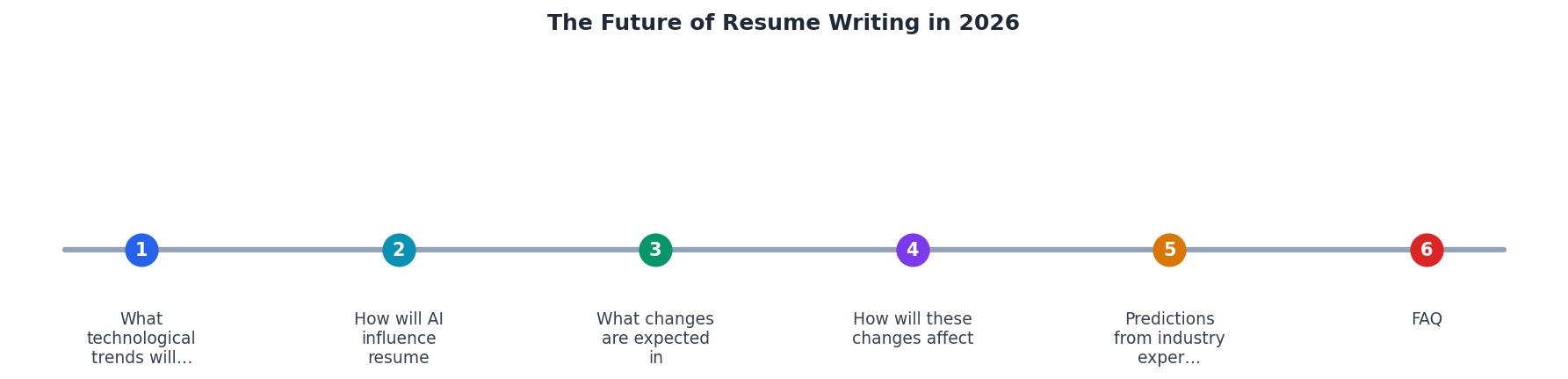
The process diagram: your 2026 resume journey
What industry experts predict
"The rules have changed, and whether you choose to go full tilt on your own or hire a professional, you should know what recruiters are looking for and how you can put your best foot forward.">, Resume Basics: What's New in 2026 and Beyond
Industry consensus on 2026 resume trends points to several clear predictions:
Prediction 2: Video resumes will be optional but increasingly expected in certain fields. Creative roles (design, marketing, sales, entertainment) will increasingly accept or request short video introductions (30-60 seconds). For most roles, video remains optional, but not providing it when asked is an immediate disqualification. The video doesn't replace the resume; it supplements it.
Prediction 3: The ATS game becomes more sophisticated, so generic templates become weaker. As algorithms evolve, the "perfect resume template" becomes less perfect. A template that was optimized for ATS parsing in 2023 might lose points in 2026 because parsers have gotten smarter and are looking for different signals. The implication: stop using old templates. Use current ones, or better yet, use a tool that adapts your resume to the specific role.
Prediction 4: Resume length starts to matter less; accuracy matters more. By 2026, a two-page or three-page resume won't hurt you if it's relevant and accurate. What will hurt you is padding, exaggeration, or irrelevant information. Algorithms can cross-reference your claims (LinkedIn, GitHub, past employer databases) and flag inconsistencies. Lying on your resume in 2026 is riskier than ever.
Prediction 5: Quantification becomes mandatory for senior roles. Entry-level resumes can get away with qualitative achievements. Senior resumes by 2026 will be expected to include numbers: revenue impacted, team size managed, percentage improvements, cost savings, user growth, etc. If you can't quantify your impact, you're signaling that you didn't measure it, a red flag for leadership roles.
Preparing your resume for 2026: a practical guide
Resume Readiness Checklist for 2026
Your progress is saved automatically in your browser.
Interactive Resume Optimization Tool
FAQ
Frequently Asked Questions
The future of resume writing isn't about reinventing the wheel. It's about understanding that your resume is now a two-audience document: it's read by both humans and algorithms, and it must work for both. By 2026, the baseline expectation will be that you've tailored your resume to the job, that you can back up your claims with a portfolio, and that your experience is accurately quantified. These aren't futuristic requirements, they're already becoming the norm. The earlier you adopt them, the sooner your job search becomes genuinely competitive.
Additional Resources
- Resume Basics: What's New in 2026 and Beyond - In 2026, resume basics means a shift from what you did to how you added value. And that value is not offered up in the form of a laundry list ...
- What's the best resume format in 2026? - In this article, we'll delve into three of the highest-impact resume formats for 2026: Reverse-chronological resumes Functional resumes Combined resumes
- 15 Must-Have Resume Tips for 2026 (Free Templates + ... - The strongest resumes in 2026 will be Clean, Impact-driven, Skills-forward, Keyword-aligned, and Human.