A resume that lands interviews in marketing, tech, or finance will fall flat when submitted for a nursing or medical coding position. Healthcare hiring managers look for a completely different set of signals, from active clinical licenses to specific patient population experience. If you are transitioning into healthcare from another field, understanding these differences is the single most important step you can take before sending a single application.
Photo by contact me +923323219715 from Pexels
TL;DR:- Healthcare resumes require active certifications and license numbers listed prominently, unlike most other industries.
- Clinical experience with specific patient populations, settings, and procedures replaces generic work history.
- Knowledge of HIPAA, OSHA, and Joint Commission standards signals readiness in ways that have no equivalent in corporate resumes.
- Transferable skills from other fields still count, but they must be reframed in healthcare terminology.
Why Healthcare Resumes Play by Different Rules
Every industry has resume conventions. Software engineers list GitHub repos. Marketers show campaign ROI. But healthcare operates under regulatory oversight that directly shapes what belongs on a resume. A registered nurse cannot simply write "experienced in patient care." Hiring managers want the license type (RN, LPN, CNA), the issuing state, the license number, and the expiration date. Skip any of those, and the resume goes into the rejection pile before a human reads it.
This credential-first culture exists because patient safety is non-negotiable. Hospitals, clinics, and long-term care facilities face legal liability if they hire someone whose license has lapsed or whose certifications do not match the role. That reality trickles down to every line of your resume.
Certifications That Belong Front and Center

"Most health care resumes need to have the specific credential related to the part of the field they are going into.">, How Health Care Resumes Differ From Others
In corporate resumes, certifications sit in a small section near the bottom. In healthcare, they often appear right after your name. Here is what recruiters expect to see:
- License type and number (e.g., RN #123456, State of California)
- Expiration date so the employer knows the license is current
- Specialty certifications like BLS, ACLS, PALS, or CPC
- Board certifications for physicians and advanced practice providers
- State-specific endorsements if you hold multi-state compact licenses
If you are coming from a non-healthcare background, this is where the gap feels widest. You may not have clinical certifications yet. The fix: list certifications in progress, including the expected completion date and the issuing body. "BLS Certification, American Heart Association, expected September 2026" tells a recruiter you are serious about the transition.
Clinical Experience vs. Generic Work History
A marketing resume might say "Managed a team of 12 across three campaigns." That structure does not translate to healthcare. Clinical experience sections need specifics that corporate resumes never include:
- Facility type: Was it a Level I trauma center, outpatient clinic, skilled nursing facility, or pediatric hospital?
- Patient population: Adults, geriatric, neonatal, psychiatric?
- Bed count: A 600-bed teaching hospital signals a very different workload than a 30-bed rural clinic.
- Procedures and equipment: EMR systems used (Epic, Cerner, Meditech), specific procedures performed or assisted.
- Caseload numbers: "Managed a caseload of 25 patients per shift" gives concrete scale.
Provided excellent patient care in a hospital setting(vague, tells the recruiter nothing)- Delivered direct patient care to 18-22 medical-surgical patients per 12-hour shift in a 450-bed Level II trauma center using Epic EMR (specific, verifiable, useful)
Reframing Transferable Skills

Switching into healthcare does not mean your previous experience is worthless. It means you need to translate it. A project manager who coordinated cross-functional teams has skills that map directly to care coordination. A teacher who managed classrooms of 30 students understands patient education and communication under pressure.
The key is using healthcare-specific language. Recruiters in this field scan for terms like:
- Patient advocacy instead of "customer service"
- Interdisciplinary collaboration instead of "cross-team communication"
- Care coordination instead of "project management"
- Clinical documentation instead of "record keeping"
- Infection control protocols instead of "safety procedures"
A tool like Resume Hedgehog can help bridge this gap by analyzing a healthcare job posting and identifying the exact terminology the employer uses, then suggesting how to align your existing experience with those terms.
Healthcare Regulations on Your Resume
No other industry requires you to demonstrate regulatory knowledge on a resume the way healthcare does. Three frameworks come up repeatedly:
- HIPAA (Health Insurance Portability and Accountability Act): Mention experience with patient privacy protocols, secure data handling, and HIPAA-compliant documentation.
- OSHA (Occupational Safety and Health Administration): Relevant for roles involving bloodborne pathogen exposure, hazardous materials, or workplace safety compliance.
- Joint Commission Standards: Hospitals seeking or maintaining Joint Commission accreditation value candidates who understand these quality and safety benchmarks.
Building a Healthcare Resume Step by Step
This diagram shows the core structure that healthcare hiring managers expect to see, from the credentials block at the top to the education and training section at the bottom.
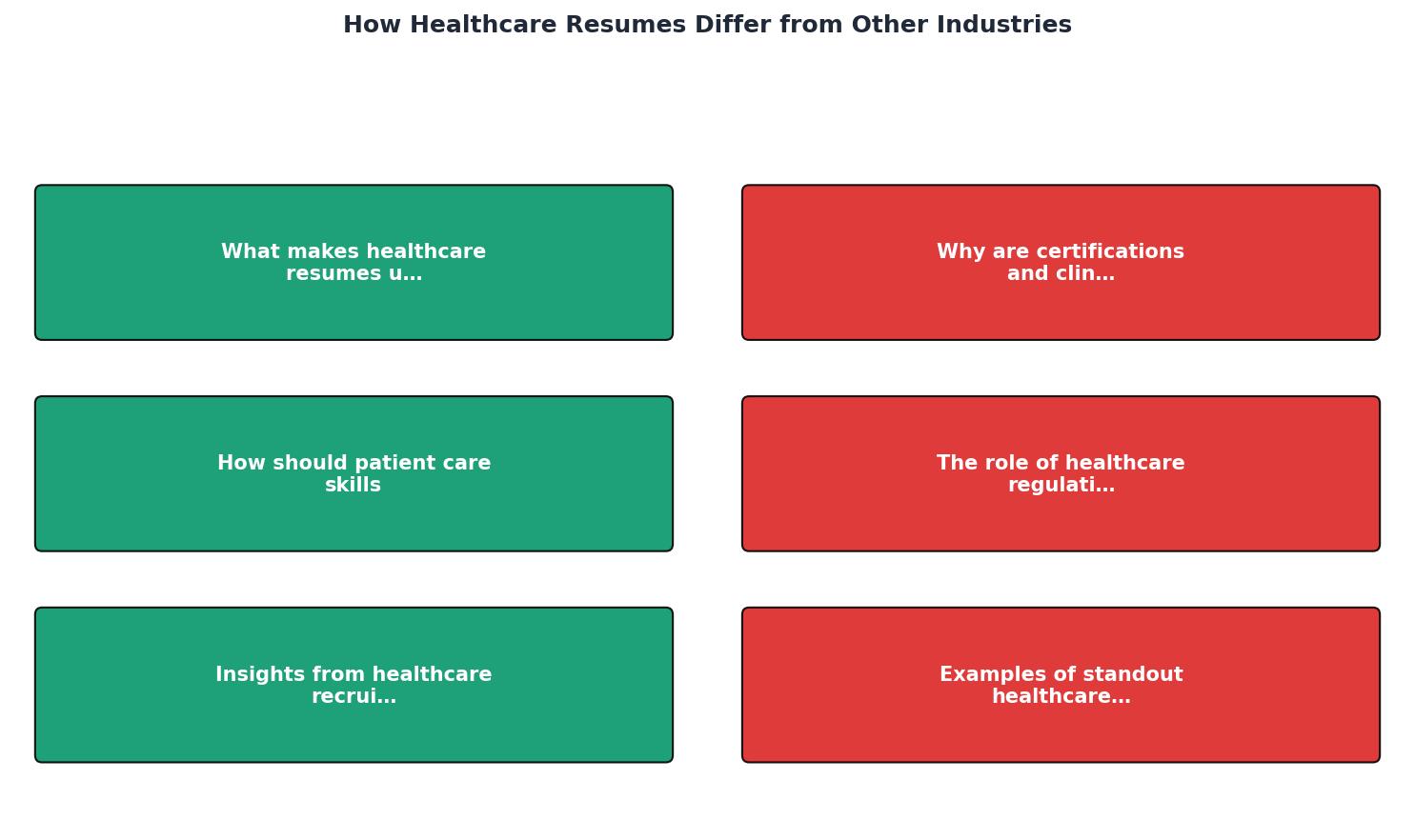
The process follows these steps: Credentials Header, then Clinical Summary, then Certifications & Licenses, then Clinical Experience, then Regulatory Knowledge, and finally Education & Training. Each block feeds into the next, creating a document that reads like a clinical profile rather than a corporate CV.
Notice that the credentials header comes before the summary. In most industries, you lead with a professional summary or objective. In healthcare, your license type and number are the first thing a recruiter needs to verify. Everything else follows.
Here is an interactive overview of how a typical healthcare resume stacks up against a standard corporate resume across key categories:
Healthcare vs. Corporate Resume
Key differences at a glance
What Healthcare Recruiters Actually Look For
Recruiters in healthcare operate under tighter constraints than their corporate counterparts. A tech recruiter might take a chance on a candidate with an unconventional background. A hospital recruiter often cannot, because credentialing departments require documentation before an offer letter goes out.
Here is what consistently rises to the top of their screening process:
- Active, verifiable licenses with no disciplinary actions
- Relevant clinical hours that match the unit or specialty
- EMR proficiency with the specific system the facility uses
- Continuing education that shows commitment to staying current
- Quantified outcomes like patient satisfaction scores, readmission rates, or quality metrics
If you are transitioning from another industry, focus on the items you can control right now: get your BLS certification, complete a HIPAA training course, and volunteer or shadow in a clinical setting to build hours you can reference.
Standout Resume Sections in Practice
The best healthcare resumes include sections you will not find in other industries:
- Licensure & Certifications (separate from education, placed high on the page)
- Clinical Rotations (for new graduates or career changers completing clinical programs)
- Professional Affiliations (ANA, APTA, AAPC membership signals engagement with the field)
- Volunteer Clinical Experience (especially valuable for career changers building hours)
- Continuing Education (specific courses, CEU hours, and completion dates)
Healthcare Resume Checklist
Your progress is saved automatically in your browser.
FAQ
Frequently Asked Questions
What part of the healthcare resume transition feels most challenging to you right now? Drop your question below and let's work through it together.
Additional Resources
- How Health Care Resumes Differ From Others - Other ways health care careers resumes differ · Most health care resumes need to have the specific credential related to the part of the field ...
- The Healthcare Resume: Definition, How-to and Examples - In this article, we'll discuss what a healthcare resume is, what elements to include in one and how to write yours with a template and example to guide you.
- How to transform your physician CV to an industry resume - Both show your experience, education, and background. But they differ in length and scope. A CV is exhaustive, containing all your ...