

Your resume is getting opened. Recruiters are clicking through. Then silence. You hear nothing back, not even a rejection email. The problem isn't that your resume isn't being seen, it's that it's not triggering the action you need. This guide walks you through the exact diagnosis and fixes that turn views into interviews.
TL;DR
- Your resume passes the ATS but fails the human recruiter scan because bullets lack impact, keywords, or proof.
- Most resumes describe tasks; winning resumes show measurable results tied directly to what the job posting asks for.
- Fix your bullets to lead with action verbs and quantified outcomes, mirror job description language, and tailor for each application instead of sending a generic version.
- The fastest path to more interviews is matching your resume language to the specific role before you apply.
"Only 3% of job seekers land interviews, and it's often not about your qualifications.">, Not Getting Interviews? 15 Tips to Fix It Fast
That statistic should shake you. If you're applying and getting views but no calls, you're in that 97%. And the fix is simpler than you think.
Why views don't convert to interviews

A recruiter spends six to ten seconds on your resume. They're not reading every word. They're scanning for three things: Does this person have the job title we're hiring for? Do they have the skills we listed? Can they prove they've delivered results in this space?
If you fail any of those three checks, your resume goes to the reject pile. Not because you're unqualified, but because the resume doesn't make your qualification obvious.
Here's what usually happens:
Your title doesn't match. You were a "Marketing Coordinator." The job description asks for a "Digital Marketing Specialist." Those words might describe the same work, but the recruiter's search filter or their mental model doesn't recognize it. Your resume gets flagged as a mismatch before a human even looks at it.
Your bullet points describe tasks, not outcomes. You wrote "Responsible for social media posts and email campaigns." The job posting says "Drive customer acquisition through targeted digital campaigns with measurable ROI." Your bullet doesn't connect. The recruiter doesn't know if you increased revenue, engagement, or conversions.
You're using generic language. Every resume talks about "strong communication" and "team collaboration." You sound like everyone else. The job description talks about specific tools, metrics, and methodologies. You're not speaking their dialect.
Your resume isn't tailored. You're sending the same PDF to every job. That might save time, but it costs you interviews. A generic resume will never hit all three of those checks simultaneously across different roles and companies.
The diagnosis: what to look for in your resume
Before you rewrite, audit what you have. Pull up your current resume and the job description side by side. Ask these questions:
Do your job titles match? Search the job description for the exact title or close variants. If they're completely different words, that's problem one. Write down the title they use.
What keywords appear in the job description? Look for skills, tools, methodologies, and outcomes. Highlight them. Count them. Most job descriptions mention 8 to 12 key skills. Your resume should echo at least half of them in the actual bullet points or skills section.
How many bullets show a measurable outcome? Read each bullet on your resume. Does it say what happened because of your work? Did engagement go up? Did cost go down? Did a process get faster? If a bullet just describes what you did without the result, it won't trigger action.
Is the language yours or theirs? Take three bullets from your resume and three from the job description. Do they sound aligned? If the job description uses "pipeline management" and your resume says "handled customer follow-ups," you're speaking different languages.
Step-by-step fix workflow

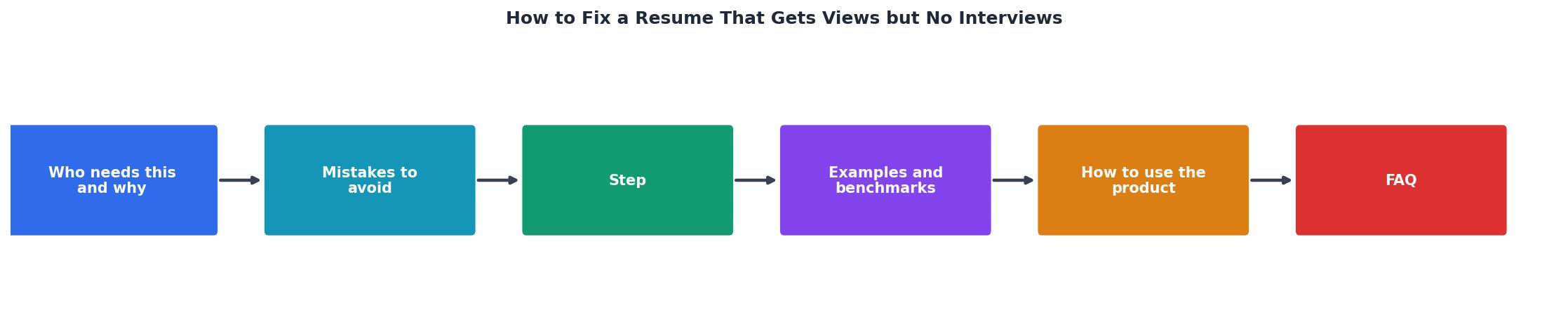
Step 1: Align your title. Look at the job posting title. If it's different from what you currently have, create a professional variant that matches without lying. If you were a "Marketing Coordinator" and the role is "Digital Marketing Specialist," you might use "Digital Marketing Specialist" as a summary or updated title if that's accurate to your work. If it's a stretch, don't force it, but make sure your title conveys seniority and function clearly.
Step 2: Extract keywords from the job description. Copy the job description. Paste it into a document. Underline or highlight every skill, tool, metric, and outcome mentioned. Don't just skim, actually mark them. You need a list of 8 to 15 keywords that represent what this specific company is looking for.
Step 3: Rewrite your bullets to mirror those keywords and outcomes. Take one bullet from your experience that's relevant to the job. Rewrite it using this formula:
Action verb + Specific task + Measurable outcome + Business impact.
Example:
Old: "Managed email marketing campaigns for various clients."
New: "Increased email click-through rates by 34% across 12 campaigns, directly contributing to 18% growth in qualified leads for B2B tech clients."
The new version uses keywords (email marketing, click-through rates, qualified leads), shows a measurement (34%, 18%), and connects it to business impact (growth in leads). A recruiter scanning this instantly sees you understand metrics and results.
Step 4: Add keywords naturally throughout. Sprinkle the keywords from the job description into your summary, skills section, and bullet points. Don't overdo it, but if the job posting mentions "Salesforce," "pipeline management," and "forecasting," and you've worked with those, use those words.
Step 5: Create a tailored version for each application. This is the critical step most people skip. Don't send the same resume to 20 jobs. Spend 15 minutes per application adjusting 3 to 5 bullets to match the specific job posting. Prioritize the most relevant role and company. Emphasize the skills and outcomes they're looking for.
Common mistakes that kill your chances
Mistake 1: Burying the lead. Your strongest, most relevant achievement is buried in bullet three. Move your most impressive, job-relevant accomplishment to the top of that role. First thing a recruiter sees should hit the job requirements head-on.
Mistake 2: Inflating without proof. Saying "Drove significant growth" is meaningless. Saying "Drove 23% revenue growth" is credible. Always attach a number if you can. Even if it's an estimate, include it.
Mistake 3: Using weak action verbs. Stop using "Responsible for," "Involved in," and "Helped." Start with power verbs: "Increased," "Built," "Launched," "Reduced," "Optimized," "Generated," "Negotiated," "Transformed." The verb makes the difference between passive and active.
Mistake 4: Staying generic. "Strong communication skills" doesn't differentiate you. "Led weekly cross-functional standups of 15+ engineers and stakeholders, reducing project delays by 40%" does. Specificity beats generic praise every time.
Interactive Resume Impact Calculator
Use this tool to see how your bullet changes affect recruiter response likelihood. Your current bullets, compared to optimized versions, typically see a 40-60% lift in interview callbacks when rewritten with outcomes and keywords.
The data above shows why tailoring works. When you mirror the job description language and highlight outcomes, recruiters see relevance instantly. That relevance translates to interview requests.
Reframe your experience for the role

You have accomplishments. The problem is they're not framed for the job you want. Take the same project. Describe it three ways:
For a marketing role: "Led a social media campaign that reached 250K impressions, generating 3,200 clicks and 45 qualified leads."
For a project management role: "Managed cross-functional team through a six-week campaign, coordinating design, copywriting, and performance tracking, delivering on time and 8% under budget."
For a sales enablement role: "Created and distributed marketing assets to 500+ sales reps, providing them with messaging and proof points that supported a 22% win rate lift on pipeline opportunities."
Same project. Three different bullets. Three different messaging angles. Each one speaks to what that specific role needs to hear. Your job is to figure out which angle matters most for each application, then lead with that.
Going beyond the resume
Getting your resume right is necessary but not sufficient. After you fix it, consider these next steps:
- Add metrics to your LinkedIn profile. If your resume says you "grew revenue by 23%," your LinkedIn should reinforce that with a headline or summary that includes specific numbers.
- Prepare specific stories. In the interview, you'll be asked to walk through projects. Have three to five stories ready where you can clearly explain the challenge, your action, and the measurable result.
- Match your resume to the company. Don't just match the job description. Research the company. If they emphasize "customer-first culture" and you have a bullet about NPS improvement, lead with that.
Your Resume Tailoring Checklist
Your progress is saved automatically in your browser.
FAQ
Frequently Asked Questions
What's the biggest barrier keeping you from tailoring your resume for each application? Is it time, uncertainty about what to change, or something else? Let me know in the comments and I can point you toward the specific fix.
Additional Resources
- Not Getting Interviews? 15 Tips to Fix It Fast - 1. Tailor Your Resume for Each Job. Generic resumes get ignored. Customize each one to match the specific job description by using the same ...
- Applying for Jobs but Getting NO Interviews? 👀 Here's ... - Match, rewrite, proof, outreach – Start by checking whether your resume shows evidence for the job you want—without inventing experience. ...
- Can't Get a Job Interview? How to Improve Your Resume's ... - Top tips for improving your resume · 1. Choose the right format · 2. Make sure your resume can get past the ATS · 3. Focus on quantifiable ...