
You've found a job posting that feels like it was written for you. The problem is you're one of hundreds of applicants, and most of your resume might not even make it past the screening software. Tailoring your resume to match the job description isn't about lying or keyword stuffing, it's about translating what you've actually done into the language the employer is using. This guide walks you through the exact process, with examples and concrete steps you can use starting today.
TL;DR
- Extract key skills, responsibilities, and qualifications from the job description first, these are your targeting list.
- Reorder and reword your resume bullets to emphasize experience that aligns with the job, using the same terminology the employer used.
- Match the role's technical and soft skills by highlighting relevant projects, tools, and achievements you've already completed.
- Avoid keyword stuffing; instead, ensure your genuine experience is presented in the language of the role.
- Use automated tools to verify your resume matches the job and identify gaps before you apply.
Step 1: Analyze the Job Description Thoroughly

Don't skim the job posting. Read it twice: once for meaning, once for patterns. You're looking for:
- Required skills (explicitly listed under "Skills" or "Requirements")
- Preferred qualifications (nice-to-haves that give you an edge)
- Tools and platforms (Salesforce, Figma, Python, Jira, name each one)
- Industry terminology (the language they use for roles, processes, deliverables)
- Responsibilities (what they actually need you to do day-to-day)
- Soft skills (collaboration, communication, problem-solving, spelled out or implied)
Here's the hidden detail: job descriptions often list skills in order of importance. The first three to five requirements tend to be the ones the ATS weights most heavily. Prioritize those in your resume.
Step 2: Inventory Your Transferable Experience

Now look at your own resume and ask: What have I done that matches this job? You don't need identical experience. You're looking for transferable moments, projects, achievements, and skills that address the job's core needs, even if the context was different.
Example: The job description asks for "experience building dashboards and reporting workflows." You've never worked in BI formally, but you built a spreadsheet system that tracked KPIs for your team. That's building dashboards. Own it. Reframe it.
List out:
- Skills you have that match their requirements
- Projects where you used similar tools or solved similar problems
- Achievements that demonstrate the qualities they're looking for (reliability, creativity, attention to detail)
- Any gaps, things they want that you don't have
Step 3: Rewrite Your Resume Bullets Using Their Language
This is where the magic happens. You don't change what you did, you change how you describe it. Use the job description's terminology, structure, and emphasis.
Before: "Managed social media accounts across platforms."
After (for a social media manager role asking for "community engagement and content strategy"): "Developed and executed community engagement strategy across Instagram, TikTok, and LinkedIn, increasing follower retention by 30% through targeted content calendars and real-time audience interaction."
Notice the difference? You used their exact keywords (community engagement, content strategy), named the platforms, and added a metric. Your work is the same; the presentation is now aligned.
"The candidate is fictional, and we will explain each change.">, Tailor Your Resume to a Job Description: Examples
Start with the job's action verbs. If they use "developed," "implemented," and "optimized," use those verbs in your bullets. If they emphasize ROI, lead with metrics. If they care about process improvement, highlight efficiency gains you've made.
Here's a reordering tactic: Move your most relevant bullet to the top of each role. If the job prioritizes project management and you've managed projects, lead with that, even if chronologically your other responsibilities came first on the job. Context matters more than order on a resume.
Step 4: Match Skills and Keywords Without Stuffing
The line between tailoring and keyword stuffing is real. On one side: honest alignment. On the other: nonsense.
Good alignment: The job mentions "Agile methodology." You've used Scrum sprints. Your resume says "Led development sprints using Scrum."
Bad keyword stuffing: The job mentions "Agile." You add "Agile" to random bullets where it doesn't belong. ("Agile customer service"? No.)
Scan the job description for:
- Hard skills (programming languages, software platforms, certifications)
- Frameworks and methodologies (Agile, Lean, Six Sigma)
- Industry jargon (CAC, LTV, funnel, attribution, etc.)
- Credentials or certifications they mention
One useful filter: Read your resume aloud after editing. If a bullet or skill phrase sounds forced or weird, remove it. Hiring managers and ATS systems both favor natural language.
Step 5: Build Your Tailored Draft and Test It

Start a fresh document. Keep your original resume in a separate file, you'll use it as a base for every tailoring. Copy your current resume, then manually update it based on the job description you've analyzed. Reorder bullets, reword descriptions, and emphasize the right skills.
Then test it. Read through the job description side-by-side with your resume. For each major requirement in the job posting, can you point to a place on your resume where you've addressed it? If not, dig deeper or add a relevant bullet.
A simple check: Scan the job description for 5-10 high-priority keywords. Use the Find function in your resume. Do those keywords appear? They should, naturally, not forced.
Speed Up Tailoring with Automation
Manually tailoring 20 resumes is exhausting. That's where tools help. Paste the job description into Resume Hedgehog along with your resume, and it identifies misalignments, suggests keyword additions, and generates a draft that's already optimized. You review, tweak, and send. What would take an hour by hand takes 10 minutes.
Automation also removes the guesswork. You're not wondering if your resume matches, you see the alignment score and exact recommendations.
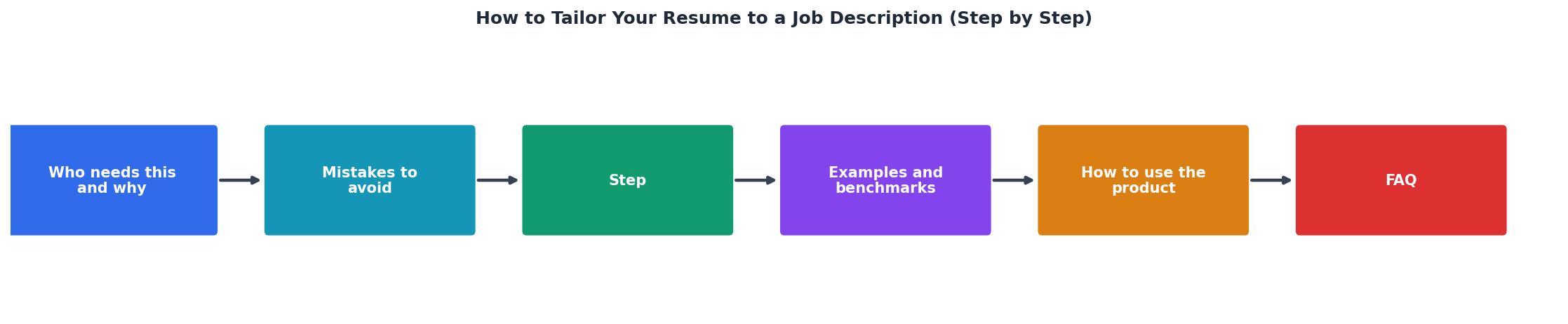
Your Tailoring Workflow
The workflow above shows how tailoring fits into your application process. Each step takes 5-15 minutes when you do it manually; automation condenses it to a few minutes. Either way, the result is the same: a resume that speaks the employer's language and passes the ATS.
Common Mistakes to Avoid
Overdoing keywords. Repeating "leadership" five times doesn't make you a better leader. Use varied terminology and trust that the ATS is smart enough.
Removing experience that doesn't match. Don't delete roles or bullets just because they seem unrelated. Reframe them instead. That retail job taught you customer service, which is relevant to almost any role.
Ignoring the "nice-to-haves." Preferred skills matter less than required ones, but they still factor into ATS scoring and human interest. If you have them, include them.
Tailoring too much. If tailoring would require you to lie or fabricate skills, don't apply to that job. Your application will fail during the interview when they ask you to demonstrate something you don't actually know.
Forgetting to proofread. A tailored resume with typos is worse than a generic one. Before you send, read it three times and run it through a spell-checker.
Resume Tailoring Checklist
Your progress is saved automatically in your browser.
FAQ
Frequently Asked Questions
Additional Resources
- How to Tailor Your Resume to a Job Description: A Worked ... - Start by putting the vacancy beside your resume. Identify the work the employer needs done, find examples you've actually delivered, and rewrite the most ...
- How To Tailor Resume To Job Description - Rate your fit + find missing keywords ✅ Rewrite using proven formulas ✅ Scan for rejection triggers Plus Jake's Resume template for perfect formatting
- Loading SpouseWorks... - Please enable JavaScript to continue using this application. Loading SpouseWorks...