
You spent three hours tailoring a resume, landed the interview, and then blanked on the very first question about your own work history. The resume got you in the door, but the interview is where the job is won or lost. This guide shows you how to turn the same tailored resume you built with Resume Hedgehog into a complete interview prep playbook, so every answer you give matches the story your resume already tells.
Photo by Tima Miroshnichenko from Pexels
TL;DR:- Your tailored resume is already an interview cheat sheet: it contains the exact keywords, achievements, and role-specific language the interviewer expects to hear.
- Resume Hedgehog aligns your resume to the job description, which means you can reverse-engineer likely interview questions straight from the output.
- Pair resume tailoring with structured answer prep (STAR method, keyword echo, achievement recall) and you walk into every interview with a consistent, confident narrative.
Why Resume-Based Interview Prep Matters
Most job seekers treat the resume and the interview as two separate events. They optimize the resume for ATS filters, then scramble to prepare answers the night before. That disconnect creates a problem: the interviewer reads one story on paper and hears a different one in person.
When your resume says you "reduced onboarding time by 30%" but you stumble explaining how, the interviewer notices. Consistency between your written application and your spoken answers builds trust. It signals that you actually did the work you claim.
A tailored resume does more than pass keyword filters. It organizes your experience around the specific requirements of the job posting. That organization becomes the skeleton of your interview answers. Every bullet point is a potential question, and every keyword is a term the interviewer expects you to use naturally.
Common Mistakes That Cost Offers

Three mistakes show up repeatedly when candidates skip resume-based interview prep:
- Generic answers that ignore the job description. The interviewer asks "Tell me about a time you managed stakeholders" and you give an example from a completely different context than what the role requires. Your tailored resume already picked the right example. Use it.
- Forgetting your own numbers. You wrote "increased conversion rate by 22%" on the resume but say "I think it was around 20-something percent" in the interview. That vagueness erodes credibility.
- Keyword mismatch. The job posting says "cross-functional collaboration" and your resume reflects that phrase. But in the interview you keep saying "working with other teams." Small language shifts matter because interviewers often score against a rubric that uses the job posting's exact terminology.
The fix for all three is the same: use your tailored resume as the single source of truth for interview prep.
Step-by-Step Interview Prep Workflow
Here is the process that turns a Resume Hedgehog output into a full interview preparation plan. Follow these steps after you receive your tailored resume and before the interview date.
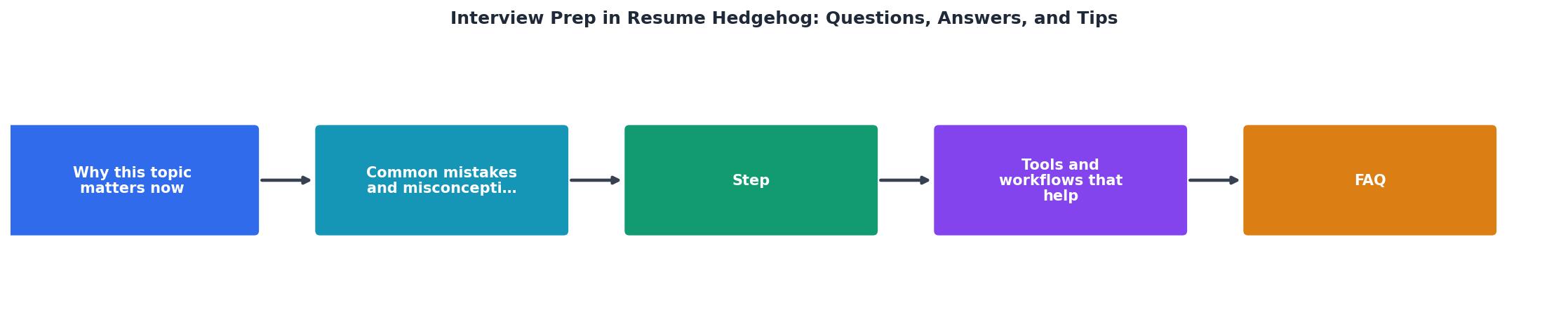
1. Upload and Tailor
Start at www.resumehedgehog.com. Upload your base resume and paste the job description. The tool aligns your experience to the role's requirements, pulling forward the most relevant skills and achievements. Save the PDF output.
2. Extract Key Themes
Open the tailored resume and identify three to five recurring themes. These are the skill clusters the tool emphasized. For a product manager role, themes might include: stakeholder management, data-driven decisions, roadmap ownership, cross-functional leadership, and user research.
3. Map Questions to Bullets
For each achievement bullet on the resume, write one likely interview question. "Reduced customer churn by 18% through proactive outreach program" becomes "Tell me about a time you improved customer retention." This is not guesswork. Interviewers pull directly from resumes.
4. Build STAR Answers
The STAR method (Situation, Task, Action, Result) gives structure to behavioral answers. Your resume bullet already contains the Action and Result. Fill in the Situation and Task from memory. Write these out. Practice them aloud until they feel natural, not rehearsed.
5. Rehearse With Keywords
Read the job description one more time. Circle every technical term, soft skill, and industry phrase. Make sure those exact words appear in your spoken answers. If the posting says "Agile methodology" and your resume reflects it, say "Agile methodology" in the interview, not "we used sprints sometimes."
Tools and Workflows That Help

Resume Hedgehog handles the tailoring step, but the full interview prep workflow benefits from a few additional tools used together:
- Resume Hedgehog for resume-to-job alignment. This is the foundation. Without a properly tailored resume, every other step is built on sand.
- A simple spreadsheet or note app for your question-to-bullet map. Two columns: likely question on the left, resume bullet and STAR notes on the right.
- Voice recording on your phone for practice runs. Record yourself answering each question, then play it back. You will catch filler words, vague phrasing, and missing keywords immediately.
- A timer set to 90 seconds per answer. Behavioral answers that run past two minutes lose the interviewer's attention. Aim for 60 to 90 seconds.
| Without Resume-Based Prep | With Resume-Based Prep |
|---|---|
| Generic answers for any role | Targeted answers per job |
| Forgotten metrics and numbers | Exact figures from resume |
| Keyword mismatch with job posting | Consistent terminology throughout |
| 30+ minutes of scattered prep | 15-minute structured workflow |
| Low confidence, high anxiety | Clear narrative, calm delivery |
The comparison above is not theoretical. When you anchor every answer to a document that was already optimized for the specific role, preparation time drops and answer quality rises.
Predict the Hardest Questions
Not every interview question maps neatly to a resume bullet. Some are designed to probe gaps or weaknesses. Here is how to handle those using your tailored resume as a guide:
- "What's your biggest weakness?" Look at the skills the job posting emphasized that your resume addressed with less depth. Acknowledge the gap honestly, then pivot to how you are closing it.
- "Why should we hire you over other candidates?" Your tailored resume already answered this. Summarize the top three alignment points between your experience and the role.
- "Where do you see yourself in five years?" Connect your answer to the career trajectory implied by the role. If the job description mentions leadership development or senior-level growth, reference that.
Candidates who prepare answers that directly echo their tailored resume report significantly higher callback rates. The consistency between paper and person is what closes the deal.
The Interview Prep Dashboard
Here is an example of how a structured prep session looks when you break down a single tailored resume into interview-ready components. This represents a typical scenario for someone applying to a marketing manager position:
Interview Prep Breakdown
Forty-five minutes of focused, resume-anchored preparation beats three hours of random Googling "common interview questions." The structure does the heavy lifting.
Interview Prep Checklist (Resume Hedgehog Edition)
Your progress is saved automatically in your browser.
FAQ
Frequently Asked Questions
What is the one interview question you always dread, and how would your tailored resume help you answer it differently?
