

Switching into AI is one of the most strategic career moves right now, but your resume doesn't automatically signal that you belong in the field. Recruiters screening AI specialist roles look for specific signals, certifications, programming proof, and the language of machine learning, that most career changers don't naturally have yet. The good news: you don't need a PhD or a decade of experience. You need a resume that translates what you already know into AI terms, highlights the right credentials, and passes the ATS filter for AI jobs.
TL;DR:- Highlight relevant AI/ML certifications (Google Cloud, Andrew Ng's Coursera courses, AWS ML Specialty).
- Emphasize programming languages: Python and R are non-negotiable; show projects or experience.
- Lead with transferable skills (statistics, data analysis, problem-solving) reframed for AI roles.
- Include industry-specific keywords (machine learning, neural networks, model optimization, ETL).
- Quantify impact: "Reduced processing time 40%" beats "Worked on AI project."
Essential Certifications and Coursework

Certifications are your shorthand proof that you know the field. Recruiters use them to filter candidates at volume. If you're coming from outside tech, a recognized credential tells hiring managers you're serious and current.
Top certifications for AI specialists:
- Google Cloud Machine Learning Engineer – Focuses on TensorFlow, model deployment, and GCP infrastructure. Highly respected for production-ready ML.
- AWS Certified Machine Learning Specialty – Tests knowledge of SageMaker, data preparation, and AWS ML pipelines. Strong signal for cloud-native roles.
- Andrew Ng's Machine Learning Specialization (Coursera) – The gold standard for fundamentals. Covers supervised/unsupervised learning, neural networks, and practical applications. Employers recognize it.
- IBM AI Engineering Professional Certificate – Good for foundational breadth; includes Python, TensorFlow, and Keras.
- Microsoft Certified: Data Scientist Associate – Positions you in the Azure ecosystem; useful if your target companies use Microsoft stack.
Recruiters screen for certifications first, they're a gating signal. If the job posting mentions "Google Cloud certification preferred," your resume must have it visible above the fold.
Programming Languages: Python and R Are Non-Negotiable
AI work lives in code. If your resume doesn't show Python proficiency, it signals you can't execute on AI projects. Python is the default; R is the statistical alternative. Both should appear prominently in your skills section and backed by project evidence.
How to showcase programming skills:
- Skills section: List Python first, then R, SQL, and any others. Don't list generic tools (Excel, PowerPoint). List technical languages only.
- Project examples: Include 2-3 concrete projects that prove coding competency. Format: "Project Name | Python, TensorFlow | Result."
- Example: "Customer Churn Prediction Model | Python, scikit-learn, Pandas | Built classification model achieving 84% accuracy on 50K+ customer records."
- Bad: "Worked on Python projects." (Vague; doesn't prove anything.)
- GitHub or portfolio link: Add a link to your GitHub profile in the contact section if you have 3+ meaningful repositories with clear README files and recent commits. An empty GitHub hurts more than no GitHub.
- Code snippets or specifics: Mention frameworks you've used: TensorFlow, PyTorch, scikit-learn, Keras, XGBoost. These are keywords recruiters and ATS systems scan for.
SQL is a close third, most AI roles touch databases. If you know SQL, mention it explicitly. If you don't, learn it; it's a mandatory skill for most production AI work.
Transferable Skills: How to Reframe Your Background
The biggest advantage career changers have is depth in their previous field. Your job is to translate that into AI language. If you came from finance, you understand risk modeling. If you came from operations, you understand process optimization. That's valuable, you just need to frame it right.
Reframing strategies:
- "I analyzed performance metrics" becomes "Developed KPI dashboards and time-series analysis for resource optimization" (signals data analysis, a core AI skill).
- "I managed projects" becomes "Led cross-functional teams through A/B testing cycles to validate hypothesis-driven decisions" (signals experimentation mindset, essential for ML).
- "I solved problems" becomes "Diagnosed root causes using statistical analysis and proposed data-driven solutions" (signals analytical thinking).
Top transferable skills for AI roles:
- Statistics and data analysis
- Problem-solving and hypothesis testing
- Project management and cross-functional collaboration
- Domain expertise (if you're pivoting within an industry, your deep knowledge is gold)
- Communication (explaining technical concepts to non-technical stakeholders is rare and valued)
- Attention to detail and documentation
Non-Traditional Experience That Counts
You don't need 10 years in tech to have relevant AI experience. Bootcamps, online learning, personal projects, and domain-specific work all count if presented correctly.
What to include:
- Bootcamp or intensive training: List it like a job. Include the bootcamp name, dates, and 2-3 key projects you built. Example: "Data Science Bootcamp | 2025 | Built churn prediction, NLP sentiment classifier, and recommendation engine using Python and TensorFlow."
- Kaggle competitions: If you've competed and placed, say it. "Ranked in top 500 nationally in Kaggle Housing Price Prediction competition (20K+ participants)" signals you compete seriously.
- Open-source contributions: If you've contributed code to ML libraries (scikit-learn, TensorFlow, spaCy), list it. Shows you can work in complex codebases and collaborate.
- Personal projects: 2-3 well-documented projects on GitHub beat years of vague "experience." Pick projects that solve real problems or answer real questions, not toy exercises. "Built housing price predictor on Zillow data; achieved 92% accuracy" is solid. "Practiced linear regression" is not.
- Freelance or consulting work: If you've built models or analyzed data for clients (even small ones), include it. Treat it like a contract role: "Data Analysis Consultant | Client ABC | 2024-2025 | Analyzed supply chain data, identified cost reduction opportunities worth $200K annually."
- Domain expertise in a specific industry: If you're moving from healthcare to healthcare AI, or finance to fintech AI, your industry knowledge is massive. Emphasize it. "15 years in pharmaceutical operations + 6-month ML bootcamp" signals you can apply AI to a complex domain, which is what employers actually need.
Industry-Specific Keywords: Winning the ATS
ATS systems filter resumes by keyword before a human ever sees yours. Your resume must contain the terminology that appears in the job description.
Keywords to always include if relevant:
- Machine Learning / Deep Learning / Neural Networks
- Model training / Model optimization / Hyperparameter tuning
- TensorFlow / PyTorch / Scikit-learn
- Feature engineering / Data preprocessing / ETL
- Classification / Regression / Clustering / Natural Language Processing (NLP) / Computer Vision
- A/B testing / Statistical significance testing
- Data pipeline / Data warehouse
- Cloud platforms: AWS, Google Cloud, Azure
- Supervised learning / Unsupervised learning / Reinforcement learning
- Cross-validation / Overfitting / Regularization
- Read the job posting carefully. Copy relevant keywords from the posting itself.
- Weave them naturally into your project descriptions, skills section, and experience bullet points. Don't keyword-stuff ("I am proficient in machine learning, deep learning, neural networks, TensorFlow, PyTorch..."). That triggers spam filters.
- Match the exact terminology used in the posting. If they say "NLP" in the job description, use "NLP" on your resume, not "natural language processing."
Building Your AI Specialist Resume: A Visual Process
The structure below shows the optimal layout and sections for an AI specialist resume:
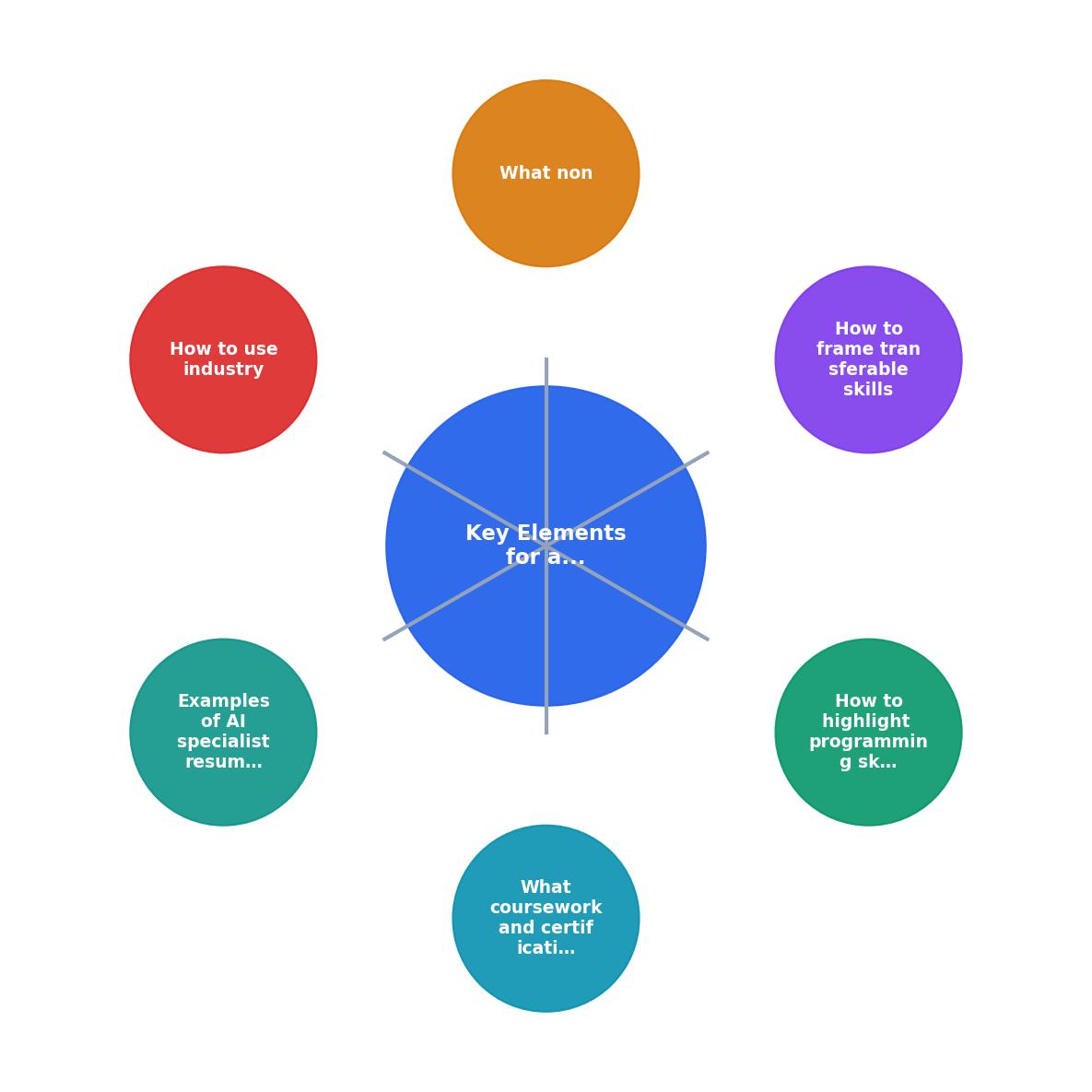
Follow this order for maximum impact:
- Header: Name, email, phone, LinkedIn, GitHub. Keep it clean and modern.
- Professional Summary (2-3 lines): "AI specialist with 5 years operations experience + Google Cloud ML certification. Expertise in predictive modeling, Python, and A/B testing. Seeking roles in fintech or supply chain optimization."
- Skills (organized by category): Programming (Python, SQL, R), ML Frameworks (TensorFlow, scikit-learn), Cloud (AWS, GCP), Tools (Jupyter, Git, Docker).
- Certifications: List prominently. Include dates and credential IDs.
- Professional Experience: Reframed with AI language and quantified results.
- Projects: 2-3 standout projects with tech stack and impact.
- Education: Degree, graduation date. If relevant coursework exists, list it.
Real AI Specialist Resume Examples
"Cut LLM inference cost per user 41% across 14 features.">, 14 AI Specialist Resume Examples & Guide for 2026
This example shows the kind of impact-driven language you want. Here's a breakdown of what makes strong AI specialist resumes:
Example 1: Career Changer from Operations- Emphasizes statistical analysis and process optimization from previous role.
- Leads with Google Cloud ML certification.
- Includes one real bootcamp project with measurable results.
- Reframes "process improvement" work as "predictive modeling and optimization."
- Strong certifications (Andrew Ng's Specialization, AWS ML).
- 3 Kaggle projects with rankings.
- GitHub link with clean README files.
- Relevant coursework listed explicitly.
- Includes freelance consulting project analyzing data for local small business.
- Deep domain expertise highlighted upfront.
- Technical skills (Python, TensorFlow, statistical analysis) proven through projects.
- Previous role reframed: "Risk analyst" becomes "Built quantitative risk models and time-series forecasts."
- Includes open-source contribution to financial ML library.
Using Industry Keywords Effectively

Keywords are your resume's oxygen in an ATS-dominated hiring process. But there's a balance: use them strategically, not desperately.
Keyword placement hierarchy (most to least important):
- Job title or professional summary
- Skills section
- Certifications
- Project descriptions and bullet points
- Education
Avoid these keyword mistakes:
"Proficient in machine learning, deep learning, neural networks, TensorFlow, Keras, scikit-learn, XGBoost, LightGBM, statistical modeling, predictive analytics, and artificial intelligence."(Spam. Contradicts your credibility.)- ✓ "Machine Learning: Python, TensorFlow, scikit-learn. Statistical Analysis: hypothesis testing, A/B testing, time-series forecasting."
Key Takeaway
The Core Truth
Your AI resume isn't about listing skills; it's about proving you can apply them. Show specific projects, use precise keywords, and translate your background into AI language. That combination gets past the ATS and convinces hiring managers.
AI Specialist Resume Checklist
Your progress is saved automatically in your browser.
FAQ
Frequently Asked Questions
Your AI specialist resume is your first impression on hiring managers and ATS systems. Build it to survive scanning and reward attention: prove every claim with a project, use precise keywords, and frame your transferable skills in AI language. The resume isn't just a list of what you know; it's proof you can apply it.
Additional Resources
- 14 AI Specialist Resume Examples & Guide for 2026 - Emphasize key AI skills such as LLMs, RAG, MLOps, Python, and responsible AI. •Showcase Your Projects: Include specific AI projects you've worked on,
- How to format your resume for AI screening - How to format your resume for AI screening · 1. Read the job application instructions carefully · 2. Keep formatting simple and clean · 3. Use keywords from the ...
- How to Write an Artificial Intelligence Resume (Step by ... - Artificial intelligence resume writing includes choosing a relevant template, adding a summary and contact information, showcasing your AI ...
