
Most resume screening happens in seconds, and most of those seconds belong to an applicant tracking system, not a human. If your resume doesn't contain the exact keywords a company's ATS is looking for, it won't reach the hiring manager, no matter how qualified you are. Data analyst roles are particularly vulnerable to this problem because the field uses technical jargon, tool names, and methodology labels that vary wildly between companies and industries. This guide walks you through the most relevant keywords for a data analyst resume in 2026, why they matter, and how to place them strategically.
Photo by FreeBoilerGrants from Pexels
TL;DR
- Data analyst resumes need technical keywords (SQL, Python, Tableau, Power BI) and business-focused terms (data-driven decision making, stakeholder communication, KPI tracking).
- ATS systems scan for exact phrases; generic resumes fail to match job postings, so mirror language from the job description.
- Place keywords in your experience bullets, skills section, and summary; avoid keyword stuffing (unnatural lists fail both ATS and humans).
- Test your resume against the job description before submitting to catch missing terminology.
Why keyword matching matters right now
The ATS (applicant tracking system) is a gatekeeper. Most companies use it to auto-screen applications. The system looks for keywords that match the job posting. If your resume contains "SQL" but the posting says "Structured Query Language," the ATS might not recognize you as a match, even though you have the skill.
For data analysts, the stakes are higher than in many roles. You're competing against both career changers who've done boot camps and people with advanced degrees in statistics. The hiring manager will never see your resume if the ATS rejects it first.
In 2026, companies are increasingly using AI-enhanced screening tools that go beyond simple keyword matching. These tools evaluate context, relevance, and keyword density. That means your keywords need to be:
- Accurate, matched to what the job actually requires
- Contextual, used where they naturally fit the role and not stuffed into every sentence
- Consistent, repeated enough to show genuine expertise, not so much you sound like a bot
Common mistakes with keywords
Mistake 1: Using generic terms only. Phrases like "data analysis" and "analytics" appear in almost every job posting, but they're too broad. ATS tools weight specificity. "Developed Python scripts to automate ETL processes" beats "Experienced in data analysis."
Mistake 2: Ignoring the job posting language. If the job says "dashboard development," don't only say "data visualization." Use both. The ATS is looking for exact matches.
Mistake 3: Stuffing keywords without context. Your resume is read by humans too. A bullet point that reads "SQL, Python, Tableau, Power BI, data warehousing, ETL, machine learning, statistical analysis" looks spammy and doesn't tell them what you actually did.
Mistake 4: Forgetting soft skills and business terms. Technical keywords matter, but so do "stakeholder communication," "executive reporting," and "cross-functional collaboration." Data analysts spend as much time explaining findings as they do analyzing data.
Mistake 5: Not updating for the role level. Junior analyst resumes should emphasize learning tools and fundamentals (SQL queries, pivot tables, data cleaning). Senior analyst resumes should emphasize strategy, mentorship, and business impact.

Core technical keywords for data analysts
These are the tools and languages most frequently listed in 2026 data analyst job postings:
SQL and databases: SQL, T-SQL, MySQL, PostgreSQL, NoSQL, data warehousing, query optimization, database design, relational databases, data modeling
Business intelligence and visualization: Tableau, Power BI, Looker, QlikView, Google Data Studio, dashboarding, data visualization, reporting, interactive reports, KPI dashboards
Programming languages: Python, R, VBA, Excel macros, JavaScript (increasingly common for web-based analytics)
Data platforms: Google Analytics, Snowflake, BigQuery, Redshift, Databricks, Apache Spark, Hadoop
Methodologies and processes: ETL (extract, transform, load), data pipeline, data quality, data cleaning, A/B testing, statistical analysis, predictive modeling, hypothesis testing
Cloud platforms: AWS, Google Cloud Platform (GCP), Azure, cloud data warehouses
Spreadsheet and office tools: Advanced Excel, VLOOKUP, pivot tables, data validation, Excel automation
Business and soft skill keywords
Don't ignore the business side. These keywords often appear in postings but are overlooked by job seekers focused only on tools:
- Stakeholder management
- Business requirements gathering
- Data-driven decision making
- KPI tracking and reporting
- Executive presentations
- Cross-functional collaboration
- Performance metrics analysis
- Root cause analysis
- Data storytelling
- Translating technical findings to non-technical audiences

Step-by-step: Keyword matching process
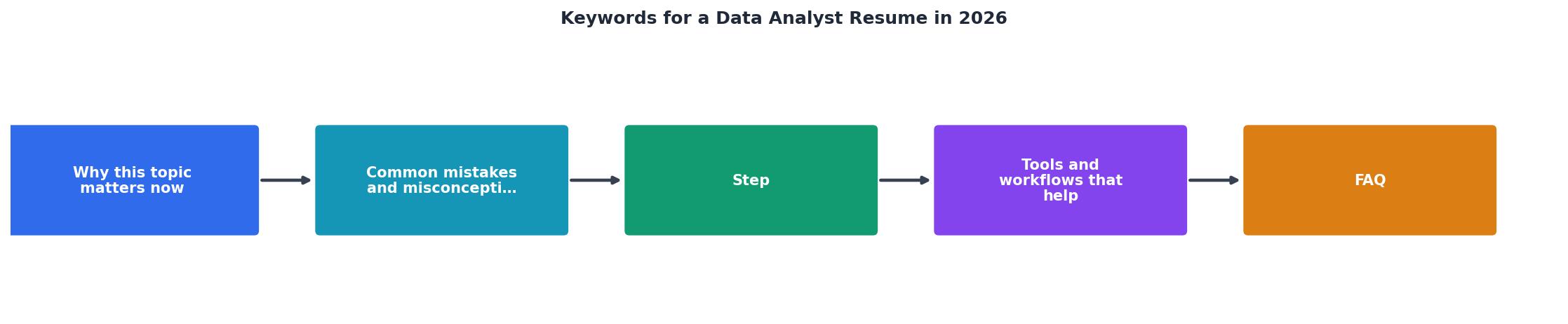
Step 1: Extract keywords from the job posting. Copy the full job description into a text editor. Highlight every tool, skill, methodology, and business term mentioned. Don't assume, actually read the posting thoroughly.
Step 2: Categorize by frequency and emphasis. If "Tableau" appears three times, it's critical. If "Python" appears once in a parenthetical note, it's nice-to-have.
Step 3: Identify gaps in your current resume. Which keywords from the posting don't appear in your resume? Can you legitimately add them?
Step 4: Rewrite bullets with keywords. Instead of "Analyzed data," write "Analyzed customer churn data using SQL and Python to identify retention drivers, reducing churn by 12%."
Step 5: Distribute keywords naturally. Place technical keywords in the experience bullets where you actually used them. Put the full list of tools in a dedicated skills section.
Step 6: Test the match. Read your resume against the posting one more time. Could an ATS reasonably match 70% of key requirements?
Tools and workflows that help
Resume optimization tools:- Jobscan, Uploads your resume and job posting, scores keyword match, highlights missing terms.
- Resumeworded, AI-powered resume scanner that simulates ATS screening.
- ChatGPT or Claude, Paste the job posting and ask: "What are the 15 most important keywords in this posting?" Then ask: "Rewrite this bullet point to include [keyword] naturally."
2026 Data Analyst Keyword Categories
This interactive breakdown shows how keywords organize into categories, use it to audit your resume and ensure you're covering tools, platforms, and business language.
| Generic Bullet | Keyword-Optimized Bullet |
|---|---|
| Performed data analysis to understand customer behavior. | Analyzed customer behavior data using SQL and Tableau to identify high-value segments, increasing marketing ROI by 18%. |
| Responsible for reporting. | Built 12+ executive dashboards in Power BI, automating monthly reporting and saving the team 8 hours weekly. |
| Used Python for various tasks. | Developed Python scripts to automate ETL pipelines, reducing data processing time from 6 hours to 45 minutes daily. |
| Supported the sales team with data. | Provided stakeholder-facing analysis to the sales team, identifying upsell opportunities that generated $240K in new revenue. |
Notice the difference? The optimized version includes specific tools, metrics, and business impact. An ATS scans both versions, but only the second one has the keywords the posting is likely looking for.

What a strong data analyst resume looks like in 2026
Here's a real example of how keywords work together:
"Data analyst with one year of internship experience and a portfolio of four published Tableau dashboards.">, Medium
That opening tells you a lot: specific tool (Tableau), quantified output (four dashboards), and demonstrated experience. A hiring manager reads that and knows immediately what you can do. An ATS reads it and finds matches for Tableau, data analysis, dashboard, and internship.
A strong data analyst resume includes:
- A summary or headline that names your key tools and competency level (e.g., "Data Analyst proficient in SQL, Python, and Tableau with 3+ years of experience building dashboards and automating reporting processes")
- Experience bullets that pair action verbs with specific tools and business outcomes (e.g., "Developed predictive models in Python to forecast quarterly sales, improving forecast accuracy by 22%")
- A skills section organized by category: Languages, Tools, Databases, Methodologies, Business Skills
- Relevant projects or portfolio if you have them (especially for career changers or new grads)
- Metrics and impact wherever possible, not just what you did, but what difference it made
Action checklist
Resume Keyword Optimization Checklist
Your progress is saved automatically in your browser.
FAQ
Frequently Asked Questions
The resume that gets past the ATS isn't the one that lists every skill you've ever learned. It's the one that speaks the language of the job you're applying for. Spend the time matching keywords to the posting, rewrite your bullets with specificity and impact, and watch your callback rate improve. If you're spending hours on applications but hearing nothing back, keyword misalignment is often the silent culprit.
Additional Resources
- How To Use Data Analyst Resume Keywords (With Example) - 6 data analyst resume keywords · 1. Technical abilities · 2. Software knowledge · 3. Industry certifications · 4. Market-specific terminology · 5.
- Data Analyst Resume Examples (2026) — Full Sample, ... - A job description asking for “SQL, Python, Tableau, and A/B testing” translates into a filter; MySQL, T-SQL, BigQuery SQL, Snowflake SQL Python
- Data Analyst Resume Examples for 2026 (With Real Bullet ... - Data Analyst Resume Keywords: The Exact Terms ATS Systems Match; Data Analyst Resume Summary Examples; Data Analyst Resume Objective vs ...
