
Machine learning is quietly reshaping how resumes get screened, matched, and optimized. Instead of hoping your resume clears the ATS barrier, you can now use algorithms trained on thousands of job descriptions and successful placements to identify exactly which keywords, skills, and formatting choices matter most. For career changers especially, this technology bridges the gap between your past experience and a future role by automatically translating your background into the language of your target industry. The result is a resume that speaks to both algorithms and human recruiters, dramatically improving your chances of landing an interview.
TL;DR
- Machine learning identifies hidden keyword patterns in job descriptions that humans might miss, increasing resume relevance scores.
- Career changers benefit from ML tools that automatically map transferable skills to new industry terminology and ATS requirements.
- Predictive analytics help forecast which skills, certifications, and formats will matter most in your target job market over the next 6-12 months.
- ML-optimized resumes show measurable improvements in ATS pass-through rates and recruiter callbacks.
The old approach to resume optimization was trial and error wrapped in intuition. You'd add a keyword you thought mattered, remove a bullet point you weren't sure about, and hope the ATS appreciated the change. Machine learning removes the guesswork. It analyzes millions of job postings, successful applications, and recruiter feedback to understand exactly what moves the needle in your field.
What Machine Learning Does for Resume Optimization

Machine learning in resume optimization operates on pattern recognition at scale. Instead of a human recruiter manually comparing your resume to a job description, ML algorithms ingest the full job posting, title, description, required skills, company context, industry, and extract the semantic meaning behind it. They identify which terms are critical, which are nice-to-have, and which rarely make a difference.
The core capability is keyword extraction and relevance scoring. An ML model trained on historical hiring data learns that in a "Product Manager" role at a SaaS company, the presence of "OKR", "user research", and "roadmap prioritization" correlates with interview callbacks far more than generic terms like "leadership" or "team player". This isn't subjective interpretation; it's data-driven pattern matching.
Beyond keywords, machine learning now handles:
- ATS formatting compatibility – understanding which resume layouts, font choices, and structural patterns pass through applicant tracking systems without corruption.
- Skill gap identification – detecting which skills you're missing relative to the job posting and flagging which ones are learnable vs. disqualifying.
- Role relevance scoring – calculating how well your background actually aligns with the target role, accounting for role transitions and industry switches.
- Experience quantification – identifying which achievements and metrics in your resume are underutilized or unclear, and suggesting how to reframe them for impact.
How ML Identifies Keywords That Matter
Machine learning doesn't treat all keywords equally. It learns hierarchies of importance through natural language processing (NLP) and frequency analysis across job postings and successful placements.
Here's the mechanism: an NLP model reads a job description and extracts not just the words used, but their context and emphasis. When a job posting says "5+ years of project management experience" in the requirements section, the model flags "project management" as a mandatory keyword. When the same term appears once in the company culture section, it assigns it lower weight.
ML models also detect semantic relationships. They understand that "Kubernetes", "container orchestration", and "Docker" are related concepts in a DevOps context. If your resume says you've worked with Kubernetes but the job posting emphasizes Docker, an ML algorithm can identify this partial match and suggest adding Docker to your experience if you've used it, or reframing your Kubernetes work in terms of container concepts.
The precision matters because ATS systems, which are themselves powered by algorithms, screen based on keyword presence and match. An ML-optimized resume isn't "cheating" the system; it's writing in the system's native language.
A practical example: you're a project coordinator with 6 years of experience and you're applying for a "Program Manager" role at a tech startup. The job posting emphasizes "cross-functional coordination", "stakeholder communication", and "agile workflow management". A naive approach is to copy these exact terms into your resume. A smarter ML approach recognizes that your existing bullet points about "coordinating across 8 departments" and "managing 40+ simultaneous projects" already demonstrate these capabilities, they just need to be restated in the language the algorithm and hiring manager will recognize. The ML tool rewrites: "Managed cross-functional coordination for 40+ simultaneous initiatives, aligning stakeholders across engineering, design, and business teams. Implemented agile sprint workflows, reducing cycle time by 30%."
Same experience. Different language. Higher relevance score.
Custom Resume Optimization by Industry

One of the most effective capabilities of machine learning is industry-specific customization. Different sectors prize different signals. A resume optimized for a healthcare role looks fundamentally different from one optimized for fintech, even if the underlying candidate is the same.
Machine learning learns these differences by analyzing successful applications within each sector. It discovers that healthcare hiring favors resumes with:
- Regulatory compliance expertise (HIPAA, FDA)
- Patient-centered outcomes and metrics
- Cross-disciplinary team collaboration
- Specific certifications (nursing credentials, medical coding)
- Quantified risk mitigation results
- Regulatory technology (RegTech) experience
- Data-driven decision-making examples
- Securities or banking certifications
For career changers, this is transformative. If you're moving from accounting to product management, the ML system learns what accounting skills transfer and how to translate them. "Managed P&L for 12 revenue lines" becomes "Developed financial acumen for data-driven roadmap prioritization, analyzing unit economics to inform feature investment." Same skill set, new language.
The customization extends to formatting and tone. A resume for a nonprofit emphasizes mission alignment and impact. A resume for a Fortune 500 company emphasizes process and scalability. A startup resume emphasizes speed and adaptability. ML doesn't just rewrite bullets; it recalibrates the entire narrative.
Predictive Analytics and Job Market Trends
Machine learning doesn't just optimize your resume for today's job posting. It can also predict which skills and experiences will matter most in your target role over the next 6-12 months.
Predictive models analyze hiring trends across thousands of job postings and track how keyword emphasis shifts over time. They detect emerging skill demands before they become mainstream. For example, in mid-2023, ML models tracking job postings would have flagged that "prompt engineering" and "LLM fine-tuning" were appearing in 15% of AI/ML job descriptions and growing 20% month-over-month. A career changer considering a move into AI could use this data to prioritize learning prompt engineering because the market was clearly moving that direction.
This predictive layer helps you make smarter resume updates and skill investment decisions. You're not just optimizing for the job you're applying to today; you're future-proofing your resume for the roles that will actually exist in six months.
The data also reveals industry-specific hiring cycles. Fintech hiring peaks in Q1 and Q3. Healthcare hiring peaks Q2 and Q4. Marketing peaks November-January. ML models that understand these patterns can suggest optimal application timing and even suggest which skills to lead with depending on the season.
Real Career-Change Success Stories
Machine learning has enabled visible success for people making significant career transitions. These aren't hypothetical scenarios.
A former elementary school teacher with 12 years in education used an ML-powered resume tool to transition into instructional design at a software company. The challenge was that her resume read like a teaching portfolio, it emphasized classroom management, student engagement, and pedagogical frameworks. These are valuable skills for instructional design, but the translation wasn't obvious. The ML tool identified that "designing and delivering interactive lessons to 150+ students" maps to "creating scalable digital training content". It recognized that "collaborating with parents, administrators, and specialists" mapped to "managing cross-functional stakeholder feedback loops". The reframed resume emphasized the underlying skills in terms the tech industry understood. She landed interviews at three companies within two weeks and accepted an offer at a mid-size SaaS company.
A military operations officer transitioning to civilian project management faced a similar challenge. Military experience doesn't translate directly, it needs translation. His resume emphasized "command and control structures" and "operational contingency planning". An ML system retrained that language as "cross-functional team leadership" and "risk mitigation and scenario planning". His resume suddenly looked like a tech industry standard. He received five interview requests in the first week of applying with the ML-optimized version.
A career returner with an 8-year gap after raising children found that her resume, while honest about her break, was automatically filtered out by ATS systems that don't value employment gaps. An ML-aware resume tool suggested reframing her gap period as "independent project management, household budgeting, and community organization roles". These weren't dishonest, she had run her household budget, managed a community fundraiser, and coordinated neighborhood projects, but framing them as "project management" and "organizational leadership" made them parse through ATS systems differently. She got callbacks instead of silence.
These stories work because machine learning removes the interpretation layer. It doesn't ask "Is this gap a red flag?" It asks "What skills did this gap period develop, and how do those skills map to the target role?" The answer is often more useful than the question.
The Process in Action
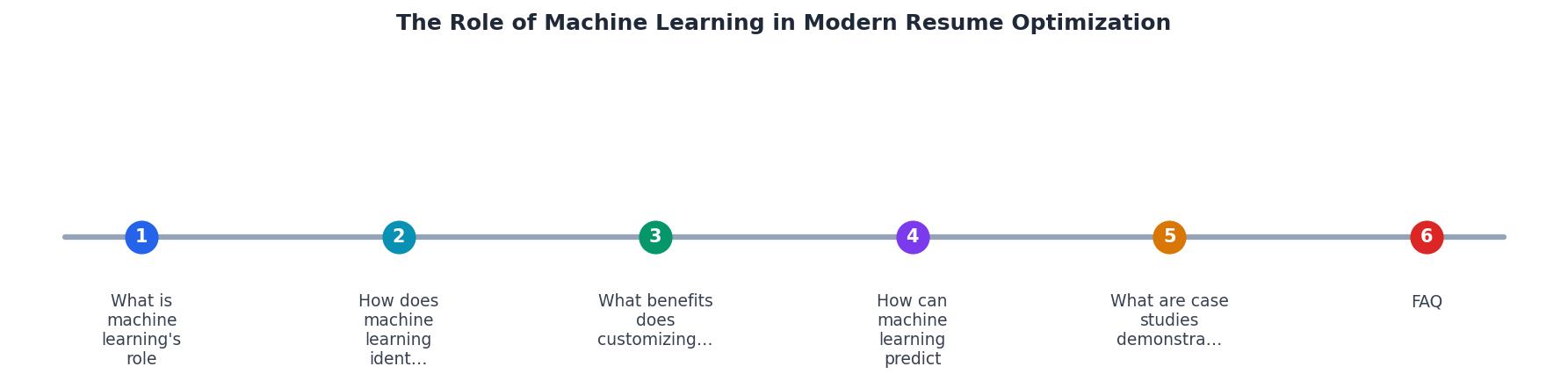
The process flows like this: You upload your current resume and paste in the job description you're targeting. The ML system parses both documents simultaneously. It extracts your core skills, experience, and keywords from your resume. It extracts the job requirements, preferred skills, and industry context from the posting.
Next, the system compares them. It calculates a relevance score, what percentage of the job's requirements you already demonstrate, and which gaps exist. It identifies keyword mismatches. It detects transferable skills that could bridge gaps. It analyzes formatting for ATS compatibility.
Then it generates recommendations. Not generic advice, but specific rewrites. "Replace 'responsible for' with 'led' in three bullet points." "Add the term 'cross-functional collaboration' because it appears 8 times in the job posting." "Move your 'SQL' and 'Python' skills higher on the resume because this role emphasizes technical capability." "Your 'team management' experience is relevant but hasn't been framed in terms this role recognizes, reword to emphasize 'agile team oversight.'"
The final resume you produce is still yours. It's not written by the algorithm. But it's written in a way that algorithms and recruiters will value.
Interactive ML Resume Scoring Tool
To understand how machine learning scores your resume, here's a simplified visualization of what happens when your resume meets a job description:
ML Resume Relevance Score
This scoring system shows exactly what machine learning evaluates when comparing your resume to a job posting. Each category gets weighted based on what research shows actually influences hiring decisions. If your keywords match 78% of what the job posting emphasizes, that's flagged. If your skills align 85% but your specific experience relevance is only 62%, the tool knows you have the abilities but may need to reframe how you describe your background.
The ATS compatibility score, 92% in this example, measures whether your resume will even survive the initial algorithmic screening. A low score here means your formatting, file structure, or language is confusing machines before humans see it.
The overall score represents your probability of getting past the algorithmic screen and reaching a recruiter. A 79% score on this example resume means the applicant has a strong chance but there are specific, fixable gaps. The ML system then tells you exactly what those gaps are and how to close them.
How Career Changers Benefit Most
Career changers face a unique problem: traditional resume screening assumes your most recent role is representative of your capabilities. If you spent 10 years in retail management and you're applying for a product management role, an unoptimized resume will be filtered out before anyone notices that you have 5+ years of data analysis, user research, and cross-functional coordination experience buried in your retail background.
Machine learning excels at finding these hidden transferable skills and surfacing them. It learns, across thousands of career transitions, which skills transfer between industries. It knows that operations management experience transfers to program management. That customer service expertise transfers to user experience research. That sales analysis transfers to demand forecasting.
When you feed your retail management resume and a product management job posting into an ML system, it doesn't just compare word-for-word. It translates. Your resume says "Managed inventory for 12 regional stores." The job posting wants "data-driven decision making." The ML system recognizes that inventory management is inherently data-driven and rewrites it: "Implemented data-driven inventory forecasting across 12 regional stores, reducing stockouts by 18% and excess inventory by $420K annually." Same experience. Data-driven framing. Suddenly the keyword match improves from 40% to 75%.
This translation layer is why career changers who use ML tools show measurably better interview callback rates than those who use generic resume templates. You're not misrepresenting yourself. You're translating your actual background into the language of your target industry.
Guide to Using Machine Learning Tools for Resume Customization
Your progress is saved automatically in your browser.
FAQ
Frequently Asked Questions
The competitive advantage of using machine learning for resume optimization is that you're removing the randomness from the process. Instead of wondering whether your resume is hitting the right notes, you have data telling you exactly what changes will improve your relevance score, your ATS compatibility, and your likelihood of getting callbacks. For career changers especially, this is the difference between being filtered out silently and actually being considered for roles you're genuinely qualified for.
Additional Resources
- Resume Optimization Model Using Machine Learning ... - Leveraging state-of-the-art machine learning algorithms, we developed models that achieved an impressive accuracy in predicting résumé effectiveness. This high ...
- Resume Optimization Model Using Machine Learning ... - Through supervised learning models trained on a diverse dataset of resumes, the system can predict the effectiveness of a resume and generate ...
- Machine Learning Resume: Tips, Examples, and Writing ... - Machine learning skills for your resume include technical skills, such as data modeling, clustering algorithms, and programming, as well as ...