
You spent three years teaching, two years in nonprofit management, and now you want to break into UX research. Your resume looks like a random walk through unrelated industries, and every recruiter seems to want a straight line from degree to current role. The good news is that a non-linear career path is not a liability when you know how to present it. With the right structure, language, and framing, those varied experiences become your strongest selling point.
Photo by Sabir Khan Shourov from Pexels
TL;DR:- Identify transferable skills across your varied roles and translate them into the language of your target field.
- Build a personal brand statement that ties your diverse experiences into a single, compelling narrative.
- Use a hybrid resume format that leads with skills and achievements rather than a chronological job list.
- Tools like Resume Hedgehog can help you match your non-linear background to specific job descriptions automatically.
Why Skill Diversity Wins

Hiring managers in 2026 increasingly value skill diversity over narrow specialization. Someone who has worked across industries brings cross-pollinated thinking, adaptability, and a broader problem-solving toolkit. A product manager who previously worked in healthcare and logistics sees user pain points that a career-long PM might miss entirely.
Here is what skill diversity looks like in practice:
- Cross-functional communication from working with different teams, clients, and stakeholders across industries.
- Rapid learning ability demonstrated by successfully transitioning between fields.
- Creative problem-solving drawn from applying methods from one domain to challenges in another.
- Resilience and adaptability proven by thriving in unfamiliar environments.
Unify Experiences With Personal Branding
A personal brand is not a logo or a tagline. It is the one-sentence answer to "What do you do and why should I care?" For someone with a non-linear path, this sentence is the thread that connects everything.
Consider these examples:
- Former journalist turned data analyst: "I find stories in data and communicate insights that drive decisions."
- Ex-military logistics officer moving into supply chain management: "I optimize complex operations under pressure, whether the cargo is ammunition or consumer electronics."
- Teacher transitioning to corporate training: "I design learning experiences that stick, for classrooms of 30 or teams of 300."
Your LinkedIn headline, cover letter opening, and elevator pitch should echo the same message. Consistency across platforms reinforces the narrative and makes recruiters remember you.
Structure That Highlights Achievements

The standard reverse-chronological resume format works against non-linear career paths. When a recruiter scans top-to-bottom and sees "Barista, 2022" followed by "Marketing Coordinator, 2020," the zigzag is the first thing they notice.
A hybrid (combination) resume fixes this. It leads with a skills-based section, then follows with a brief work history. The structure looks like this:
- Professional Summary (your brand statement, 2-3 sentences)
- Core Competencies (6-9 skills matched to the job description)
- Selected Achievements (3-5 bullet points with metrics, pulled from any role)
- Professional Experience (job titles, companies, dates, brief descriptions)
- Education & Certifications
""Led a team of 10, increasing productivity by 20% through streamlined workflows.".">, Navigating Non
That bullet point works whether it came from a restaurant, a startup, or a school district. The achievement speaks for itself.
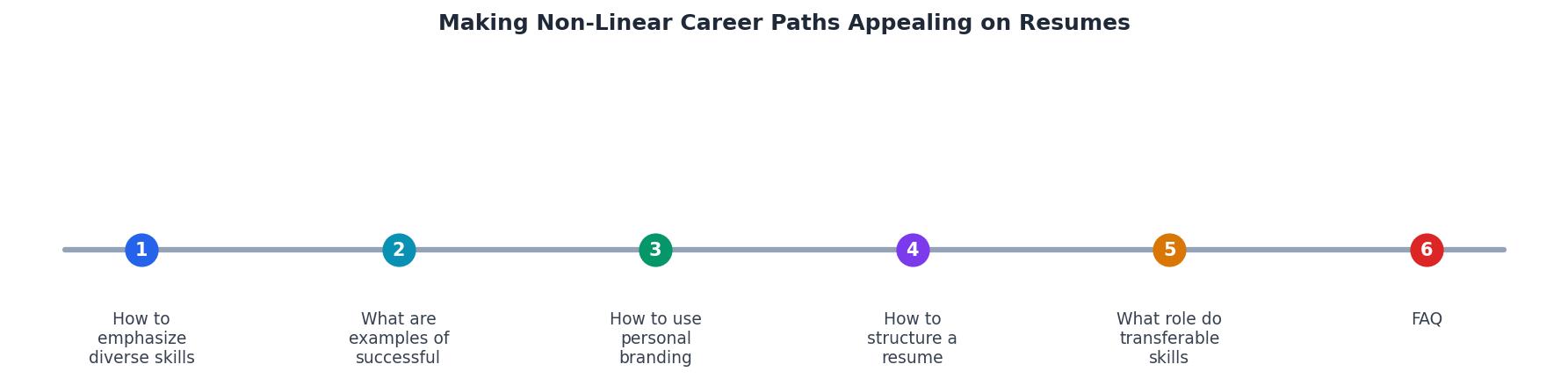
The diagram above shows the flow: Audit Skills, Build Brand Statement, Choose Hybrid Format, Match to Job Description, and Quantify Achievements. Each step feeds the next. Skip the audit and your brand statement will be vague. Skip the matching and your resume will not pass ATS filters.
Transferable Skills Are the Bridge
Transferable skills are capabilities that apply across industries and roles. They are the reason a non-linear path can be an advantage rather than a red flag.
Here is a breakdown of common transferable skills and where they show up:
| Skill | Example From Non-Traditional Role | How It Applies to Target Role |
|---|---|---|
| Project Management | Coordinated a school fundraiser with 15 volunteers and a $5K budget | Manages product launches with cross-functional teams |
| Data Analysis | Tracked restaurant inventory and reduced waste by 12% | Analyzes customer data to inform business decisions |
| Stakeholder Communication | Presented quarterly reports to nonprofit board members | Delivers client presentations and status updates |
| Training & Development | Onboarded 20+ new hires at a retail chain | Designs employee training programs |
| Budget Management | Managed a $50K annual program budget for a community org | Oversees departmental budgets and forecasting |
The trick is translating the language. Every industry has its own vocabulary. A teacher calls it "differentiated instruction." A corporate trainer calls it "personalized learning paths." A UX designer calls it "user-centered design." Same underlying skill, different words. Your resume needs to use the words from the job posting, not the words from your old career.
This is where tools like Resume Hedgehog save hours. Upload your existing resume, paste the job description, and the AI identifies which of your experiences match the target role's requirements and rewrites them in the right terminology.
Real Examples That Work
Let's look at two before-and-after scenarios.
Scenario 1: Hospitality to Project Management
Managed daily restaurant operations and staff schedulingbecomes "Coordinated daily operations for a 25-person team, maintaining 98% on-time service delivery across 200+ daily customers."Handled customer complaintsbecomes "Resolved escalated client issues, achieving a 4.8/5 satisfaction rating on Google Reviews."
Supervised a platoon of 40 soldiersbecomes "Led a 40-person team through high-stakes operational environments, maintaining zero safety incidents over 18 months."Managed equipment logisticsbecomes "Oversaw a $2M equipment inventory with 99.5% accountability rate, implementing tracking systems that reduced loss by 30%."
Here is an example dashboard showing how a non-linear resume can score when properly optimized for a target role:
Optimized Non-Linear Resume Score
The dashboard above illustrates a typical outcome when a career changer restructures their resume using the hybrid format and translates their skills into the target field's language. Notice that overall ATS compatibility can reach 91% even with zero direct experience in the new field.
Non-Linear Resume Optimization Checklist
Your progress is saved automatically in your browser.
FAQ
Frequently Asked Questions
What is the one role from your past that you think would surprise a hiring manager in your target field? Share it below and let's figure out how to reframe it.
Additional Resources
- Navigating Non-Linear Career Paths: How to Showcase ... - 1. Start with Your Story · 2. Turn Transferable Skills into Superpowers · 3. Show Impact, Not Just Job Titles · 4. Choose the Right Resume Format.
- Are Nonlinear Career Paths the New Normal? 5 Ways You ... - A nonlinear career path is a career trajectory that is not limited to vertical growth. Keep an Open Mind and Open Door. For example, you could ...
- Your career path doesn't have to be linear (I'm living proof ... - Career paths aren't ladders anymore—they're lattices, full of twists, turns, and unexpected opportunities. As a career coach and resume writer, ...
