
Photo by Vitaly Gariev from Pexels
Employers say they want experience, but what they really want is proof you can do the job. The gap between "lacking direct experience" and "being unqualified" is wider than most job seekers realize. You're not competing by checking boxes on a job description, you're competing by showing you've solved similar problems, even if the context was different. This article shows you how to reframe what you've already done so hiring managers see capability, not just history.
TL;DR
- Transferable skills, problem-solving, project management, communication, learning agility, apply across industries and roles, even without job titles that match.
- Projects, volunteer work, and freelance gigs count as real experience; highlight measurable outcomes and specific results, not just activities.
- Reframe your narrative: connect past achievements to the target role's language, keywords, and pain points using the job description as your translation guide.
- Use case studies and expert guidance to articulate how your non-traditional path is actually an asset, not a liability.
Why employers emphasize direct experience, and why it's not the whole story
Direct experience means you've held a job title that matches the one you're applying for. It's the default filter. Hiring managers use it because it's fast: "Did you do this before? Yes or no." The problem is that this filter is lazy and expensive. Companies miss talented people who can do the work but lack the label.
That 67% number matters because it shows the bias is real. But here's what the other 33% know: experience is a proxy for capability. If you can show the capability directly, the job title becomes irrelevant.
"On this week's episode of the From Dorms to Desks Podcast, we discuss how employers almost always prefer to hire candidates with experience, even for roles that they consider to be entry-level.">, 4 strategies for overcoming a lack of experience in your job search
The bias exists. What you do about it on your resume determines whether you get past the ATS and into human hands.
How to identify and showcase transferable skills
Transferable skills are the abilities that cross industry and role lines. Problem-solving, communication, project coordination, data analysis, customer empathy, these aren't tied to one job title. But most people list them as vague adjectives ("excellent communicator") instead of hard proof.

Start here: pull the target job description and look for the actual problems the role needs to solve. A product manager job description might say "drives alignment across teams" or "owns the roadmap from concept to launch." Those aren't job-title-specific needs, they're outputs.
Now look at your own history. Where have you done similar work, even in a completely different context?
- Taught a class? You've owned a roadmap, managed stakeholder expectations, and iterated based on feedback.
- Ran a nonprofit fundraiser? You've aligned teams (volunteers, board members, donors), prioritized limited resources, and measured impact.
- Switched careers after a five-year break? You've learned a complex domain quickly, adapted to new tools, and proved you can ramp up.
Common transferable skills worth emphasizing:
- Process improvement: Identified bottlenecks, redesigned workflows, measured results.
- Cross-functional leadership: Coordinated people without direct authority, built buy-in.
- Rapid learning: Mastered new software, industry knowledge, or domain in weeks or months.
- Communication: Translated technical concepts for non-technical audiences, or vice versa.
- Project delivery: Owned timelines, budgets, dependencies, and outcomes.
- Data literacy: Interpreted metrics, made decisions based on evidence, tracked KPIs.
Projects and volunteer work: building proof outside traditional employment
Direct employment isn't the only way to build credible experience. Projects, volunteer work, freelance gigs, and side work count, but only if you present them with measurable outcomes.

Personal projects show you can own something from concept to execution. If you built a tool, designed a website, or created a system, that's real proof of capability. Include a link if you can, let hiring managers see the work, not just your claim.
A junior developer showing a GitHub portfolio of real projects is stronger than someone with a job title but no code to show. A career changer who built a project management system for a local nonprofit demonstrates the skills they're claiming better than someone who only listed responsibilities.
Volunteer work is underused on resumes. If you ran a nonprofit's social media, fundraising, or operations, those are legitimate roles. Frame them with the same rigor as paid work: scope, timeline, outcome, impact.
Example: Instead of "Managed social media for local nonprofit," try "Built social media strategy for nonprofit serving 200+ families, grew Instagram from 0 to 2,500 followers in 6 months, increased event registrations by 40%." Same work, but now the hiring manager sees scale and measurable results.
Freelance or contract work fills gaps and shows you can operate independently. If you've invoiced for work, shipped deliverables, managed your own clients, that's entrepreneurial proof. It counts on your resume.
That 72% tells you it works, but only if you present it professionally. Treat freelance projects like jobs. Include the client context, the problem you solved, and the measurable outcome.
The case for non-traditional paths as competitive advantages
Career changes, gaps, and unconventional backgrounds feel like liabilities on a resume. They're not. They're proof of adaptability, learning agility, and resilience, exactly what employers claim to want but rarely see.

A teacher moving to instructional design isn't starting from zero. They've designed curriculum, managed learning outcomes, worked with diverse learners, and iterated based on feedback. Those are the core skills of instructional design. The job title changed; the capability didn't.
Someone returning after parental leave isn't "rusty." They've managed complex systems (household logistics, competing priorities, on-the-fly problem-solving), learned new tools out of necessity, and maintained professional networks. That's maturity and self-direction.
A career-changer from military service to tech has already proven they can learn quickly under pressure, work within structured processes, and deliver results with high stakes. The acronyms are different; the discipline isn't.
The strongest resume doesn't hide these transitions, it highlights them. Frame the story:
- Why you changed: "Realized my passion was in X, not Y." (This shows intentionality, not flakiness.)
- What you retained: "My background in Y taught me [specific skill or mindset] that directly applies to X."
- What you've done to prepare: "Since deciding to transition, I've [completed project, learned tool, volunteered in the field, built relevant skills]."
Reframing your experience through the target role's lens
The gap between "I have experience" and "I have the right experience" is language.
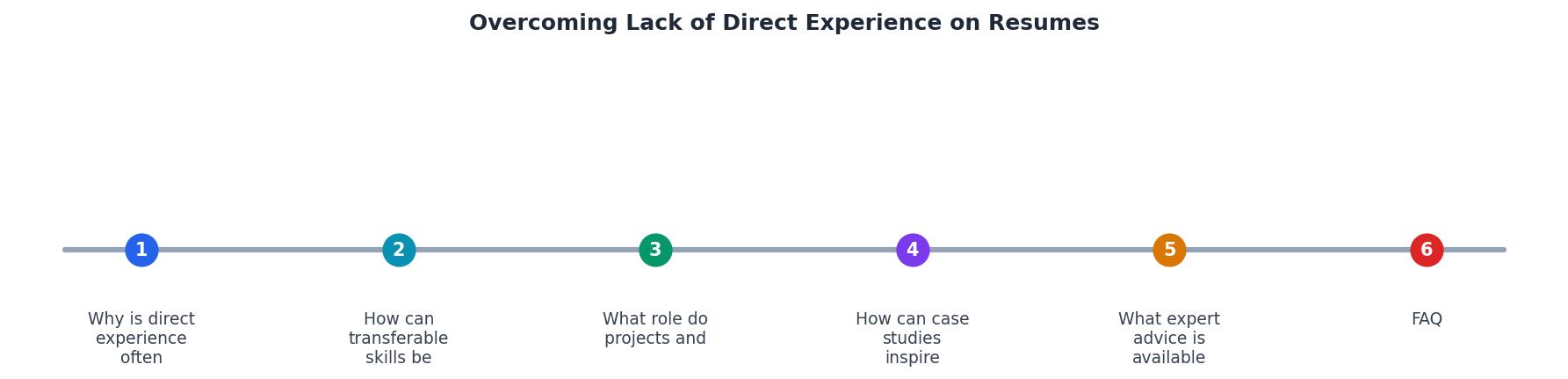
The process is straightforward: translate your experience into the target role's language.
Step 1: Extract the job description's keywords and requirements. Not just the job title, but the actual problems, tools, and outcomes they mention. A customer success manager job description might emphasize "reduces churn," "owns the customer relationship," "drives retention through strategic communication," and "uses Salesforce to track outcomes."
Step 2: Audit your experience for parallel outcomes. You didn't work in customer success, but did you reduce something? Did you own a relationship or process? Did you drive an outcome through communication? Did you use data to track results?
Step 3: Rewrite your achievement using their language. Don't say "Coordinated volunteer outreach." Say "Owned outreach strategy for 200+ households, resulting in 35% participation increase, similar to the retention metrics required in this customer success role."
You're not lying or exaggerating. You're translating what you've done into the frame the hiring manager uses. They screen for keywords because those keywords signal the specific problem they need solved. If you've solved that problem, say so, in their language.
Expert insights: how to frame the narrative
Career coaches and HR professionals consistently advise the same approach: own the narrative, don't apologize for it.
The worst resume for someone without direct experience is one that pretends the gap doesn't exist. The best one acknowledges it and demonstrates why it doesn't matter.
This means your resume should make the connection for the hiring manager. Don't assume they'll see that your teaching background proves you can project-manage, or that your nonprofit fundraising proves you can build relationships at scale. Tell them explicitly.
Use a summary or cover letter section to bridge the gap: "Bringing 5 years of project delivery and cross-functional leadership from education into [target role]. Core transferable skills: X, Y, Z. Actively [learning tool / completing project / working in the field] to deepen expertise."
Then back it up on the rest of the resume with specific examples that prove it.
How to present gaps and transitions without weakness
Resume gaps and career transitions are normal. The silence around them is what kills your candidacy.
Address them head-on. If you took time off, a brief explanation handles it: "Career break (2020–2022) to manage family needs; actively returned to [field] in [year], completed [project/course], and have been [working/volunteering] for [duration]."
This is not a liability statement. It's a facts statement. You're showing continuity and intentionality, not hiding and hoping they don't notice.
The same applies to job transitions. If you've switched industries, say why: "Transitioned from marketing to operations after recognizing a passion for process efficiency. Leveraged communication and project management from marketing background, added skills in [area], and have been delivering results in operations for [duration]."
Gaps and transitions are only red flags if you treat them as shameful. Frame them as strategic decisions or life circumstances, back them with current activity, and move on.
An interactive skills alignment tool
To make this process concrete, here's a visual tool for mapping your transferable skills to a target role. Think of this as your personal translator: it shows how experience from one context connects to requirements in another.
Your Skills → Target Role
This tool is meant to show you the pattern. Your teacher background isn't useless for a product manager role, it's a different entry point with the same core capability. Your career gap isn't a weakness, it's context for resilience. Your volunteer work isn't resume filler, it's proof of ownership.
Guide to Identifying and Showcasing Transferable Skills on Your Resume
Your progress is saved automatically in your browser.
FAQ
Frequently Asked Questions
The experience you have is stronger than you think. You've solved problems, learned quickly, managed complex situations, and delivered results. The only gap is the gap between how you've presented it and how the hiring manager needs to see it. Close that gap on your resume, and the experience suddenly becomes directly relevant. That's not hiding who you are, that's showing them exactly why you're the right choice for the job.
What's the biggest gap between your background and your target role? The answer to that question is usually where your strongest resume story lives.
Additional Resources
- 4 strategies for overcoming a lack of experience in your job ... - Second, include all relevant experience, such as volunteer work and academic projects, on resumes and in interviews. Third, showcase your ...
- How to Write a Resume With No Experience (2026 Guide ... - 1. Writing an "Objective" full of adjectives. · 2. Apologizing for lack of experience. · 3. Padding with irrelevant high school content past the ...
- 5 Steps to Land a New Job When You Lack Experience - Step 1: Overcome Lack of Work Experience · Step 2: Properly Construct Your Resume · Step 3: Write a Cover Letter that Tells Your Story · Step 4: ...
