
Sending out dozens of resumes and hearing nothing back is demoralizing, but the problem often is not your experience. It is that your resume reads like every other resume in the pile. A clear personal brand woven into your resume gives recruiters a reason to remember you and, more importantly, a reason to call you. This article walks through exactly how to build that brand into every section of your document so each application feels targeted, distinct, and worth a second look.
Photo by Anna Shvets from Pexels
TL;DR:- Personal branding on a resume means aligning your summary, skills, and achievements around a single professional identity rather than listing everything you have ever done.
- Highlight the unique combination of skills and results that only you bring to the table.
- Consistency across your resume, LinkedIn, and cover letter multiplies the effect.
What personal branding actually means
Forget the influencer connotation. On a resume, personal branding is the deliberate choice of which skills, achievements, and language you lead with so a hiring manager instantly understands what you do and why you are good at it. Think of it as a thesis statement for your career.
A generic resume says: "Experienced marketing professional with 7 years of experience." A branded resume says: "Growth marketer who turned three startups from zero organic traffic to 100K monthly visitors in under 18 months." Same person, completely different impression.
With recruiters spending roughly seven seconds on an initial scan, your brand has to land fast. That means the top third of your resume carries almost all the weight.
Align branding with career goals

Before you touch a single bullet point, answer two questions:
- What role am I targeting? Not a vague category like "marketing." A specific title: "Senior Product Marketing Manager at a B2B SaaS company."
- What is my unique angle for that role? The intersection of your strongest skills and the employer's biggest need.
Consistency across channels
Your LinkedIn headline, your portfolio tagline, and your resume summary should echo the same core message. Recruiters cross-reference. If your resume says "data-driven operations leader" but your LinkedIn says "passionate people person," the mixed signal costs you credibility.
Here is a quick consistency check:
- Resume summary states your brand in two to three sentences.
- LinkedIn headline mirrors the same positioning in under 120 characters.
- Cover letter opening reinforces the brand with a story or metric.
- Portfolio or personal site uses the same keywords and tone.
Only about 65% of job seekers maintain consistent branding across their resume and LinkedIn. The other 35% leave easy credibility on the table.
Practical steps for every section
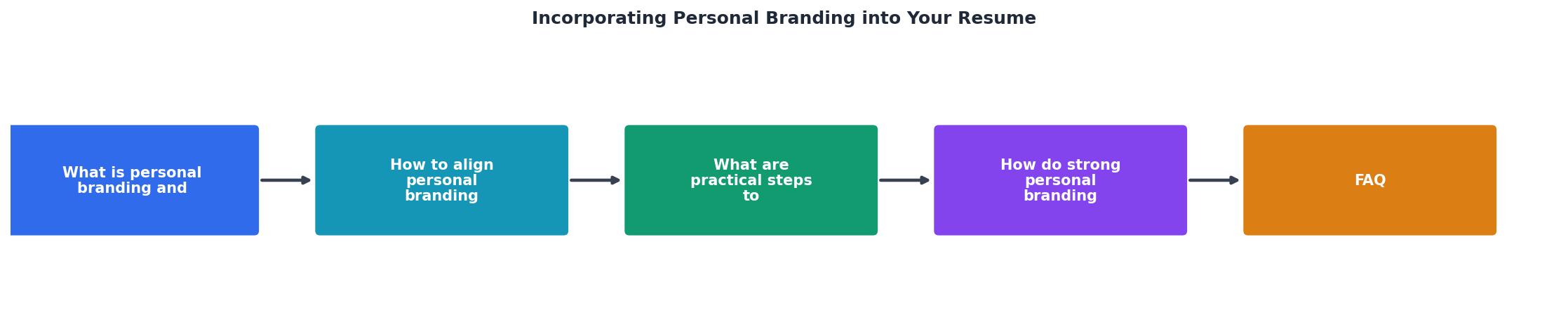
Here is how to work your brand into each part of the resume, following the steps in the diagram above: Define Brand, Audit Resume, Rewrite Summary, Update Skills, Quantify Achievements, and Review Consistency.
1. Define your brand statement
Write one sentence that captures your professional identity. Format: [Role descriptor] who [key achievement or skill] to [outcome].
Examples:- "Full-stack engineer who builds accessible web apps that reduce user drop-off by 30%+."
- "Operations analyst who automates reporting workflows, saving teams 15+ hours per week."
2. Audit your current resume
Print it out. Highlight every line that supports your brand statement in green. Highlight everything that does not in red. If more than a third is red, you have a focus problem.
3. Rewrite the summary
Your professional summary is the billboard. Keep it to three or four lines. Lead with the brand statement, follow with one or two supporting proof points, and close with what you are looking for.
"Results-oriented professional seeking new opportunities to leverage my skills."
That tells the reader nothing. Replace it with specifics:
"Growth marketer with 6 years scaling B2B SaaS products. Built and led a content team that grew organic pipeline from $0 to $2.4M ARR. Looking to bring that playbook to a Series B company ready to own its category."
4. Update the skills section
List only skills that reinforce your brand. If you are branding yourself as a data-driven marketer, "Google Analytics," "SQL," and "A/B testing" belong. "Microsoft Word" does not.
5. Quantify achievements
Numbers are the backbone of a branded resume. Every bullet in your experience section should follow the Action + Context + Result pattern:
- Action: Led, built, redesigned, automated
- Context: For whom, at what scale
- Result: Measurable outcome (%, $, time saved)
6. Review for consistency
Read the entire document top to bottom. Does every section point in the same direction? If your summary says "data-driven" but your bullets never mention a metric, the brand falls apart.
"The film incorporates elements of fantasy and science fiction.">, INCORPORATING definition
Just as a film weaves together different genres into a cohesive story, your resume should incorporate diverse experiences into a single, coherent professional narrative.
Strong branding examples

Let's look at two before-and-after snapshots.
| Generic Resume | Branded Resume |
|---|---|
| "Managed social media accounts" | "Grew Instagram from 2K to 85K followers in 10 months using data-backed content calendars" |
| "Responsible for sales targets" | "Exceeded quarterly quota by 140% three consecutive quarters, ranking #1 on a 22-person team" |
| "Worked on cross-functional projects" | "Led a 5-team integration after acquisition, cutting onboarding time from 6 weeks to 10 days" |
| Skills: "Communication, Leadership" | Skills: "Stakeholder Alignment, P&L Ownership, Post-Merger Integration" |
The branded column does three things the generic column does not: it names a specific scope, attaches a number, and uses language that matches the target role.
Candidates who present a clear, consistent brand on their resume report up to three times more interview callbacks compared to those sending generic applications.
The following card shows how a branded resume stacks up across the key dimensions recruiters evaluate during that initial scan.
Branded Resume Score Card (example)
Branding meets ATS optimization
A branded resume still needs to pass the Applicant Tracking System. The good news: branding and ATS optimization are not at odds. Both require you to use the exact language the employer uses in the job posting.
Here is the workflow:
- Copy the job description into a text file.
- Highlight repeated keywords and phrases.
- Map those keywords to your brand statement and experience bullets.
- Swap in the employer's terminology where it fits naturally.
Your branding checklist
Personal Branding Resume Checklist
Your progress is saved automatically in your browser.
FAQ
Frequently Asked Questions
What is the one sentence you would use to describe your professional brand? Drop it in the comments and let's workshop it together.
Additional Resources
- INCORPORATE Definition & Meaning - The meaning of INCORPORATE is to unite or work into something already existent so as to form an indistinguishable whole.
- INCORPORATING definition | Cambridge English Dictionary - to include something as part of something larger: When a company incorporates, the articles of incorporation state how many shares are authorized and can be ...
- Incorporate.com - Start and manage your business with Incorporate.com. Get expert help so you can launch, stay compliant, and focus on growth while we handle the paperwork.
