

You spent four years earning a degree, and now your resume is a single page with two internships and a group project. Sending that thin document into the void of online job portals creates a specific kind of dread that no career services workshop fully prepares you for. Optimizing that resume does more than improve your callback rate. It rewires how you feel about the entire job search.
TL;DR:- Optimizing an entry-level resume reduces job search anxiety by giving you a clear, structured document you actually trust.
- The process itself forces you to recognize skills and achievements you overlooked, which directly boosts confidence.
- A tailored, ATS-friendly resume shortens the feedback loop: more callbacks mean less of the silence that erodes motivation.
The real cost of a thin resume
Graduating and entering the job market feels like showing up to a marathon in sandals. Everyone around you seems to have more experience, better connections, and a resume that fills two pages. That comparison trap is not just uncomfortable. It actively damages your mental health during the search.
"Entry-level applicants face the steepest ATS rejection rate of any career stage: 75% of entry-level resumes are screened out before a human recruiter reads them (iCIMS, 2024).">, Entry
Three out of four resumes from new graduates never reach a human. That statistic alone explains the silence. You apply to 50 jobs, hear back from three, and start questioning whether your degree was worth anything. The psychological toll compounds:
- Decision fatigue from customizing each application manually
- Learned helplessness when weeks pass without a single response
- Imposter syndrome triggered by comparing your resume to job requirements that list "3-5 years experience" for "entry-level" roles
How optimization reduces search anxiety

Resume optimization means restructuring your document so it matches what a specific job posting asks for, using the right keywords, format, and emphasis. For entry-level candidates, this process has a psychological benefit that experienced professionals rarely talk about: it forces you to inventory your actual skills.
Most new graduates undercount what they bring. A senior capstone project where you managed a team of five? That is project management. A part-time retail job where you handled returns and complaints? That is conflict resolution and customer service. Optimization makes you translate experiences into professional language, and that translation changes how you see yourself.
Here is what happens when you sit down and properly tailor a resume:
- You read the job description closely and identify exactly what the employer wants
- You match your experiences to those requirements, one by one
- You rewrite bullet points using action verbs and measurable outcomes
- You realize you have more relevant experience than you thought
A structured, tailored resume also gives you a sense of control. Job searching is full of uncontrollable variables: who else applied, whether the role was already filled internally, whether the recruiter had coffee that morning. Your resume is one thing you can control completely. Taking that control seriously reduces the helplessness that makes job searching so draining.
Confidence through effective design

A well-designed resume does not just impress recruiters. It impresses you. Opening a clean, professional document with your name at the top and clearly articulated achievements underneath creates a tangible sense of competence.
Compare these two experiences:
| Generic Resume | Optimized Resume |
|---|---|
| Same document sent to every job | Tailored to each specific posting |
| Vague descriptions ("helped with projects") | Specific outcomes ("coordinated 5-person team delivering app prototype in 8 weeks") |
| Random skills list | Keywords matched to job description |
| Feels like a formality | Feels like a strategic tool |
| Triggers doubt before clicking "Apply" | Triggers confidence before clicking "Apply" |
That last row matters most. The moment before you hit "Submit" is psychologically loaded. If you are sending a generic document you threw together in 20 minutes, you already expect rejection. If you are sending a resume you carefully built to match the role, you expect a fair shot. That expectation shift changes your entire emotional experience of the search.
What recent graduates actually experience
The pattern repeats across new graduates who take optimization seriously. The shift is not about landing a dream job overnight. It is about breaking the cycle of apply-wait-despair-repeat.
Common changes graduates report after optimizing their resumes:
- Shorter search timelines. More targeted applications mean fewer wasted submissions and faster callbacks.
- Better interview performance. Writing strong resume bullet points forces you to articulate your value, which directly prepares you for behavioral interview questions.
- Reduced comparison anxiety. When your resume clearly communicates your strengths, you stop fixating on what other candidates might have.
- Increased motivation to apply. Confidence in your document makes the act of applying feel productive instead of futile.
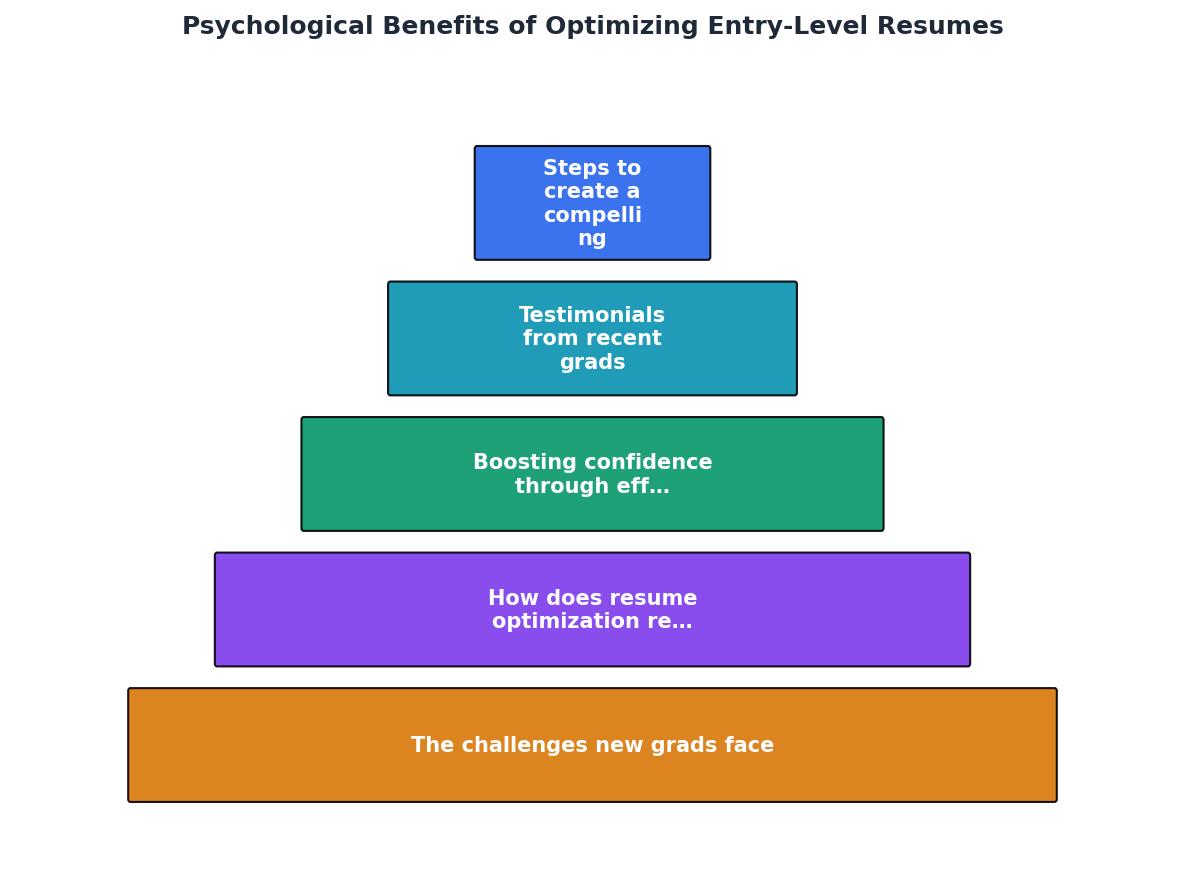
Steps to build a compelling resume

Here is the process, broken into concrete steps. Each one builds on the last, and each one contributes to the psychological benefits described above.
- Inventory everything. List every job, internship, project, volunteer role, certification, and relevant coursework. Do not filter yet.
- Read the target job posting three times. First for the overall role. Second for specific skills and keywords. Third for the tone and priorities.
- Match and map. For each requirement in the posting, find an experience from your inventory that demonstrates it.
- Write achievement-based bullets. Use the format: Action verb + what you did + measurable result. Example: "Designed social media campaign that increased student org engagement by 40% over one semester."
- Run an ATS check. Tools like Resume Hedgehog compare your resume against the job description and flag missing keywords, formatting issues, and alignment gaps.
- Trim ruthlessly. Remove anything that does not support the specific role. A one-page resume with 100% relevant content beats a two-page resume with 50% filler.
- Get one outside review. Ask someone in the target industry to read it. Fresh eyes catch what you miss.
Common pitfalls that hurt your mindset
Certain resume mistakes do not just reduce your callback rate. They actively reinforce negative self-perception.
Listing every job you have ever had. Including irrelevant roles makes your resume feel scattered, and makes you feel scattered. Cut anything that does not connect to the target role.Using a "creative" template with columns, graphics, and icons. Most ATS software cannot parse these. When your fancy resume gets rejected, you blame yourself instead of the format.Writing an objective statement like "Seeking an entry-level position where I can grow". This communicates uncertainty. Replace it with a professional summary that states what you bring.Copying job description language word-for-word. ATS tools flag keyword stuffing. Rephrase naturally.
The dashboard below shows how a typical new graduate's job search metrics shift after switching from generic to optimized applications.
Entry-Level Resume Optimization Checklist
Your progress is saved automatically in your browser.
FAQ
Frequently Asked Questions
What was the moment during your job search when your confidence shifted? Share what changed for you below.
Additional Resources
- How To Write an Entry-Level Mental Health Resume ... - Your entry-level mental health resume objective can attract attention from an employer and show them you have the potential to learn and grow ...
- Entry-Level Resume Examples for Every Field (2026 Guide) - Entry-level applicants face the steepest ATS rejection rate of any career stage: 75% of entry-level resumes are screened out before a human ...
- Employers, Take Note: 70% of Workers Choose Mental ... - Among entry-level employees, 30% reported feeling stressed due to work, while 16% said their job actually improves their mental well-being. At ...
