

Career transitions trigger real fear. You're leaving a world you understand to enter one that doesn't know your name or value. A strong resume is not just a document, it's your reframing tool. It translates your past into the language of your future, turning anxiety into confidence by showing you, and hiring managers, that your experience actually fits the role you're pursuing.
TL;DR:- A well-crafted resume reframes past roles into relevant skills that reduce career-change anxiety
- Strategic keyword placement and skill translation help you survive ATS screening and reach human readers
- Self-confidence grows when you see your experience articulated in terms that match the new industry
- Tailoring your resume to each job posting turns vague worry into concrete, actionable proof of fit
Understanding career anxiety
Career anxiety isn't just nerves. It's the gap between what you've done and what you believe the new industry needs. You spent five years in marketing. Now you're applying to be a product manager. The anxiety whispers: "They'll see I have no PM experience. They'll reject me in seconds."
When you reframe, you're not lying or exaggerating. You're translating. You're taking work experience that exists in one context and showing how it applies in another. A project manager who managed timelines, stakeholders, and budgets in manufacturing has managed projects. That's directly relevant to software delivery.
The anxiety lessens when you have a resume that proves the translation. When you can point to a document that shows, in the language of your target industry, why you belong there, that's when the story changes from "I'm lost" to "I'm deliberate."
The role of a strong resume in managing anxiety

A strong resume does three concrete things that reduce anxiety:
1. It shows you the bridge. When you sit down to write a tailored resume for a new role, you're forced to articulate how your past connects to the future. That exercise alone is grounding. You realize you've done more relevant work than you thought. You've managed cross-functional teams (leadership). You've solved customer problems (user empathy). You've shipped projects on time (execution). Those skills transfer. Writing them down makes that visible.
2. It passes the machine filter. ATS systems screen resumes before humans see them. Anxiety feeds on the unknown, what if your resume gets silently rejected by software you can't see? A strong resume uses the keywords and terminology of your target role. It speaks the language the ATS is listening for. You're no longer throwing work into a void; you're putting it in front of readers.
3. It resets your self-perception. You read your own reframed resume, and something shifts. You're not a failed [old role]. You're a skilled professional entering a new domain. The narrative changes. That matters more than it sounds. Self-doubt is louder when you're not sure how to explain yourself. Silence is where anxiety grows. A clear resume breaks the silence.
Strategies for reframing past roles

Reframing isn't about hiding your history. It's about choosing which details you emphasize and how you describe them. Here are the core strategies:
Use outcome language, not task language. Task language: "Managed social media accounts." Outcome language: "Grew community engagement by 150% through strategic content planning and audience insights." The first describes what you did. The second describes what changed because you did it. Hiring managers for new roles care about results. Results prove capability.
Identify your transferable skill clusters. Pull together the skills you used in your old role that apply in the new one. A teacher switching to instructional design used: learning design (building curriculums), stakeholder communication (parent and student meetings), feedback delivery (grading and assessment), and project management (semester planning). Those are not "teaching" skills, they're design and operations skills.
Translate role titles when needed. If you were a "Business Analyst" and you're moving into data analysis, your old title can stay. But your description shifts from business logic to data translation. Same person, different lens.
Lead with relevance, not chronology. In a traditional resume, you list your most recent job first. When changing careers, consider a hybrid or skills-based format where your strongest transferable skills get top billing. You want hiring managers to see fit before they worry about timeline gaps.
Reframe gaps as intention. A two-year career break isn't a liability in your resume if you describe what you did during it. "Career transition period: Completed advanced certification in [Field], built prototype projects, conducted industry research." That's growth, not absence.
Techniques for reframing past experiences
Here are the concrete techniques you can apply to any role transition:
Reframing Your Resume for Career Change
Your progress is saved automatically in your browser.
Examples of successful reframing
Real people, simplified examples:
Teacher to Instructional Designer:- Old: "Taught high school English to 150+ students annually."
- New: "Designed and delivered comprehensive learning curricula for 150+ students. Assessed individual learning needs, created targeted interventions, and tracked engagement metrics to optimize outcomes."
- Old: "Managed store with $2M annual revenue, 15 employees."
- New: "Oversaw end-to-end operations for $2M business unit. Optimized workflows, reducing labor costs by 12% while maintaining service quality. Managed and developed 15-person team."
- Old: "Built Excel models and financial forecasts for executive stakeholders."
- New: "Translated complex business data into actionable insights for C-suite decision-making. Defined requirements, prioritized initiatives based on financial impact, and communicated findings to cross-functional stakeholders."
How reframing builds confidence

Confidence isn't blind optimism. It's evidence. When you reframe your resume, you're building evidence that the transition makes sense. You can point to specific projects, metrics, and skills. You're not hoping; you're showing.
"The narrative we tell the world can be very different to what we have actually got experience in.">, Resume Anxiety? Just tell your story.
The reframing process also reveals patterns in your own history that you may have overlooked. You discover you've always been good at problem-solving, or mentoring, or cross-team collaboration. You realize your resume has been underselling you to your target industry because it was written for your old one. Fixing that is empowering.
When you sit in an interview and the hiring manager says, "Tell me about a time you led a team through a complex project," you don't fumble. Your reframed resume has already trained you to think about your experience in terms they understand. The anxiety doesn't disappear, but it's replaced with clarity. You know what story to tell and how to tell it.
The reframing process at a glance
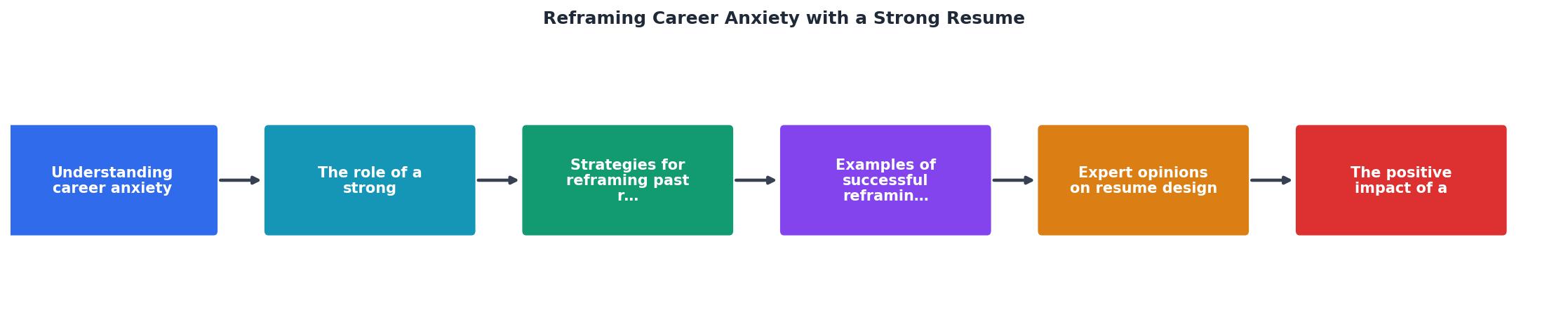
The diagram shows five key steps:
- Audit Your Experience - List all past roles and responsibilities without filtering.
- Identify Transferable Skills - Extract the underlying capabilities that apply to your target role.
- Research Target Industry Language - Study job postings and industry terminology in your field.
- Translate and Tailor - Rewrite your bullets using target-industry language and emphasizing relevant outcomes.
- Test and Refine - Validate your resume against job postings and get feedback from industry peers.
Interactive resume reframing dashboard
Understanding how your experience maps to a new role can feel abstract until you see it laid out. Here's an interactive tool to help you visualize the translation:
This interactive dashboard illustrates how the same core competency can be described and valued differently depending on your target industry. A skill that mattered in your old role doesn't disappear, it gets reframed. That's the essence of a successful career transition resume.
What expert sources say about resume reframing
Career coaches and hiring managers agree on a few core principles:
- Your resume is your narrative. Use it to tell the story of your transition, not just list your past.
- Keywords matter. Hiring managers and ATS systems scan for specific terminology. Use the language of your target industry.
- Quantify where possible. "Improved process efficiency" is vague. "Reduced turnaround time by 30%" is concrete.
- Recency and relevance beat job titles. If your side project in the new field is more relevant than your job title from five years ago, lead with the project.
FAQ
Frequently Asked Questions
Reframing your resume isn't about hiding who you were, it's about showing who you're becoming. What part of your career history have you been overlooking as irrelevant to your transition? There might be more there than you think.
Additional Resources
- Resume Anxiety? Just tell your story. - Many people, despite having amazing experience in their career, have anxiety when writing their resume. Just tell your story. It makes sense to ...
- Job Search Anxiety and Your Career - Assign designated times to research companies, tailor resumes, or follow up with recruiters. Structuring your time prevents the process from feeling chaotic and ...
- 8 Strategies for Overcoming Job Search Anxiety - Try reframing rejection as redirection—each “no” gets you closer to that “yes” that's the right match for you.
