
Photo by Jahra Tasfia Reza from Pexels
You've heard it all: use only one page, include an objective statement, make your resume visually creative, add every achievement you've ever had. The advice comes fast and contradicts itself constantly. The real problem is not confusion, it's that you're spending energy on tactics that don't move the needle while ignoring what actually gets you past the ATS and into a recruiter's hands. Most resume advice floats between outdated convention and outright myth, disconnected from how hiring systems actually work.
Distinguishing fact from fiction starts with understanding what truly impacts resume effectiveness. Not your gut instinct about what sounds professional. Not what worked for someone's cousin in 2015. Not the advice recycled across LinkedIn without evidence. The strategies that work are measurable, testable, and grounded in how ATS systems, recruiters, and hiring managers really evaluate candidates. This article cuts through the noise and shows you how to spot the difference.
TL;DR
- Most resume advice is anecdotal and outdated; focus instead on ATS compatibility, keyword alignment, and clear achievement statements backed by measurable results.
- Creative formats, infographics, and unusual layouts harm resume performance by breaking ATS parsing; plain, structured formats score higher.
- Cover letters matter more than many think, especially for competitive roles, but only when they add genuine value rather than repeating resume content.
- Evidence-based strategies include quantified metrics, role-specific keywords, reverse chronological formatting, and honest claims that withstand verification.
Common myths in resume advice
Resume mythology thrives because hiring is opaque. You apply, hear nothing, and never know why. That silence breeds speculation and folklore. Let's clear away the most damaging myths.
Myth 1: One page only. The "one-page rule" lingers from the 1990s when hiring managers received dozens of physical applications. Today, ATS systems process digital files with no length penalty. A mid-career professional with ten years of experience compressing everything onto one page does a disservice, key achievements get buried, keywords drop out, and context vanishes. The rule that actually matters is relevance and density. A recruiter scanning your resume for role-specific skills needs to find them fast. If that takes two pages, two pages is correct.
Myth 2: Objective statements are essential. Objective statements waste space. "Seeking a challenging role in a dynamic team" tells the recruiter nothing they don't already know. They know you want the job, you applied. A stronger move is a summary at the top that mirrors the job description: key skills, years of experience, and specific domain knowledge relevant to that opening. Better yet, use a strong headline: "Marketing Strategist | 8 Years B2B SaaS | Content & Demand Gen."
Myth 3: Your resume should be unique and creative. Visual creativity kills resume performance. Infographics, colored bars, custom fonts, sidebars, and unusual layouts look polished on a designer's portfolio but break ATS parsing. When an ATS tries to extract text from a sidebar or read a non-standard font, data gets corrupted or lost entirely. Resumes with graphics also fail when passed through email or converted to plain text. Recruiters will never see your beautiful PDF if their system can't parse it. Consistency and structure win. A clean, simple, well-organized resume outperforms visual flair every single time.
Myth 4: Include everything you've done. More does not mean better. A 15-year career doesn't need a 4-page resume listing every project and task. What matters is relevance to the target role. Older roles that don't align with your target should be abbreviated or removed. Achievements unrelated to the job you're applying for dilute the signal and waste space that could highlight skills the employer cares about.
Myth 5: Your resume gets read first. False. Recruiters skim. They give your resume a six-second scan, looking for keywords and role fit. Your resume doesn't get a careful read, it gets a pattern match. That means structure, formatting, and keyword placement matter far more than prose quality. A well-organized list of skills and metrics beats eloquent bullet points every time.
Identifying fact-based resume strategies
Fact-based strategies are those grounded in how hiring systems actually work, not in what sounds right. Here's how to spot them.
Check for specificity. Advice that works is specific and testable. "Use action verbs" is vague and assumes all action verbs work equally, they don't. "Use role-specific action verbs from the job description" is specific and testable. When you see actionable, narrow guidance, you're usually onto something real.
Look for evidence. Real resume advice comes with reasoning tied to hiring mechanics. For example: "Include quantified metrics because recruiters scan for numbers" ties the advice to observable behavior. "Use keywords from the job description because ATS systems filter candidates by keyword match" connects to a documented system. Advice without this grounding, "Do X because it looks professional" or "Do X because I did it", is likely anecdotal.
Test the advice against ATS reality. The ATS is the gatekeeper. Anything that impairs ATS parsing is a liability, no matter how professional it looks. Standard fonts, consistent formatting, plain text structure, and keyword-rich content pass through ATS systems cleanly. Complex layouts, graphics, and non-standard elements don't. If advice conflicts with ATS compatibility, it's wrong.
Follow the money. Recruiters optimize for speed and accuracy. They care about filtering candidates efficiently and finding the right fit fast. Advice aligned with recruiter efficiency is usually sound. Advice that adds friction or complexity, like elaborate formatting or lengthy narratives, works against recruiter incentives and is likely false.
The role of creative formats and design

The desire to stand out is natural. Your resume sits in a pile of hundreds. Shouldn't it look different to catch attention? The data says no.
Creative formats do one thing well: they look impressive in isolation. A well-designed resume as a PDF viewed on a desktop looks professional. The problem emerges in practice. Most resumes never reach a human as a PDF. They pass through:
- ATS systems that extract text and strip formatting
- Email filters and forwarding that corrupt files
- Applicant tracking platforms that convert everything to plain text
- Mobile phone screens where complex layouts become unreadable
The evidence is clear: plain, structured resumes with standard fonts, left-aligned text, and consistent bullet formatting score higher in ATS matching and pass through email and system conversions without data loss.
One exception: if you're applying for a creative role, graphic design, art direction, UI design, and the company specifically invites portfolio links or accepts creative formats, a well-designed PDF as a supplement to your standard resume can help. But even then, your primary resume should follow standard formatting. The portfolio or design piece is the place to show creativity; your resume is a data document.
Why cover letters still matter
The cover letter is declared dead every few years, yet it persists. That's because when done right, it works.
"When targets are exceeded it is rarely by a nice convenient round figure yet you frequently see comments like " Over achieved sales targets by 140%".">, CV's
A cover letter serves a purpose your resume cannot: it explains context and intention. Your resume shows what you've done. A cover letter shows why that experience makes you right for this specific role. For competitive positions, especially at larger companies, a thoughtful cover letter lifts your candidacy. For high-volume junior roles, it matters less.
The catch: most cover letters are boilerplate garbage that doesn't help. A cover letter that repeats your resume adds no value. A cover letter that's generic and impersonal reads as lazy. But a cover letter that addresses a specific challenge the company faces, connects one or two of your achievements directly to their needs, and shows you've researched the role, that one makes an impression.
Cover letters also matter when there's friction in your profile. Returning from a career break? A cover letter can address that briefly and contextualize your return. Switching industries? A cover letter connects your transferable skills to the new role. These are moments when a few sentences of explanation matter.
How to apply evidence-based resume tips

Applying evidence-based strategies means grounding your resume in what works rather than what sounds right. Here's the framework.
Step 1: Match keywords. Extract 15-20 critical keywords from the job description, skills, tools, frameworks, certifications, and industry terms. Ensure your resume includes these keywords naturally, woven into your achievement statements and skills section. ATS systems filter by keyword match; if the job description says "SQL" and your resume says "database management," you might be filtered out even if you know SQL.
Step 2: Lead with quantified metrics. Every achievement should have a number attached. Not "improved performance" but "reduced page load time by 35%." Not "managed social media" but "grew Instagram following from 10K to 150K in six months." Numbers make claims specific, memorable, and verifiable. Recruiters scan for numbers because numbers prove impact.
Step 3: Use reverse chronological format. The standard format, recent jobs first, is standard because it works. ATS systems expect it, recruiters are used to scanning it, and it's easy to follow. Functional resumes or combo formats confuse both machines and humans.
Step 4: Be honest about every claim. Your resume is a factual document. Anything on it can be verified. Inflating a title, misrepresenting a skill level, or exaggerating responsibility is a landmine. If you get the job and your employer discovers you claimed skills you don't have or inflated your role, you're fired. The reputational and legal risk is not worth a marginal interview boost.
Step 5: Optimize for the first scan. Assume a recruiter gives you six seconds. Make the top third of your resume scannable: a strong header, a summary line with key skills and years of experience, and your most recent role. Make key information jump out through consistent formatting and bold headings.
How to avoid common resume pitfalls
The gap between myth and fact leads to predictable mistakes. Avoid these.
Pitfall 1: Forcing a resume onto one page when you have substantial experience. A two-page resume for a professional with 8+ years of relevant experience is appropriate. Don't compress and lose important keywords and achievements to hit an arbitrary page limit.
Pitfall 2: Using creative software that locks your resume in a proprietary format. If your resume can't be downloaded as a .PDF or .DOCX, can't be pasted into an applicant tracking system, and can't be read by an ATS parser, it will fail. Stick with standard tools: Google Docs, Microsoft Word, or a simple resume builder that exports standard formats.
Pitfall 3: Listing every job and every responsibility. Tailor your resume to each application. Remove roles that don't support your target. Trim responsibilities that don't relate to the job. Adding a "Miscellaneous" section of unrelated tasks dilutes your message.
Pitfall 4: Writing in narrative paragraphs instead of bullet points. Recruiters and ATS systems both favor bullet points. They're scanned faster, keywords are easier to extract, and achievements stand out. A paragraph of prose gets skimmed over. A crisp bullet point gets read.
Pitfall 5: Assuming your resume is your primary marketing tool. Your resume is a filter, not a sales pitch. Its job is to get you past the ATS and into a recruiter's callback list. The sell happens in the cover letter and the interview. Don't overload your resume with personality or narrative. Keep it clear, data-rich, and aligned with the role.
Evaluating Resume Advice: Fact-Check Checklist
Your progress is saved automatically in your browser.
Here's a custom interactive element to visualize how different resume approaches perform against modern hiring systems:
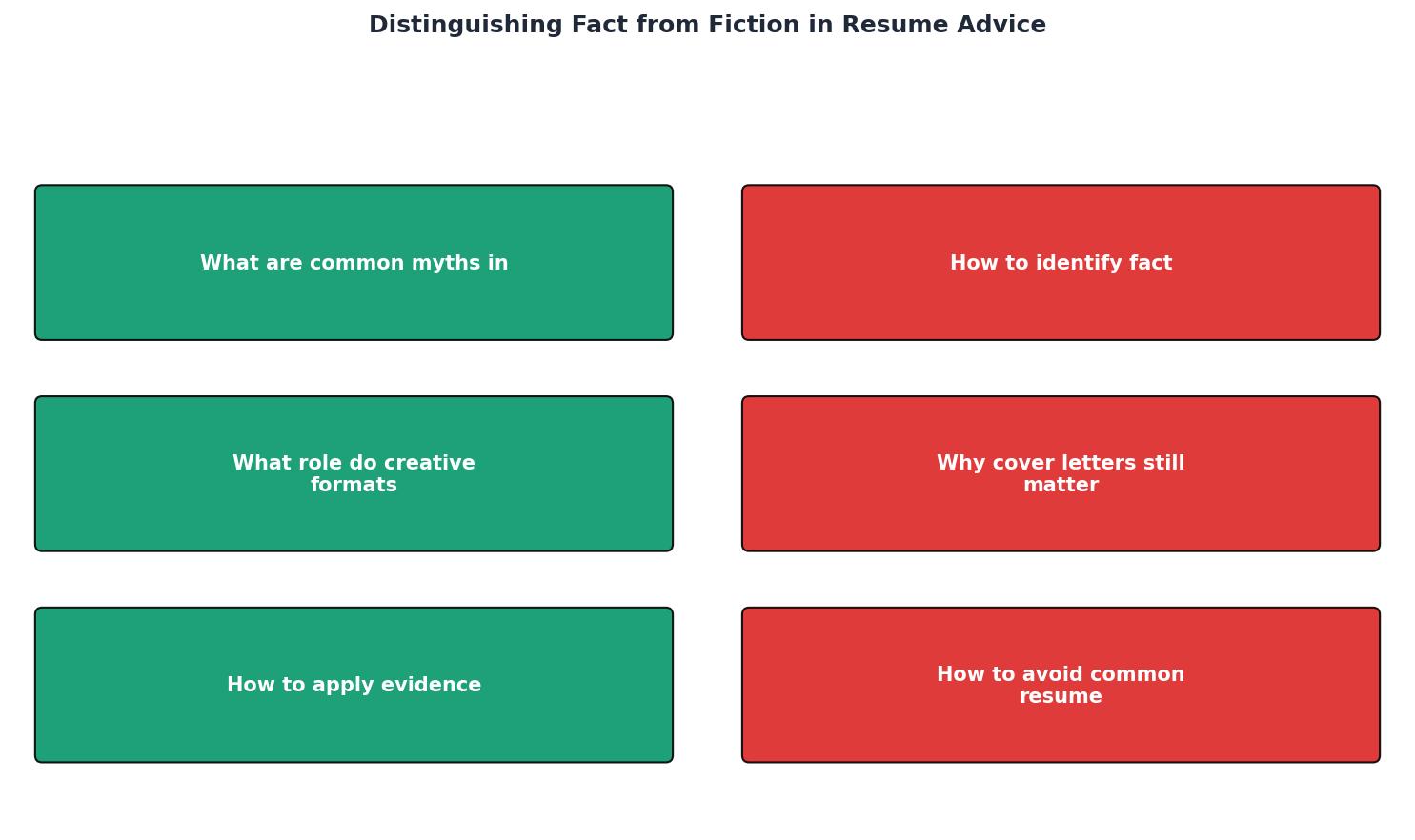
The custom dashboard above shows at a glance how myth-based approaches differ from fact-based ones. On the left, you see what sounds good but fails in practice. On the right, what actually works because it aligns with how hiring systems operate. Use this as a quick reference when you're tempted by advice that feels right but contradicts these principles.
FAQ
Frequently Asked Questions
Hiring systems and recruiter behavior are not mysteries. They're measurable, observable, and documented through millions of applications. The resume advice that works is the advice aligned with these realities. When you catch yourself following guidance that contradicts ATS mechanics, recruiter incentives, or testing, stop. Ask why. Test the claim. The most effective move you can make is trusting evidence over intuition and ditching advice that sounds right but doesn't work in practice.
Additional Resources
- CV's - Separating Fact From Fiction.. - I believe employers should request proof of academic achievement as part of the recruitment process. This is standard practice in many other ...
- Writing Your Resume for the Right Audience: Fact Versus ... - Fiction: top makes sense. Fiction: Include a purpose statement at the top of your resume. Your resume needs to be tailored for your audience ...
- Tips for Handling False or Misleading Résumé Info - “Helped” is a key word to discredit contributions. Ask what challenge initiated the project, how the issue or opportunity arose, the background ...
