
You clicked "Submit Application," watched the confirmation screen flash, and then nothing. Days pass. Weeks pass. You start wondering if your resume fell into a digital void or if a real person ever laid eyes on it. The truth is your resume goes on a surprisingly complex journey before anyone decides to call you, and understanding that journey gives you a concrete edge over every other applicant who stays in the dark.
Photo by Tima Miroshnichenko from Pexels
TL;DR:- Your resume first enters an Applicant Tracking System (ATS) that parses, scores, and ranks it against other applicants based on keyword matches and formatting compatibility.
- Resumes that score high enough reach a human recruiter, who spends roughly 6 to 8 seconds on an initial scan before deciding to read further or move on.
- Optimizing for both the algorithm and the human reader is the single biggest lever you have to land more interviews from the same number of applications.
The journey starts before a human sees anything
Most job seekers picture a hiring manager reading their resume over coffee. That is not how it works at any company using modern recruiting software. The moment you hit submit, your file enters an automated pipeline. The ATS ingests the document, extracts text, and maps it against the job requisition's requirements. Only after the software decides your resume is worth surfacing does a recruiter get involved.
That number is not a scare tactic. It reflects the reality that most large employers receive hundreds of applications per opening, and the ATS exists specifically to reduce that pile to a manageable shortlist.
What is an ATS, exactly?
An Applicant Tracking System is software that companies use to collect, organize, and filter job applications. Think of it as a database with a built-in scoring engine. Popular systems include Workday, Greenhouse, Lever, iCIMS, and Taleo. Each one works slightly differently, but the core logic is the same: parse the resume text, compare it to the job description, assign a relevance score, and rank candidates.
The ATS does not "read" your resume the way a person does. It looks for:
- Keywords that match the job posting (job titles, skills, certifications, tools)
- Structured sections it can parse (work experience, education, skills)
- File format compatibility (
.docxand.pdfare safest; heavily designed templates often break parsing) - Recency and relevance of listed experience
How ATS scoring actually works
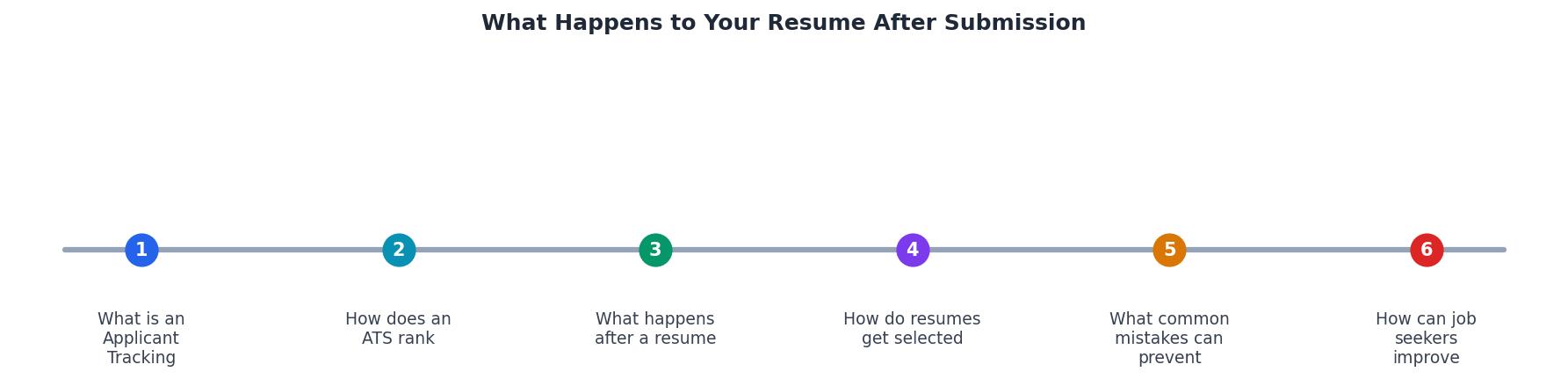
The diagram above shows the high-level flow: Submit, Parse, Score, Rank, Human Review, Interview Decision. Each step is a gate. Fail at Parse and your content never gets scored. Score low and a recruiter never sees your name.
Here is what happens at each gate:
- Submit: Your file lands in the ATS database. Metadata like submission date, source (job board, referral, direct), and position ID are logged.
- Parse: The system extracts plain text from your document. Headers, bullet points, dates, and section labels are identified. Parsing errors here are silent and fatal.
- Score: The extracted text is compared against the job requisition. Each matching keyword or phrase adds to your score. Some systems weight certain fields more heavily (job title matches count more than a skill buried in a list).
- Rank: All applicants are sorted by score. Recruiters typically review the top 10 to 25 candidates first.
- Human Review: A recruiter opens your parsed profile (not always your original PDF) and decides in seconds whether to dig deeper.
- Interview Decision: The recruiter or hiring manager moves you to a phone screen, rejects you, or puts you in a "maybe" pile.
What happens after the ATS says yes?

Once your resume clears the automated filter, a recruiter opens your profile. This is where the 6-to-8-second scan happens. Recruiters are not lazy. They are processing volume. In those seconds, they look for:
- Current or most recent job title and whether it aligns with the open role
- Company names they recognize (brand recognition creates instant credibility)
- Tenure patterns (frequent short stints raise questions; steady progression builds confidence)
- Quantified achievements ("increased retention by 18%" beats "responsible for retention")
- Location and availability (remote roles are more flexible here, but local candidates still get a bump for hybrid positions)
"Nowadays, less than 20 percent of candidates who submit applications attach a cover letter.">, What Happens After You Submit a Job Application
That statistic means cover letters are increasingly optional, but a well-tailored resume is not. The resume carries almost all the weight in getting you past both the ATS and the recruiter.
Common mistakes that kill your chances

These are not theoretical. They are the reasons real resumes get filtered out every day:
- Using a graphic-heavy template. Canva templates look great on screen. The ATS sees scrambled text or nothing at all.
- Submitting a generic resume. If your resume does not mirror the language in the job posting, the ATS scores it low. "Project management" and "program management" are not the same keyword.
- Burying skills in paragraphs. A dedicated Skills section with clear, comma-separated terms is easier for both the ATS and the recruiter to scan.
- Omitting measurable results. Recruiters skip vague descriptions. Numbers create contrast and credibility.
- Wrong file format. Some older ATS platforms choke on PDFs with embedded fonts. When in doubt,
.docxis the safest bet. Check the application instructions. - Spelling the job title differently. "Sr. Software Engineer" vs. "Senior Software Engineer" can matter in keyword matching. Use the exact phrasing from the posting.
- Including headers and footers with critical info. Many parsers ignore header/footer content. Your name and contact info belong in the main body.
How to optimize for both ATS and humans
The goal is not to game the system. It is to present your real qualifications in a format that both software and people can quickly understand. Here is what works:
- Mirror the job description's language. If the posting says "stakeholder management," use that exact phrase. Do not paraphrase it as "working with stakeholders."
- Use a clean, single-column layout. Standard section headings: Summary, Experience, Skills, Education, Certifications.
- Front-load each bullet with an action verb and a result. "Reduced onboarding time by 30% by redesigning the training workflow" tells the recruiter exactly what you did and what happened.
- Include a skills section with hard skills listed explicitly. Tools, platforms, certifications, programming languages, methodologies.
- Tailor for every application. This is the part most people skip because it takes time. Tools like Resume Hedgehog exist specifically to solve this: upload your resume, paste the job description, and get a version optimized for that specific role in minutes instead of an hour.
Resume Pipeline Survival Rates
ATS Optimization Checklist
Your progress is saved automatically in your browser.
FAQ
Frequently Asked Questions
.docx files more reliably than PDFs, especially PDFs created from design tools like InDesign or Canva. Modern systems like Greenhouse and Lever handle both formats well. When the job posting does not specify a format, .docx is the safest choice. If you prefer PDF, make sure it was generated from a word processor (not a graphic design tool) so the text layer is clean and selectable.What part of the resume submission process surprised you the most? Share your experience below.
Additional Resources
- What Happens To My Resume After I Click Apply? Plus ... - What happens after I submit my resume? · A software system scans for keywords · A recruiter completes preliminary candidate reviews · The direct ...
- What Happens After You Submit a Job Application - Typically after applying, you will receive an email to inform you that your information was received and is being reviewed.
- What Happens After You Submit Your Resume? - Whether you've submitted your resume to a recruiter or directly to an employer, it will likely face some form of technology before it is thoroughly reviewed by ...
