
You apply to a job that feels like the perfect fit. Your experience matches the requirements. You tailor your cover letter. Then silence. Days pass. Weeks pass. No rejection, no interview request, just nothing. This is resume ghosting, and it's more common than you'd think. The frustration isn't irrational; the problem is real and systemic.
TL;DR
- ATS systems filter out 75% of resumes before a human sees them, often due to missing keywords or incompatible formatting.
- Recruiters are overwhelmed with applications; the average corporate job posting receives 100+ submissions.
- Common resume mistakes, generic content, poor formatting, irrelevant skills, make ghosting more likely.
- Optimizing your resume with job-specific keywords and clean formatting dramatically improves visibility.
- Following up and tailoring each application can recover opportunities that would otherwise disappear.

What is resume ghosting?
Resume ghosting is the job application equivalent of being ignored. You submit your resume through a company's careers page or job board. You wait for a response. It never comes. No email telling you the position was filled. No feedback. No suggestion to apply elsewhere. Just silence.
The scale is significant. More than half of job seekers experienced ghosting within the last year, according to a report from Criteria, a pre-employment testing company. This isn't a few people slipping through the cracks, it's a widespread breakdown in the hiring process.
"More than half, 53%, of job seekers experienced ghosting within the last year, according to a new report from pre-employment testing company Criteria.">, Job seekers aren't imagining things: the number of candidates ghosted by employe
Ghosting differs from a rejection. A rejection is a decision. Ghosting is the absence of one. The company doesn't explicitly turn you down, they simply never acknowledge your application.
How ATS systems contribute to ghosting
Most large employers use Applicant Tracking Systems (ATS) to manage applications. These software platforms screen resumes automatically, flagging relevant candidates and discarding the rest. The problem: ATS systems are rigid, literal, and unforgiving.

An estimated 75% of resumes are filtered out by ATS systems before they ever reach a recruiter. Here's why:
Keyword matching is the core mechanism. The ATS searches your resume for specific words and phrases found in the job description. If the job posting says "project management" and your resume says "coordinated projects," you might not match. The system doesn't understand synonyms or context, it looks for exact or near-exact matches.
Formatting matters more than you'd expect. ATS systems parse resumes by looking at text structure. If your resume uses tables, graphics, unusual fonts, or complex formatting, the parser might misread entire sections. A creative resume design that looks great to humans can become unreadable to software.
File format can be a barrier. Submitting a resume as a PDF with embedded fonts, or in an unsupported format, can corrupt the parsing. Some ATS platforms struggle with certain file types or versions.
Missing header information. If you leave out a phone number, email, or LinkedIn URL, the system might not know how to contact you even if your resume passes the keyword screen.
The math is harsh: if your resume doesn't match the keywords the hiring team programmed into the ATS, your application is automatically rejected before anyone reads it. You're ghosted by a bot.
Why recruiter overload accelerates ghosting
Even if your resume makes it past the ATS, human ghosting is just as real.

A single job opening at a mid-sized company often receives 100–300 applications. Senior-level roles can get 500+. One recruiter or hiring manager cannot thoughtfully review every submission. The volume is staggering.
Here's what happens:
- A recruiter spends time screening top candidates identified by the ATS.
- They conduct interviews with the strongest 5–10 applicants.
- They make a hire.
- The remaining hundreds of applicants, including many qualified candidates, are simply never contacted.
The volume of applications has grown dramatically in recent years as job boards became more accessible and remote work expanded the candidate pool. Recruiters are expected to handle the same workload with the same staff, which means more applicants get less attention.
Common resume mistakes that lead to ghosting
Even experienced job seekers make mistakes that trigger the ATS filter or cause resumes to be skipped in human review. These are the most common culprits:
Generic, non-customized content: A one-size-fits-all resume will never stand out. Hiring managers expect to see language from the job description reflected back in your resume. A resume that could apply to any job in your field applies to none in particular.
Missing critical keywords: The job description lists specific skills, tools, or certifications. Your resume must contain those exact terms if you want to pass the ATS. "Ruby on Rails" is not the same as "RoR" in the eyes of a keyword filter.
Poor formatting: Dense walls of text, inconsistent bullet points, multiple fonts, or text boxes can either confuse the ATS parser or exhaust a recruiter's attention span. Clean, scannable formatting wins.
Vague accomplishments: Saying you "improved efficiency" is useless. Saying you "reduced average processing time by 40%, cutting operational costs by $120K annually" is memorable and credible.
Outdated or irrelevant experience listed first: If your most recent role or strongest accomplishment isn't prominent, recruiters might not dig deep enough to find it. Lead with impact.
Typos and grammatical errors: These signal carelessness and reduce credibility. A single typo can drop your resume to the bottom of the pile.
Unclear contact information: Make sure your phone number, email, and LinkedIn profile are easy to find at the top of the resume. If a recruiter can't reach you, you're effectively ghosted.
Unexplained resume gaps: If you took time off and don't address it, recruiters may wonder why and deprioritize you. A simple line explaining a gap ("Career break for family care, 2023–2024") prevents speculation.
The pattern is clear: resumes that are generic, poorly formatted, or missing keywords are more likely to be filtered by ATS or ignored by human readers.
How to improve your resume visibility
The solution starts with understanding how resumes are actually reviewed and then building one that passes both the ATS filter and captures human attention.
Step 1: Extract keywords from the job description. Copy the job posting into a document and highlight every skill, tool, industry term, and requirement mentioned. Your resume should reflect these keywords naturally in your experience descriptions. If the job asks for "Salesforce experience," your resume should say "Salesforce" not just "CRM platform."
Step 2: Tailor your resume to each job. You're not rewriting your entire resume for each application, you're adjusting the language and emphasis. Reorder bullet points to prioritize accomplishments relevant to the specific role. Adjust your professional summary to reflect the job title and key requirements.
Step 3: Use a clean, ATS-friendly format. Stick to a simple layout with consistent fonts (Arial, Calibri, or Times New Roman), standard bullet points, and clear section headers. Avoid tables, graphics, text boxes, and colored backgrounds. Save as .docx or PDF depending on what the job posting specifies.
Step 4: Quantify accomplishments. Instead of "managed a team," say "led a team of 6, delivering 3 projects on time and under budget." Numbers are specific, credible, and memorable.
Step 5: Include a keyword-rich professional summary. Write a 2-3 line summary at the top that mirrors language from the job description. This gives the ATS more keyword matches and tells recruiters you understand the role.
Step 6: Add a skills section. List hard skills, tools, and certifications in a dedicated section. This gives the ATS more keyword opportunities and makes it easy for recruiters to scan.
Step 7: Proofread rigorously. Read your resume aloud. Have a friend review it. Use a spell-checker. Typos are resume killers.
Real-life stories of overcoming resume ghosting
Many job seekers have escaped the ghosting cycle by making these changes. Here are a few patterns:
A marketing manager was sending 20 generic resumes per week and heard back from almost no one. She started tailoring each resume to the job posting, matching keywords and adjusting her summary. Her response rate jumped from 2% to 15% within a month.
A software engineer realized his resume was in PDF format with a colored background and custom font. The ATS couldn't parse it. He reformatted it as a simple .docx file with standard fonts and saw immediate improvement in his ATS pass-through rate.
A career changer wasn't including the terminology of her new field on her resume. She researched the language used in job postings for her target role and rewrote her experience descriptions to translate her existing skills into that field's language. Recruiters suddenly started responding.
These aren't outliers. The pattern repeats: job seekers who tailor their resumes, optimize for ATS, and maintain clean formatting see significant increases in response rates.
Visual guide to the resume screening process
Understanding the journey of your resume through the hiring funnel helps you see where ghosting happens and how to prevent it.
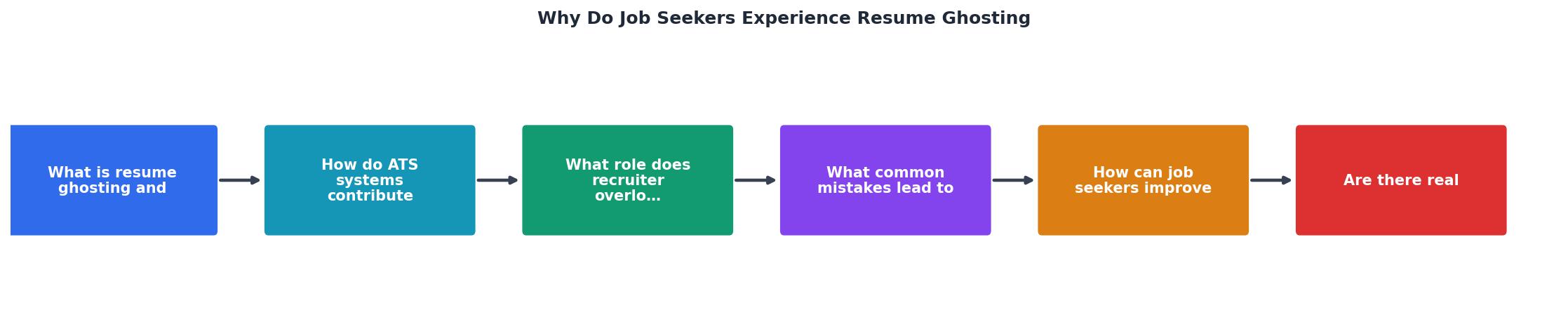
The funnel starts wide at the top, hundreds of applications submitted, and narrows dramatically. Most resumes never reach a human reviewer. Of those that do, most never get a response. Understanding this funnel is why ATS optimization and keyword targeting matter so much.
Understanding your resume's journey
To drive this home, here's an interactive breakdown of how a resume gets screened from submission to decision:
Resume Screening Journey
Submission
Resume enters applicant tracking system
ATS Parse
System scans for keywords and required skills
Keyword Match (75% filtered here)
Does your resume contain job description terms?
Human Review
Recruiter screens finalist resumes
Decision
Interview offer or (often) silence
This visual shows why keyword optimization is critical. The majority of resumes are eliminated at step 3, before any human involvement. The resumes that survive that filter, and are tailored to the role, are the ones that receive interviews.
Resume Optimization Checklist for Avoiding Ghosting
Your progress is saved automatically in your browser.
FAQ
Frequently Asked Questions
Resume ghosting feels like rejection without closure, but it's usually not personal. It's systemic. Hundreds of resumes arrive. The ATS filters most of them. Recruiters are overwhelmed. Communication infrastructure is minimal. Understanding this doesn't make the silence less frustrating, but it does reveal where you can take action.
Optimizing your resume for keywords, tailoring each application to the specific job, and using clean formatting won't guarantee you'll never be ghosted again. But it will dramatically increase the odds that your resume reaches a human, gets read, and earns a response.
The job search is already challenging. Don't let your resume disappear into the void due to preventable mistakes. Take control of the factors you can influence, and ghosting becomes less inevitable.
Additional Resources
- Job seekers aren't imagining things: the number of ... - More than half of job-seekers have experienced ghosting within the past year, reaching a three-year peak—and experts say it's because hiring ...
- Ghosting job candidates after interviews: A sign of a ... - You're overqualified for the position. Your achievements don't match the employer's preferences. Your resume has typos and grammatical errors.
- Candidate Ghosting: Why It Happens and How to Stop It in 2026 - Among 1 in 4 job seekers (25%) who admit to ghosting an employer, the most-cited reason is acceptance of a competing offer (LiveCareer, 2025).