
You're sending out resumes. You're qualified. But the callbacks aren't coming. The problem usually isn't your credentials, it's that your resume never reaches a human recruiter. Most nursing applications get filtered out by applicant tracking systems before anyone even sees them. The fix is straightforward: tailor your resume to match what the job posting asks for, using the exact language healthcare employers scan for.
Photo by Laura James from Pexels
TL;DR:- Mirror keywords from the job posting, clinical skills, certifications, software systems, into your experience section.
- Lead with measurable achievements: patient satisfaction scores, bed management numbers, medication error rates, infection control metrics.
- Certifications like ACLS, BLS, PALS, and specialty certs (CCRN, TNCC) belong at the top or in a dedicated section.
- Use ATS-friendly formatting: no graphics, no columns, clear headers, standard fonts.
- Tailor every application, a generic resume works for almost no one in nursing recruitment.
Healthcare hiring relies on automated screening. With 75% of applications getting rejected by applicant tracking software, only a fraction make it to hiring managers for review. That statistic stings, but it's fixable. Most nurses don't realize their resume loses to the system not because of lack of skill but because the resume doesn't speak the system's language. You have the experience. You need the resume to prove it in 6 seconds.
The rest of this guide walks you through exactly what hiring managers and ATS systems look for in a registered nurse resume, then shows you how to structure your application so it lands in the right hands.
What skills matter most on a nursing resume

Start by listing the core skills every registered nurse needs. These aren't soft skills or generic competencies, they're the clinical and technical abilities that distinguish a working nurse from someone who just has a license.
Clinical and technical skills that belong on every RN resume:
- Patient assessment and monitoring
- IV therapy and medication administration
- Electronic health record (EHR) systems, especially if you name the specific system (Epic, Cerner, Meditech)
- Vital signs monitoring and interpretation
- Wound care and dressing changes
- Catheter care and management
- Infection control and sterile technique
- Pain management and assessment
- Cardiac monitoring and telemetry
- Blood pressure and glucose monitoring
- Patient education and discharge planning
- Phlebotomy
- Communication with interdisciplinary teams
- Patient advocacy
- Time management under pressure
- Critical thinking and clinical judgment
- Leadership and charge nurse responsibilities
- Precepting and training new staff
- Conflict resolution
How to use healthcare-specific keywords
ATS systems scan for keywords. Recruiters scan for results. You need both. Keywords get your resume into the pile; achievements get you the interview.
Here's how to find the right keywords:
- Read the job posting closely. Copy the job description into a document. Highlight every skill, certification, software platform, and specialty mentioned. This is your keyword list.
- Scan the "requirements" and "preferred qualifications" sections separately. Requirements are must-haves; keywords there get extra weight. Preferred qualifications still matter but are secondary.
- Look for software and system names. If the posting says "proficiency in Cerner," write "Cerner" in your resume, not "EHR management" or "clinical documentation." Exact match wins.
- Identify specialty terminology. A posting for "acute care nurse" uses different language than one for "home health nurse" or "OR nurse." Match the terminology to the role.
- Add keywords naturally into your work history bullets. Don't keyword-stuff. Write: "Managed care for 8-10 ICU patients using Epic EHR, achieving 98% medication accuracy and reducing patient falls by 20%." That sentence uses keywords (ICU, Epic EHR, medication accuracy, patient falls) while telling a story.
- Include keywords in your professional summary. Example: "Registered Nurse with 5 years acute care experience. Skilled in ACLS, BLS, PALS, and emergency triage. Proficient in Epic and Meditech EHR systems. Committed to patient safety and evidence-based care."
How to highlight clinical experiences
Your work history should tell a story of patient care, not just list duties. This is where most nurses lose points. Generic bullets like "Provided nursing care to patients" or "Assisted physicians" don't demonstrate competence.
Specific, achievement-focused bullets do:
- "Managed care for 12 concurrent patients in a busy medical-surgical floor, maintaining 100% accuracy on medication administration and zero adverse events over 12-month period."
- "Triaged and stabilized emergency patients during high-volume shifts (100+ daily visits), prioritizing critical cases and reducing average wait times from 35 minutes to 18 minutes."
- "Inserted and maintained central lines and peripheral IVs for 15+ patients daily, achieving 95% first-attempt success rate and reducing infection-related complications by 30%."
- "Performed discharge planning and patient education for post-operative orthopedic patients, resulting in 94% patient satisfaction scores and 12% reduction in 30-day readmissions."
If you worked in a specialty, ICU, OR, emergency department, pediatrics, oncology, critical care, lead with that specialty in your job title or first line. Example:
Registered Nurse – ICU / Intensive Care Unit XYZ Hospital, [dates]- Managed care for 6-8 critically ill patients in a 20-bed ICU...
- Prepped 8-12 patients daily for surgical procedures, ensuring sterile field integrity and reducing surgical site infections by 18%...

How to quantify nursing achievements
Numbers make you credible. Patient satisfaction is subjective; a 94% satisfaction score is concrete proof you delivered care people actually experienced as good.
Track and include these metrics:
- Patient satisfaction scores (e.g., "89% Press Ganey satisfaction rating," "92% HCAHPS scores for communication")
- Patient outcomes (readmission rates, infection rates, falls prevented, wound healing timelines)
- Efficiency metrics (average time to medication delivery, discharge time, turnaround on orders)
- Safety records (days without incidents, medication error rates, infection prevention achievements)
- Volume and acuity ("managed care for 8-12 patients daily," "triaged 80-100+ patients per shift")
- Specialty metrics (OR: surgical site infection rates, specimen handling accuracy; ICU: ventilator management days, central line maintenance; ED: door-to-bed times)
- Training and mentoring ("precepted 6 new graduate nurses," "mentored 3 nursing students," "trained 12 staff on new EHR system")
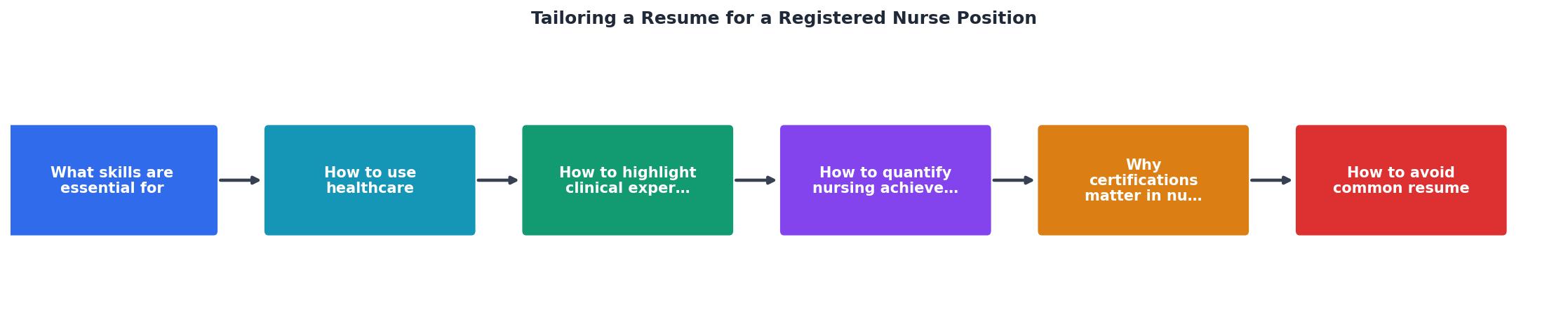
The process moves from identifying the role's needs, to extracting keywords and priority skills, to mapping your experience against those requirements, to structuring bullets that prove it. Each step matters.
When you tailor your resume to a specific job posting, the relevance score jumps dramatically. A generic resume might hit 40-50% keyword match. A tailored one hits 85%+ and sails through ATS screening. That's the difference between getting lost in the pile and getting called.
Why certifications matter in nursing resumes
Certifications are hiring triggers. They appear in job postings as requirements or nice-to-haves. They cost money and time to earn, so they signal commitment. Recruiters and hiring managers scan for them first.
Core certifications nearly every job posting expects:
- BLS (Basic Life Support) – non-negotiable; list the expiration date
- ACLS (Advanced Cardiovascular Life Support) – required for most hospital roles; if you don't have it, get it
- PALS (Pediatric Advanced Life Support) – required for pediatric, emergency, and many general care roles
- CCRN (Critical Care Registered Nurse) – for ICU and critical care roles
- TNCC (Trauma Nursing Core Course) – for emergency and trauma nursing
- CNOR (Certified Nurse Operating Room) – for operating room roles
- OB Nursing Certification (RNC-OB) – for labor and delivery, postpartum
- CNA or CCNA for ambulatory care
- Oncology Nursing Certification – for cancer centers
- Wound Ostomy Continence Nursing Certification (CWOCN) – for specialty wound care
- Certified Diabetes Educator (CDE) – for endocrinology roles
Put certifications in a dedicated section near the top of your resume, right after your professional summary. Format matters:
CERTIFICATIONS & LICENSES
- Registered Nurse (RN), [State], License #[number], Expires [date]
- BLS (Basic Life Support), American Heart Association, Expires 06/2026
- ACLS (Advanced Cardiovascular Life Support), American Heart Association, Expires 06/2026
- CCRN (Critical Care Registered Nurse), AACN, Expires 12/2025
Always include expiration dates. An expired certification tells a recruiter you're not current. If a certification is about to expire, renew it before applying.
Common nursing resume mistakes to avoid
Most nursing resumes fail for the same reasons. Avoid these pitfalls:
- Sending a generic resume to every job. This is the biggest mistake. You're competing against tailored resumes. You lose. Spend 10 minutes customizing keywords for each application.
- Burying your specialty or experience. If you have ICU or OR experience and you're applying for an ICU role, lead with it. Don't make recruiters hunt for relevance.
- Using weak action verbs. Skip "responsible for," "helped with," "involved in." Use "managed," "led," "improved," "maintained," "achieved," "reduced," "increased."
- No numbers or outcomes. "Provided patient care" tells no one anything. "Managed care for 10 ICU patients daily with 98% medication accuracy" proves you know your job.
- Listing certifications without expiration dates. Recruiters need to know certifications are current. Always include the expiration date.
- Poor formatting for ATS readability. No graphics, no columns, no tables, no creative fonts. Use Arial, Calibri, or Times New Roman. Standard headers. Bullet points. Keep it clean and scannable.
- Inconsistent date formatting. Use "06/2024 – Present" or "June 2024 – Present" consistently throughout.
- Forgetting the EHR systems you've used. List them explicitly. Epic, Cerner, Meditech, eClinicalWorks, these are keywords recruiters search for. Omitting them is money left on the table.
- Not addressing employment gaps. If you have a gap (career break, additional schooling, time out), address it briefly in a neutral way. Example: "Medical leave, 2022–2023; returned to active practice 2023." Don't volunteer more than necessary, but don't hide it either.
- Forgetting to proofread. Typos and grammatical errors tell hiring managers you don't pay attention to detail, a liability in nursing. Use a spell-checker, read it aloud, have someone else review it.

What a strong nursing resume looks like in practice
Here's what the pieces come together into. A real structure that works:
[Your Name]
[Phone] | [Email] | [City, State]
PROFESSIONAL SUMMARY
Registered Nurse with 6 years of progressive acute care experience. Skilled in patient assessment,
EHR documentation (Epic, Meditech), and interdisciplinary collaboration. Current certifications:
BLS, ACLS, PALS. Committed to patient safety, evidence-based practice, and mentoring new staff.
CERTIFICATIONS & LICENSES
- Registered Nurse (RN), State Board of Nursing, License #12345678, Active
- BLS (Basic Life Support), American Heart Association, Expires 06/2026
- ACLS (Advanced Cardiovascular Life Support), American Heart Association, Expires 06/2026
- CCRN (Critical Care Registered Nurse), AACN, Expires 12/2025
EXPERIENCE
Registered Nurse – Medical-Surgical Unit
[Hospital Name], [City, State] | 01/2022 – Present
- Managed care for 8-10 complex patients daily on a 32-bed medical-surgical floor
- Maintained 100% accuracy on medication administration over 24-month period; zero medication errors
- Reduced patient falls by 22% through implementation of hourly rounds and mobility protocols
- Achieved 92% patient satisfaction scores (HCAHPS) for communication and care
- Precepted 4 new graduate nurses and 2 nursing students; all successfully transitioned to independent practice
- Collaborated with case management on discharge planning, reducing 30-day readmissions by 15%
Registered Nurse – ICU (Medical-Surgical ICU)
[Hospital Name], [City, State] | 06/2019 – 12/2021
- Provided skilled nursing care for 6-8 critically ill patients in a 20-bed ICU
- Managed complex drips (vasopressors, sedatives, antibiotics) with 99% accuracy
- Maintained central lines and peripheral IVs with 96% first-attempt success rate; zero CLABSI incidents
- Supported physicians during bedside procedures and code events
- Communicated patient updates to families with empathy; 95% family satisfaction scores
EDUCATION
Bachelor of Science in Nursing (BSN)
[University Name], [City, State] | Graduated: 05/2019
Associate Degree in Nursing (ADN)
[Community College Name], [City, State] | Graduated: 05/2017
SKILLS
Patient Care: Assessment, IV therapy, medication administration, wound care, catheter care, discharge planning
Clinical Systems: Epic EHR, Meditech, telemetry monitoring, vital signs, pain management
Specialty Skills: Patient education, charge nurse responsibilities, precepting, conflict resolution
Notice: keywords appear naturally, numbers back claims, certifications are clear and current, formatting is clean and scannable.
Before you hit send:
Tailored Nursing Resume Checklist
Your progress is saved automatically in your browser.
FAQ
Frequently Asked Questions
The gap between "I'm qualified" and "I got the interview" usually isn't experience, it's communication. Your resume needs to speak the language of the system and the people screening it. Name the keywords they're looking for. Back your claims with numbers. Lead with your specialty. Make it easy to scan. Do that, and your resume won't disappear into the ATS black hole. It'll land on a hiring manager's desk, and your phone will ring. That's the whole point.
Additional Resources
- Nursing Resume Guide – With Template & Examples (2025) - Tailor for each nursing role – Customize for specialized roles like ICU nurse, operating room nurse, school nurse, or nurse practitioner to ...
- Registered Nurse Resume Examples & Writing Guide - Advice for Writing Your Registered Nurse Resume · Include relevant certifications and training · Write a strong professional summary · Showcase ...
- 10 Tips for Creating a Great Nursing Résumé - Be Specific, Not Generic Nurses should tailor their résumés to the job posting or educational program they are applying for.
