

Hundreds of software engineers, data analysts, and DevOps specialists apply for the same opening, and most of them never hear back. The problem is rarely a lack of skill. It is almost always a resume that fails to prove relevance in the six seconds a recruiter spends scanning it. This guide breaks down the exact elements that separate tech resumes that land interviews from those that disappear into the void.
Photo by Tima Miroshnichenko from Pexels
TL;DR:- Tech resumes stand out when they lead with quantified impact, not just a list of technologies.
- Relevant certifications, personal projects, and open-source contributions signal initiative that job descriptions alone cannot capture.
- Industry-specific keywords matched to the posting get you past ATS filters and into human hands.
Why tech hiring is brutally competitive
Every open role at a recognizable tech company attracts between 100 and 250 applicants. Startups with strong employer brands see similar numbers. The supply of candidates with "React" or "Python" on their resume is enormous. What is scarce is proof that a candidate can use those tools to solve real business problems.
Roughly three out of four resumes never reach a human reviewer. Applicant Tracking Systems like Greenhouse, Lever, and Workday parse your document for keywords, job titles, and formatting consistency. If the system cannot extract your skills cleanly, or if the keywords do not match the posting, you are out before anyone reads a single line.
This is not a broken system you can ignore. It is the reality you design your resume around.
Technical skills that actually matter

Not all skills carry equal weight. A recruiter hiring for a backend role at Stripe does not care that you know Photoshop. Relevance beats volume every time.
Here is how to structure your technical skills section for maximum impact:
- Read the job posting first. Pull out every named technology, framework, and methodology.
- Mirror the exact phrasing. If the posting says "CI/CD pipelines," do not write "continuous integration." ATS matching is often literal.
- Group skills by category. Languages, frameworks, cloud platforms, databases, and tools. This helps both the ATS parser and the human scanner.
- Drop irrelevant items. Listing 40 technologies signals that you copied your entire career history instead of tailoring.
- Languages: TypeScript, Python, SQL
- Frameworks: React, Next.js, FastAPI
- Cloud & DevOps: AWS (EC2, Lambda, S3), Docker, Terraform, GitHub Actions
- Databases: PostgreSQL, Redis, DynamoDB
Certifications worth listing
Certifications matter in tech when they validate skills that are hard to demonstrate on paper. The AWS Solutions Architect certification, for example, tells a hiring manager you understand cloud architecture patterns beyond what a weekend tutorial covers. Google Professional Data Engineer, Certified Kubernetes Administrator (CKA), and CompTIA Security+ all carry weight in their respective domains.
Skip certifications that duplicate what your work experience already proves. If you have three years of production Kubernetes experience, the CKA is a nice bonus. If you have zero Kubernetes experience, the CKA is the proof you need.
Personal projects set you apart

A personal project section is where you show initiative, curiosity, and the ability to ship something without a manager telling you to. This is especially valuable when your day job does not use the stack you want to move into.
What makes a personal project worth listing:
- It solves a real problem. A Chrome extension that blocks cookie banners. A CLI tool that automates invoice generation. A Discord bot that tracks fantasy football scores.
- It has users or measurable outcomes. "500+ weekly active users" or "reduced manual data entry by 4 hours per week" turns a hobby into evidence.
- The code is public. Link to the GitHub repo. Recruiters and hiring managers do click through.
"For example, instead of saying "Developed a website for a client," you could say "Developed a responsive website that increased the client's online sales by 20%.".">, How to Make Your Resume Stand Out in Tech
Open-source contributions as proof of skill
Contributing to open-source projects signals something that personal projects alone cannot: you can work within an existing codebase, follow contribution guidelines, write clear pull request descriptions, and collaborate with strangers asynchronously. These are exactly the skills remote-first companies value.
You do not need to be a core maintainer of React to benefit. Meaningful contributions include:
- Bug fixes with tests that reproduce the issue
- Documentation improvements that clarify confusing APIs
- Feature additions that went through code review and got merged
- Issue triage and community support in projects you use daily
What tech recruiters actually look for

I have talked to recruiters at companies ranging from Series A startups to FAANG. The patterns are consistent:
- Impact over responsibility. "Led a team of 5" is less interesting than "Led a team of 5 that reduced API latency by 40%, saving $12K/month in infrastructure costs."
- Recency bias is real. Your most recent role gets 80% of the attention. Front-load it with your strongest bullets.
- Clean formatting. Single-column layouts parse better in ATS. Avoid tables, headers/footers, and multi-column designs.
- No objective statements. Replace them with a two-line professional summary that names your specialty and your biggest recent win.
- GitHub and portfolio links. A clickable link to your GitHub profile or portfolio site is expected, not optional.
The following diagram shows the process at a glance:
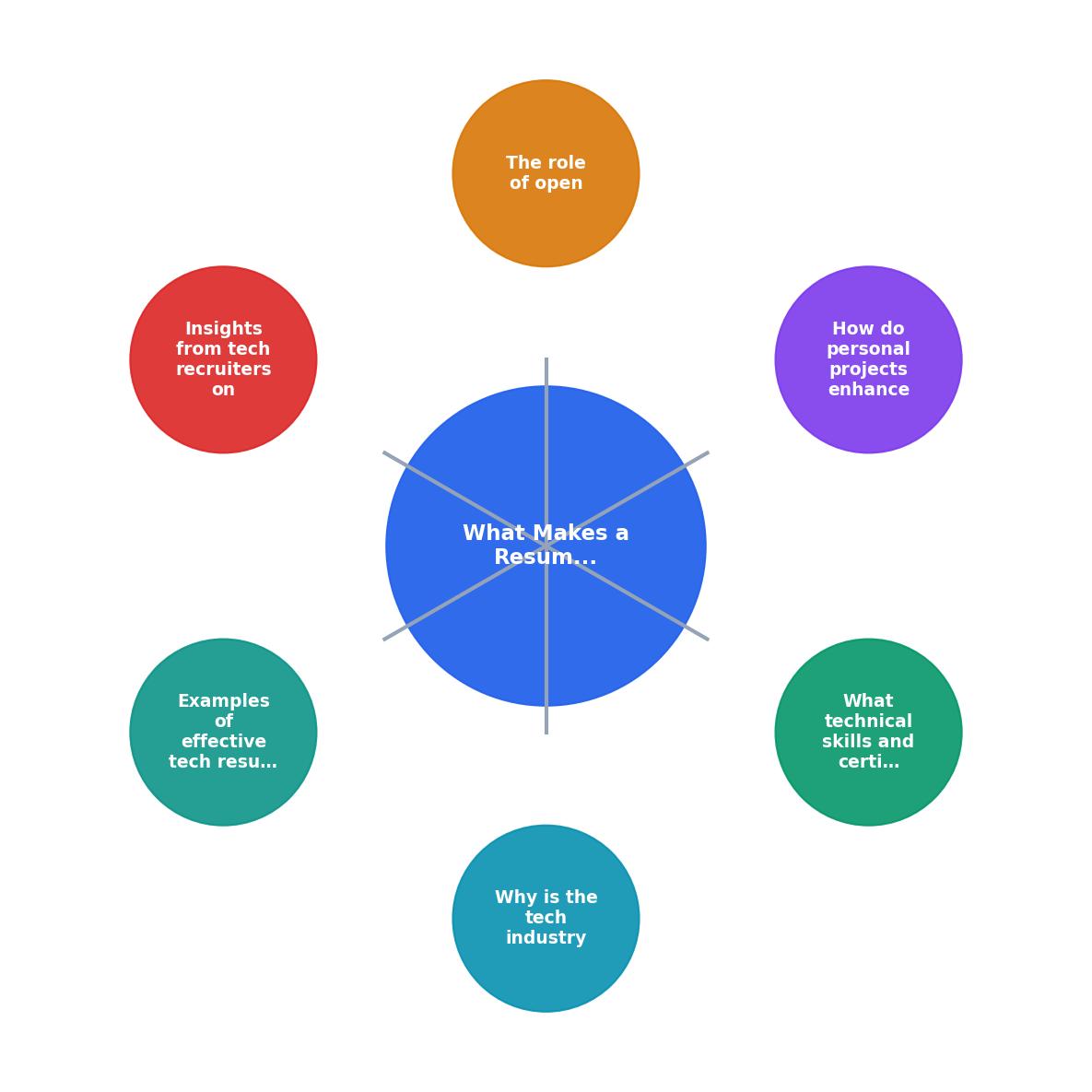
Effective resume sections in action
Here is what separates a forgettable experience bullet from one that gets highlighted:
| Weak Bullet | Strong Bullet |
|---|---|
| Worked on backend services | Built a Go microservice handling 2M requests/day with 99.95% uptime |
| Responsible for database management | Migrated 14 PostgreSQL databases to Aurora, cutting query latency by 35% |
| Helped improve CI/CD pipeline | Redesigned GitHub Actions workflows, reducing deploy time from 45 min to 8 min |
| Participated in code reviews | Reviewed 200+ PRs across 3 teams, reducing production bugs by 22% in Q3 |
Every strong bullet follows the same formula: action verb + specific technology + quantified result. This pattern works for any role, from junior developer to engineering manager.
The dashboard below shows how different resume elements influence recruiter interest, based on common hiring patterns in the tech industry:
Resume Element Impact on Recruiter Interest
Based on common recruiter screening patterns in tech hiring.
Tailoring saves time (and sanity)
Sending the same generic resume to 50 companies is the fastest way to collect 50 rejections. Each posting uses slightly different language, prioritizes different tools, and targets a different level of seniority. Your resume needs to reflect that.
The good news: you do not have to rewrite from scratch every time. Start with a strong base resume, then adjust three things per application:
- Skills section to mirror the posting's exact terms
- Top two bullet points in your most recent role to emphasize the most relevant work
- Professional summary to name the specific role and company
Tech Resume Standout Checklist
Your progress is saved automatically in your browser.
FAQ
Frequently Asked Questions
Additional Resources
- How to Make Your Resume Stand Out in Tech - Making your resume stand out in the tech industry is all about showcasing your skills, experience, and adaptability. It's about proving to potential employers ...
- The Elements of a Tech Resume - Medium - In a tech resume, leave out any subjective descriptions of the skills, like “beginner,” “proficent,” or “advanced.” Those terms mean different ...
- Tech Resume Tips for 2026: Stand Out with No Experience - Clear structure, impactful language, and job-aligned skills make the difference.
