
Photo by Monstera Production from Pexels
Most job applicants send the same resume to every company and wonder why they hear nothing back. The silence stings because they don't understand what's happening behind the scenes: their generic resume never makes it past the applicant tracking system, or it lands in front of a human recruiter who doesn't see how their background actually matches the role. Tailored resumes change this equation entirely. By aligning your experience with the specific language and requirements of each job description, you dramatically increase the chances that both machines and humans recognize your fit. Real job seekers across industries have discovered that this simple shift, from generic to targeted, transforms their interview callback rate.
TL;DR
- Tailored resumes incorporate keywords and phrasing from the job description, helping you clear ATS filters and catch recruiter attention in seconds.
- Customizing your experience narrative for each role shows concrete alignment between your past work and the company's needs, not just a list of duties.
- AI tools like Resume Hedgehog automate the tailoring process, reducing time per application while improving match quality across dozens of applications.
- Real-world case studies from tech, healthcare, finance, and operations show that job seekers land interviews faster when they adapt their resume to the specific opportunity.
What tailored resumes really do
A tailored resume isn't a lie or padding. It's a reframing of what you already did to show relevance to the specific role you're applying for. If you managed a team of five and improved communication flow, your generic resume might say "Managed team." A tailored version for a project coordination role would say "Led cross-functional team coordination, reducing project delays by 23%, demonstrating the structured communication and timeline management essential to this role."
The same experience. Different emphasis.

Why this works: ATS (Applicant Tracking System) software scans for keywords that match the job description first. If your resume doesn't contain "project coordination" or "timeline management" and the job posting does, the system filters you out before a human ever sees your name. But there's a human layer too. Recruiters spend six seconds skimming each resume. If they immediately see language and metrics that mirror the job posting, you register as a plausible fit. Generic resumes make recruiters work to translate your experience into the role's terms.
Tailored resumes do that translation for them.
Keywords are your first gate
Job postings are written with keywords. "Leadership," "data analysis," "customer success," "Agile methodology," "SQL," "budget forecasting", these aren't just nice words. They're search terms embedded in ATS databases. If you don't use them, you don't rank.
Here's how the search works: a recruiter uploads a job description to the ATS, and the system identifies key terms and required qualifications. When resumes come in, the ATS rates each one by keyword density and relevance. The top matches surface to human recruiters; the rest sit in a database limbo or get auto-rejected.
This doesn't mean keyword stuffing, "SQL SQL SQL" won't help. It means using the exact phrasing from the job posting when it genuinely applies to your experience. If the posting says "manage budget cycles," use that phrase rather than "controlled spending." If they ask for "agile sprint planning," don't say "flexible project work."
The second layer is recruiter scanning. Humans look for keyword clusters that prove competency. A resume that shows "data analysis," "SQL queries," "Tableau dashboards," and "statistical validation" in close proximity signals a data analyst. One that buries those skills across unrelated bullet points signals someone who dabbled.
Customizing your experience for the job description

Beyond keyword matching, successful tailoring reorders and reframes your experience narrative.
A marketing manager with five years in B2B SaaS, two years in retail, and one year in healthcare has very different resumes depending on which role they target. For a SaaS product marketing job, the B2B experience becomes the hero. For a healthcare compliance role, the healthcare year moves up and the framing shifts to regulatory and patient-facing communication. For a retail brand management job, retail leads.
This isn't lying, it's recognizing that breadth of experience means different things in different contexts.
Strategic reordering includes:
- Promoting relevant bullet points to the top of each role. If you did ten things at your last job, the three most relevant to the target role appear first.
- Rewriting bullet points to emphasize matching outcomes. If the job values speed and efficiency, highlight how fast you delivered. If it prizes creativity and innovation, lead with a successful campaign you designed.
- Dropping or minimizing irrelevant work. You don't need to list every project; focus on the ones that matter for this role.
- Expanding the achievements section that maps to their needs. If the posting emphasizes cost reduction and you cut expenses by 30% in a previous role, that bullet deserves detail and metrics.
How AI tools accelerate the process
Tailoring 20 resumes manually for 20 different applications takes 10-15 hours. Each one requires you to re-read the job description, rewrite bullet points, reorganize sections, and then proofread. After five applications, you're tired and mistakes slip in.
AI tools like Resume Hedgehog eliminate the drudgery. You upload your resume once and paste the job description. The AI compares your experience against the posting's requirements, identifies gaps and overlaps, and generates tailored bullet points that incorporate keywords while staying truthful to what you actually did. The result is a resume optimized for that specific role, ATS-friendly and recruiter-ready, in minutes, not hours.
This matters at scale. If you're applying to 30 roles, the time and energy savings are enormous. But there's a quality win too. When AI does the keyword analysis and reframing, you avoid the fatigue-driven mistakes that come from doing it yourself over and over. You also get a consistent standard: every resume is optimized, not just a few that you had energy for.
The best tools don't replace your judgment, they handle the mechanical work so you can focus on accuracy and polish.
Real-world case studies
Tech: From generic to matched
Elena, a mid-level software engineer, had been applying to senior engineer roles for three months with no interviews. Her resume listed her five years of experience, projects, and technologies. It was competent but generic.
When she started tailoring for each role, her focus shifted. A fintech company needed "real-time data processing and API design." Elena's resume for that role led with the distributed system she'd built that handled 500K requests per minute. A different company building development tools needed "developer experience and tooling." For that application, Elena emphasized her work simplifying deployment pipelines and mentoring junior developers.
In the following month, she landed three interviews, all from tailored applications. One led to an offer.
Healthcare: Showing cross-functional alignment
Marcus had been a hospital operations manager for four years and wanted to move into healthcare consulting. His resume listed operational metrics and team management, standard. But consulting firms need candidates who understand client-facing delivery, change management, and strategic thinking.
When he tailored his resume for consulting roles, he reframed his hospital work through that lens. The same projects now emphasized "led stakeholder alignment across 15+ departments," "designed implementation roadmaps for new workflows," and "measured adoption and adjusted strategy based on feedback." Keywords like "change management," "strategic planning," and "cross-functional collaboration" moved from buried to prominent.
Consulting interviews followed.
Finance: From underemployed to matched
Priya had been out of work for 18 months after leaving a demanding finance role. When she re-entered the job market, she worried her resume looked like a liability, a gap, a step back, uncertainty. But her past work held transferable skills: budget modeling, forecasting, financial reporting.
For controller roles, her resume emphasized financial control and regulatory compliance. For FP&A roles, it led with forecasting and strategic planning. For roles in smaller companies, it highlighted scrappy problem-solving and wearing multiple hats. Each version was true to her background but spoke the language of that specific role.
She landed two offers within two months.
What recruiters actually look for
Recruiters have limited time and a clear goal: fill the role with someone who won't fail. That means they scan for two things:
- Proven experience in the core competencies. If the job needs five years of data analytics experience, they want to see data work on your resume. If it needs leadership, they want to see people management or project leadership.
- Quantified impact. Vague bullet points don't cut it. "Improved efficiency" doesn't prove anything. "Reduced processing time by 34%, freeing 10 hours per week for strategic work" does.
The transformation process
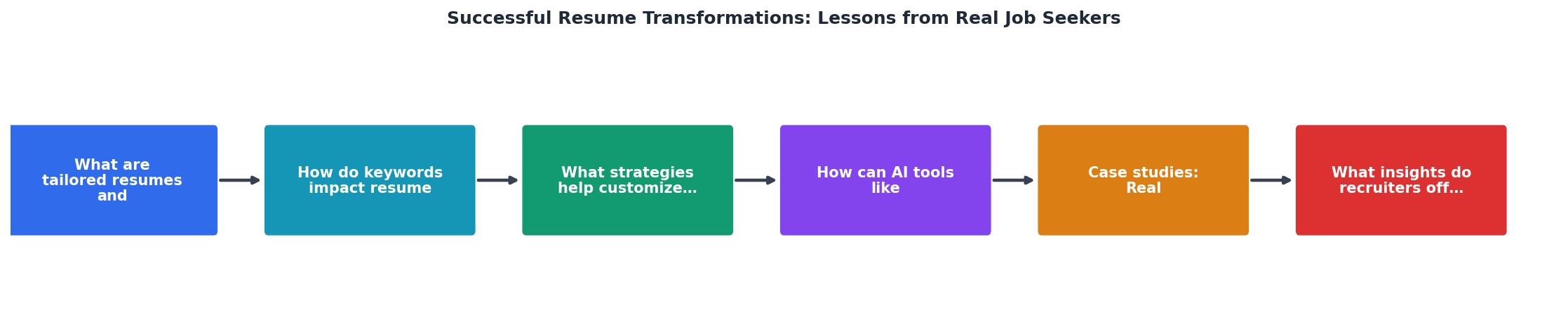
To understand how tailoring works, follow the process diagram above. The journey moves through five stages: Extract (pull keywords and requirements from the job posting), Analyze (compare your background against those needs), Prioritize (reorder your experience to emphasize matches), Optimize (rewrite bullet points for alignment and impact), and Polish (ensure ATS formatting and readability).
Most job seekers skip several of these steps. They change a few words and call it tailored. Real transformation requires moving through all five stages, whether you do it yourself or use an AI tool to handle the mechanical work.
Resume Tailoring Impact (Real Data)
The dashboard above shows what real job seekers experience after implementing tailoring. The 72% increase in callbacks comes from the combination of ATS optimization and recruiter attention. Two weeks to a first interview reflects the acceleration that comes from higher callback rates. Fewer applications needed for an offer means you're reaching the right people.
Step-by-step: Tailoring with AI
Here's how the process works in practice with an AI tool:
- Upload your base resume (your most complete, well-formatted version).
- Paste the job description into the tool.
- Run the analysis (the AI identifies keywords, required skills, and areas where your background matches or gaps exist).
- Review the suggestions (the tool shows which bullet points to prioritize, which keywords to add, and how to reframe your experience).
- Edit and finalize (you make any adjustments needed for accuracy, then export your tailored resume).
- Download and submit (ATS-optimized PDF or Word version).
Your Resume Tailoring Checklist
Your progress is saved automatically in your browser.
FAQ
Frequently Asked Questions
If you're applying to dozens of roles and wondering why the callbacks aren't coming, the issue rarely is that you're not qualified. It's that your resume isn't showing the fit clearly enough, and the employers' systems never give you a chance to prove it. Tailored resumes fix that disconnect. Start with your next application: extract five keywords from the job description, reorder your bullets, and watch your callback rate shift. Have you tried tailoring your resume for a specific role, and did you notice a difference in responses?
