Photo by Tima Miroshnichenko from Pexels
Sustainability consulting is a high-growth field, but standing out requires a resume that speaks the language of both environmental impact and business results. Most career changers coming into sustainability don't know which skills to spotlight or how to frame their previous experience in this new context. A strong sustainability consultant resume bridges that gap by showcasing your technical knowledge, project wins, and certifications in a way that passes ATS systems and convinces hiring managers you belong in the role.
TL;DR:- Highlight quantifiable sustainability project outcomes (waste reduction %, emissions cuts, cost savings)
- Feature certifications like LEED, B Corp, ISO 14001, or sustainability-specific credentials
- Reframe prior experience using sustainability terminology and frameworks
- Include specific environmental metrics, compliance achievements, and stakeholder management results
- Use industry keywords: carbon footprint, circular economy, ESG, renewable energy, supply chain optimization
What does a sustainability consultant do?
Sustainability consultants advise organizations on reducing environmental impact, improving social responsibility, and managing economic sustainability. The role spans energy efficiency audits, supply chain optimization, carbon footprint assessment, waste management strategy, regulatory compliance, and ESG (environmental, social, governance) reporting. The work is often cross-functional, you'll partner with operations teams, finance, marketing, and C-suite leaders to build business cases for green initiatives.
If you're moving into this field from operations, project management, environmental science, or even finance, your resume needs to show that you understand both the environmental side and the business logic that drives decision-making in corporate settings.
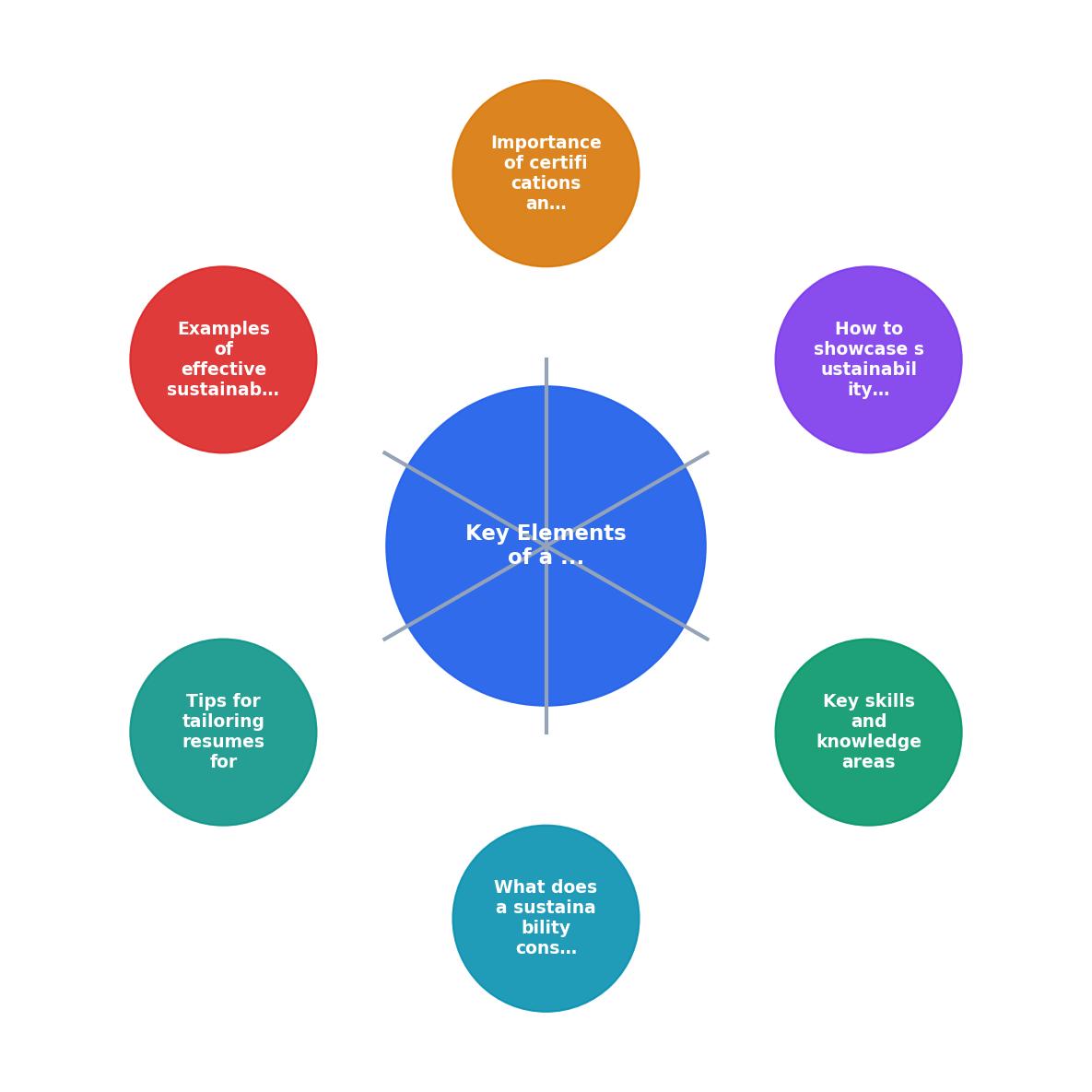
Key skills and knowledge areas for sustainability consultants

A winning sustainability consultant resume demonstrates mastery across several core competencies:
- Data Analysis – Collecting and analyzing environmental, social, and economic data to assess sustainability performance and identify areas for improvement.
- Carbon accounting and emissions measurement – Understanding Scope 1, 2, and 3 emissions and using tools like carbon accounting software to quantify impact
- Regulatory compliance – Knowledge of environmental regulations (EPA, ISO 14001, GDPR data handling for ESG reporting), industry standards, and reporting frameworks (GRI, SASB, TCFD)
- Stakeholder engagement – Managing relationships with internal teams, external partners, NGOs, and regulatory bodies to align on sustainability initiatives
- Project management – Leading multi-phase initiatives from pilot to scaled implementation (renewable energy projects, zero-waste programs, circular economy pilots)
- Supply chain optimization – Auditing supplier practices, reducing logistics emissions, and evaluating circular sourcing models
- ESG and impact reporting – Building sustainability reports, communicating results to investors and the public, and tracking key performance indicators
- Financial acumen – Developing business cases for green investments, calculating ROI on sustainability projects, understanding carbon pricing and cost-benefit analysis
How to showcase sustainability projects in a resume
Your project experience is your most effective selling point. Generic descriptions like "managed environmental initiative" won't cut it. Hiring managers want to see impact.
Use the format: [Project name] – [Your role] – [Outcome with metric]
Here's a strong example:
"Led carbon footprint reduction initiative across 12 manufacturing facilities, implementing energy audits and supplier engagement program. Achieved 34% reduction in Scope 1 and 2 emissions (8,000+ tons CO2e annually), resulting in $2.1M energy cost savings over three years."
Compare that to a weak version: "Worked on environmental projects to reduce carbon emissions."
The strong version includes:- Scale (12 facilities, 3 years)
- Specific metrics (34%, 8,000 tons, $2.1M)
- Your ownership ("led")
- Method (audits, supplier engagement)
- Business outcome (cost savings)
- What was the problem or business goal?
- What specific actions did you take?
- What was the quantifiable result (emissions reduction %, cost saved, waste diverted, renewable energy installed)?
- Who did you work with (internal stakeholders, external partners, regulators)?
Importance of certifications and industry knowledge
Certifications prove you've completed formal training in sustainability principles and methods. They're especially valuable when you're making a career pivot, they signal serious commitment and remove doubt about gaps in your background.
High-impact certifications for sustainability consultants include:
- LEED AP (Leadership in Energy and Environmental Design) – Top credential for building sustainability; many roles require or prefer this
- ISO 14001 Lead Auditor – Environmental management systems certification, valuable for compliance-heavy roles
- GRI Standards Certification – Teaches ESG and sustainability reporting frameworks recognized globally
- B Corp Certification (or B Corp Assessor training) – Relevant for companies pursuing certified B Corp status
- Certified Sustainability Professional (CSP) – Offered by ICMAD; comprehensive, respected credential
- Carbon Trust Standard Auditor – Specialized in carbon accounting
- Science-Based Targets (SBTi) Practitioner – For organizations setting climate goals aligned with Paris Agreement
- Renewable Energy Associate – For roles focused on solar, wind, or other renewable projects
- Sustainability frameworks you've used (Circular Economy Canvas, Ellen MacArthur Foundation, Natural Capital Protocol)
- Standards you understand (Science Based Targets, UN Sustainable Development Goals, ESG rating methodologies from MSCI, Sustainalytics, or Bloomberg)
- Tools and software (carbon accounting platforms like SIMAP or Cool Farm Tool, ESG reporting software like Workiva or Anaplan, LCA software like OpenLCA)
Examples of effective sustainability consultant resume sections
Here are three actual resume sections that work:
Professional Summary (for a career changer):
"Environmental consultant with 8 years of operations and supply chain experience transitioning to sustainability strategy. Proven track record designing and implementing cost-saving efficiency programs that reduced environmental impact at scale. GRI Standards certified. Seeking to leverage project management expertise and newfound sustainability knowledge to drive enterprise decarbonization initiatives."
- Designed and executed zero-waste facility program across 6 locations, diverting 420 tons of waste from landfills annually (62% waste reduction)
- Partnered with procurement team to audit 200+ suppliers for ESG compliance; identified 15 high-risk vendors and implemented corrective action plans
- Developed GHG emissions inventory per Scope 1, 2, and 3 methodology; identified top 5 emission sources and created 5-year decarbonization roadmap targeting 50% reduction
- Managed $800K sustainability budget; secured board approval for 2 MW rooftop solar and battery storage system with 7-year payback"
These sections are specific, quantified, and written in sustainability industry language. They immediately signal competence to both ATS systems and human reviewers.
Tips for tailoring resumes for sustainability roles
Every sustainability job is different. A utility company hiring for renewable energy strategy needs different skills than a consumer goods firm building a circular product line or a real estate firm certifying buildings for LEED.
Read the job description carefully and identify the top 5-7 keywords and focus areas. If the posting emphasizes "carbon neutral operations," make sure you have a bullet point showing your carbon accounting work. If "stakeholder engagement" appears three times, highlight your communication and partnership successes.
Reorder your resume bullet points to match the job priorities. Your strongest, most relevant wins should appear first in each section. If the job prioritizes renewable energy but you have more supply chain expertise, lead with renewable energy projects even if they're less recent.
Use the exact terminology from the posting. If they write "decarbonization pathway," use that phrase rather than "emissions reduction plan." If they mention "circular economy principles," and you've worked with them, say so explicitly.
Customize your professional summary for each application. A one-line tweak that ties your background to the specific company and role increases your chances of getting past both ATS and the hiring manager's first read.
Resume checklist for sustainability consultants
Sustainability Consultant Resume Checklist
Your progress is saved automatically in your browser.
FAQ
Frequently Asked Questions
A strong sustainability consultant resume opens doors because it proves you can talk the talk and deliver results that matter to companies serious about their environmental and social impact. Start by identifying your most impressive quantified outcomes, then translate your background into the language of sustainability. The hiring manager will feel confident you're not just looking for a job title, you understand the role and you can contribute immediately.
Resume Review Tool
Use this quick assessment to evaluate your sustainability consultant resume before submitting:
- Quantified Impact: Do at least 3 bullet points show specific metrics (%, $, tons)?
- Certifications: Are relevant certifications listed with issuing organization and year?
- Industry Language: Does your resume use terms from the job posting (carbon accounting, ESG, supply chain optimization)?
- Business Outcomes: Does each project tie to financial or operational impact, not just environmental metrics?
- Career Bridge: If changing careers, is your prior experience clearly reframed for sustainability roles?
Score 5/5 on this checklist and your resume will stand out to sustainability hiring managers.
Additional Resources
- How to write a sustainability consultant CV (with example) - How to write a sustainability consultant CV · 1. Review the job description · 2. Provide your contact information · 3. Include a professional ...
- [Sustainability Consultant CV example + guide [Land top jobs]](https://standout-cv.com/cv-examples/government-and-public-service/sustainability-consultant-cv) - Important skills for your Sustainability Consultant CV · Data Analysis · Life Cycle Assessment (LCA) · Carbon Footprinting · Environmental Compliance · Renewable ...
- Top 3 tips to tailor your resume for sustainability environmental ... - A resume checklist with detailed guidance and best practices seen in the industry. Part 2: Tips to tailor your resume Part 3: Prepare for the ...