
Your resume just got a boost from Resume Hedgehog, tailored, ATS-optimized, and job-specific. Now the cover letter sits on your desk, generic and mismatched. The problem is real: send a stock letter and hiring managers spot it immediately. But rewriting from scratch for every application drains time you don't have. The fix is to use the same job description that shaped your resume to craft a letter that amplifies it, not repeats it.
TL;DR:- Use the job description to extract priorities, tone, and culture signals your resume doesn't address.
- Write a letter that showcases depth on 2–3 key requirements, not all of them.
- Avoid verbatim echoing of your resume; the letter answers "why you" and "why them."
- Align your letter's themes to your resume's keywords without duplication.
- Pair a tailored resume with a tailored letter to maximize impact on both human readers and ATS systems.
Key Takeaway
A cover letter is not a summary of your resume—it's your chance to show personality, explain gaps, and answer why you want this specific job and why you're the right fit. By extracting the three most important requirements from the job description and building mini-stories around them, you create a document that complements your optimized resume without repeating it. When you spend 15 minutes per letter to address culture fit, highlight your strongest connection points, and use the job description's language and tone, you move from the generic pile into the interview pile.
Your resume has been optimized to pass the ATS and speak the language of the job. Now it's time to use that same job description to write a cover letter that works with your resume, not against it. A well-tailored cover letter does something your resume alone cannot: it shows personality, explains gaps, signals culture fit, and answers the question recruiters ask after scanning your resume: "Should I care about this person?"
The mistake most people make is treating the cover letter as a summary of the resume. It isn't. A cover letter is a chance to be strategic about what your resume doesn't say. When you're sending 20 applications, a generic letter feels like 20 rejections waiting to happen. But when you spend 15 minutes per letter, using the job description as your guide, you create a document that feels written for this role, not at this role.
Why this matters right now

Recruiters still read cover letters. Not every one, but enough. A tailored letter signals respect for the role and attention to detail, both things employers notice. What they don't read is a letter that could describe any job at any company. They spot boilerplate in seconds and move on.
The job description is a roadmap. It tells you what the hiring manager prioritizes, the language they use, the problems they need solved, and often the tone of the team. Your resume speaks to what you've done. Your letter speaks to why you want this job and why you're the right fit. When both documents pull from the same job description but speak in different voices, they become stronger together.
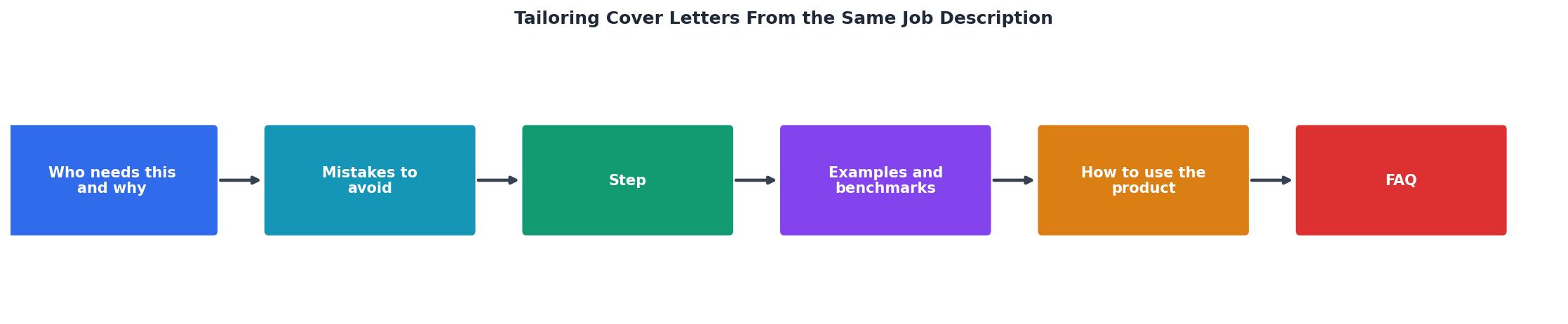
Mistakes to avoid
Before you start writing, know what kills a cover letter attached to an optimized resume.
Repeating your resume verbatim. Your letter should not be a narrative version of your resume. If you worked on a Salesforce implementation, your resume shows the project; your letter explains what you learned or why that specific problem excites you about this new opportunity. Don't reuse sentences.
Ignoring the tone of the job description. A job post for a startup uses different language than one for a Fortune 500 company. A creative agency wants to hear different energy than a compliance team. Read between the lines. Are they formal or conversational? Urgent or methodical? Your letter should match that tone without feeling forced.
Addressing the wrong pain point. Not all requirements in a job description are equal. A "nice-to-have" and a "must-have" are different. Spend your letter on the things listed first or emphasized multiple times, not everything.
Generic opening. "I am writing to express my interest..." is noise. Open with something specific: a problem they mentioned, a project you know they're working on, or a reason you want to work there beyond the paycheck.
Forgetting to sell yourself on culture and team fit. Your resume proves you can do the job. Your letter proves you want this job and will thrive in this environment. Use the job description to infer what matters to them, growth, autonomy, collaboration, impact, and show you align.
The step-by-step workflow
Step 1: Extract the real requirements
Read the job description three times. The first time, read for emotion. What tone do they set? What language shows up repeatedly? Do they say "fast-paced" or "collaborative"? Do they emphasize "autonomous" or "team player"?
The second time, highlight the 3–5 requirements that show up first or get the most emphasis. These are your anchor points. A mid-level marketing role might list 20 skills; focus on the top three. Your letter will address those.
The third time, look for problems hidden in the job description. If they mention "managing stakeholder expectations" twice, that's a pain point. If they ask for "strong documentation habits," they've probably been burned by poor handoffs. These clues tell you what stories to tell.
Step 2: Identify your three strongest connection points
Now that you know what matters to them, map your background against it. You likely have more relevant experience than any single letter can hold. Choose your three strongest, most specific examples that connect to the job description's language.
If they emphasize "driving process improvement" and you led a project that cut deployment time by 40%, that's a point. If they say "mentoring junior engineers" and you've done it, that's another. If they want "experience shipping products under tight deadlines" and you've shipped three, pick the most similar one in context.
Write these down as bullet points. They become the skeleton of your letter.
Step 3: Craft your opening with specificity
Skip the generic greeting. Open with something that shows you've done your homework.
Good: "When I saw that your team is expanding the API platform, I knew I wanted to be part of it. I spent two years building integrations at TechCorp, and I've seen firsthand how a clean API can unlock efficiency across an entire organization."
Better than: "I am writing to express my strong interest in the Senior Backend Engineer position."
Your opening should reference something specific from the job description or company, not just the job title. This immediately signals that your letter was written for this role, not mass-produced.
Step 4: Build the body around your connection points
Use your three strongest examples as mini-stories. For each, follow this structure:
- Reference the requirement from the job description.
- Give a specific example from your experience.
- Show the outcome or what you learned.
- Connect it back to what they need.
"Your description mentions the need to improve documentation practices. At my current company, I inherited a codebase with almost no onboarding guides. I created a tiered documentation system, quick-start, architecture, troubleshooting, and within three months, new developers were productive 50% faster. I'd bring that same focus to your team's knowledge management challenges."
This takes 3–4 sentences. Build two or three of these into your letter body. You now have substance that complements your resume without repeating it.
Step 5: Address culture and team fit
Your resume proves competence. Your letter proves alignment. Use the job description to infer what kind of person they're looking for.
If they emphasize "collaborative environment," show you're a listener, not just a doer. If they mention "growth mindset," tell them about a time you learned something hard or asked for feedback. If they talk about "impact," explain why that matters to you, not just that you want to drive it.
One paragraph. Keep it genuine. "I thrive in environments where..." followed by a reason why, not just a claim.
Step 6: Close with clarity and a call to action
Your closing should be brief, confident, and not robotic.
Good: "I'd love to talk about how my experience scaling infrastructure could help your team. I'm available for a call next week."
Avoid: "I look forward to hearing from you and the opportunity to contribute my skills."
Make it easy for them to move forward. Suggest a time. Show energy without desperation.
Examples and benchmarks
Let's look at a real scenario. Suppose the job description for a Product Manager role says:
"We're looking for someone to own our onboarding experience. You should have experience shipping features end-to-end, working with design and engineering, and improving user retention metrics. We move fast and value ownership and scrappiness."
A weak cover letter would write: "I have shipped features end-to-end. I have worked with design and engineering. I have improved retention metrics. I am excited about this role."
A strong cover letter would write: "When I read that you're rebuilding the onboarding experience, my first thought was the three weeks I spent with our design team creating a new signup flow. We cut drop-off by 22%, which added $400K ARR. More importantly, I learned that onboarding isn't just a feature, it's your first conversation with a customer. That's exactly the mindset I'd bring to your team, and I know there's a lot of room to experiment faster than we did."
The difference: specifics, outcomes, mindset, and evidence of the culture fit ("experiment faster"). The strong version also avoids repeating the resume; it expands on it.
Benchmarks for length and tone
A cover letter should be 250–400 words. Not a page, not three paragraphs. Around three solid paragraphs.
Tone should match the company. A startup cover letter can be conversational. A law firm's should be professional but not stiff. A nonprofit might appreciate warmth and passion. Read the job description's language and mirror it.
How to use Resume Hedgehog alongside your letter

Resume Hedgehog optimizes your resume to the job description, highlighting keywords and reframing your experience to match what the ATS and hiring manager are looking for. Your cover letter should amplify that, not contradict it.
Here's the workflow:
- Upload your resume and job description to Resume Hedgehog. You get back an optimized resume with your most relevant experience and keywords front-and-center.
- Read the optimized resume and the job description together. Notice what Resume Hedgehog emphasized. Those are your hot buttons.
- *Write your cover letter using the job description and the themes from your optimized resume. Don't copy sentences, but align your letter's stories to reinforce what your resume already proved.
- Check for overlap. If your resume says "Led migration to microservices," your letter shouldn't repeat that. Instead, it might say "I thrive in environments where architecture decisions are made quickly, and I've always approached technical decisions with business outcomes in mind."
How to make it faster
Writing tailored letters for 20 applications feels like a time sink. Here's how to speed up without losing quality.
Create a template for your three strongest anchors. Write the structure once: opening, three connection-point paragraphs, culture fit paragraph, closing. Save it. For the next application, swap out the specific examples and job details, but keep the framework. You're now working from a scaffold, not a blank page. Reuse stories, not sentences. You probably have 8–10 strong professional stories in your background. You'll use the same ones for multiple roles, but framed differently each time. Your product launch story works for a product manager role and a marketing role, just with different emphasis. Reframe, don't copy-paste. Use keywords from the job description. Resume Hedgehog pulled these out for your resume already. Use the same terms in your letter body when they fit naturally. Consistency across both documents strengthens your application in the eyes of both ATS systems and humans. Set a timer.* Spend 15 minutes per letter max. This forces you to be deliberate. You'll pick your three strongest points and stick to them instead of overthinking every word.Interactive guide: Cover letter versus resume
To clarify the different roles these documents play, here's a side-by-side view of what each one should accomplish:
Your Resume
- Proves you can do the job
- Shows your skills and track record
- Uses keywords from job description
- Optimized for ATS and scanning
- Answers: "What have you done?"
- Factual, structured, scannable
Your Cover Letter
- Proves you want this specific job
- Shows personality and alignment
- Explains context your resume can't
- Optimized for human readers first
- Answers: "Why you? Why them?"
- Narrative, personal, strategic
When you understand these roles, your letter stops feeling like a duplicate and starts feeling like a complement.
Real-world pacing and progress
Research shows that a tailored cover letter combined with an optimized resume improves your callback rate compared to a generic resume alone. The step-by-step approach, extracting requirements, mapping your experience, addressing culture fit, takes 15–20 minutes per application but moves you from the "no response" pile into the "schedule a call" column faster.

Actionable takeaways from this guide
Cover Letter Tailoring Checklist
Your progress is saved automatically in your browser.
FAQ
Frequently Asked Questions
Additional Resources
- DESCRIPTION Definition & Meaning - The meaning of DESCRIPTION is an act of describing; specifically : discourse intended to give a mental image of something experienced.
- DCMI: Description - The LRMI™ Working Group is charged with defining and executing DCMI work on the LRMI family of metadata specifications. Application Profiles Working Group.
- Description - Returns the description of the given page as defined in front matter.