

Photo by Vitaly Gariev from Pexels
Your resume lands in a pile of 200 others for a single teaching position. The hiring manager scrolls through the stack in minutes. If your skills aren't crystal clear on the first read, you're gone. Teachers often bury their best work under generic job titles and vague descriptions. This article shows you exactly how to surface the skills schools actually hunt for, how to back them up with numbers, and how to make sure your resume survives the ATS screening that filters out most applications before a human ever sees them.
TL;DR:- Highlight core teaching skills like classroom management, curriculum development, differentiated instruction, and assessment design.
- Use quantifiable outcomes (student test scores, attendance rates, parent engagement metrics) to demonstrate impact.
- Mirror job description keywords and include ATS-friendly formatting to bypass automated screening.
- Integrate skills into job duties and achievements, not into a separate generic skills list.
Why Key Skills Matter in a Teacher Resume
Most teacher resumes fail at the first checkpoint: the ATS (Applicant Tracking System). Schools use these systems to filter applications by keyword match. If your resume doesn't contain the exact skills and terms the posting asks for, it gets automatically rejected. But there's a second reason skills matter. Hiring principals scan resumes in under 60 seconds. They're looking for proof that you can do the job, not a narrative of where you've worked. Teaching is skill-intensive. Classroom management, curriculum design, student assessment, parent communication, and technology integration are non-negotiable. If your resume doesn't make these skills obvious within the first 10 seconds, the reader has already moved on.
The difference between a resume that lands an interview and one that doesn't often comes down to this: specificity. "Taught high school English" tells them nothing. "Implemented Socratic seminar discussions that improved essay scores by 18% and raised attendance by 12%" tells them exactly what you can deliver.
What Are Essential Skills for Teachers?

Teaching requires a blend of hard and soft skills. Here are the ones that make the strongest impression on hiring managers:
Classroom Management, Your ability to create a structured, productive learning environment. This means establishing routines, handling disruption, building rapport, and maintaining focus without heavy-handed tactics. Schools are drowning in discipline referrals; a teacher who prevents problems before they start is worth their weight in gold.
Curriculum Development, Not just delivering someone else's lesson plan. Schools want teachers who adapt, modify, and create materials that fit their specific students. This includes backwards planning from standards, aligning assessments to outcomes, and integrating cross-curricular connections.
Differentiated Instruction, Teaching a room full of kids with wildly different needs and reading levels. You use scaffolding, tiering, flexible grouping, and multiple modalities to reach every learner. Schools are increasingly mandated to serve diverse learners in inclusive settings.
Assessment and Data Analysis, Using formative and summative assessments to track progress, identify gaps, and adjust instruction. Schools now live and die by test scores and growth metrics; teachers who can talk data fluently stand out.
Classroom Technology Integration, Blended learning, learning management systems (Google Classroom, Canvas, Schoology), interactive tools (Nearpod, Peardeck), and tech troubleshooting. "Tech integration" is no longer optional.
Parent and Family Engagement, Communication, conferences, building relationships with families, creating welcoming classroom cultures. Schools prioritize this heavily.
Differentiated Professional Development, Some teachers mentor, lead workshops, or facilitate professional learning communities. This leadership credential strengthens your candidacy significantly.
How to Present Skills in Your Experience Section

The worst place to put your skills is in a separate "Skills" section. A list of buzzwords like "Classroom Management" and "Curriculum Development" proves nothing. Instead, weave skills into your job descriptions and achievements. Here's how:
Start with the skill, follow with proof. Instead of:- "Responsible for classroom management"
- "Established clear behavioral expectations and routines that reduced discipline referrals by 35% and increased instructional time from 28 to 42 minutes per period."
Mirror the job posting language. If the posting says "differentiated instruction" and "inclusive classroom," use those exact phrases in your resume. The ATS scans for keyword matches. More important, when the principal reads your resume, they see you speaking their language. If they use "formative assessment" and you write "student progress monitoring," you're both saying the same thing, but the match feels weaker.
Layer skills into your bullet points. Each achievement should contain at least one skill and one result. Look at this example:
"Designed and delivered 24 differentiated mini-lessons aligned to Common Core standards, using formative assessments to group students into three proficiency tiers; 89% of students met grade-level benchmarks by end of term."
This single bullet point hits:- Curriculum development (designed lessons)
- Differentiation (proficiency tiers)
- Assessment (formative assessments)
- Standards alignment (Common Core)
- Measurable outcome (89% benchmark)
How to Quantify Achievements in Teaching
Numbers make teaching tangible. But not all metrics are created equal. Here are the quantifiable outcomes that matter:
Student Achievement Metrics- Test scores (percentage improvement, absolute gains, growth percentile)
- Assignment/project pass rates
- Benchmark assessment performance
- Grade distribution shifts (e.g., "reduced D/F rate from 18% to 7%")
- Portfolio assessment scores
- Classroom attendance rate
- Participation rate (hands raised, discussion frequency)
- Homework completion rate
- Assignment submission rates
- Percentage of students meeting grade-level standards
- Percentage of students meeting growth targets
- Performance gains for specific subgroups (ELL, special education, low-income)
- AP exam pass rates or college-readiness metrics
- Number of students served (in electives, clubs, intervention groups)
- Retention rate (students staying in the program or advanced course)
- Student feedback scores or survey results
- College acceptance rates (for high school teachers)
- Number of professional development sessions led
- Teachers trained or mentored
- Curriculum units developed or revised
- Grant funding secured
"Taught 115 students across five sections of 10th-grade Geometry using Desmos and station rotations to target individual skill gaps. Implemented pre- and post-assessments that showed 77% of students met proficiency targets by end of semester, up from 64% the prior year under traditional instruction. Led two professional development sessions on blended learning adoption for 28 teachers district-wide."
This bundles enrolment (115 students), specific pedagogy (Desmos, stations), a benchmark metric (77% proficiency, up from 64%), and professional leadership. It shows depth and scope.
Get the baseline. Before you can show growth, you need a starting point. "Increased pass rate by 12%" only works if you mention that it started at 63%. Include both the before and after number.
Time matters. Specify the period: "one semester," "two years," "this school year." A 15% improvement over nine months is more impressive than the same improvement over five years.
How to Ensure ATS Compatibility

The ATS doesn't read your resume the way a human does. It's a keyword scanner. Here's what works and what doesn't:
Use standard section headings. The ATS expects "Experience," "Education," "Certifications," "Skills." Avoid creative headings like "My Journey" or "Highlights." If the machine can't find the section, it can't parse it.
Keywords from the job posting. Copy exact phrases from the posting. If it says "response to intervention (RTI)," use "RTI" or "response to intervention" in your resume. If it mentions "IEP compliance," include it. The ATS matches strings. You want as many matches as possible.
"Many schools have embraced digital tools, even for their youngest students.">, Strong Teacher Resume Tips: Skills, Degrees & Certifications Stick to simple formatting. Avoid:
- Tables, columns, or text boxes
- Special characters or symbols (★, →, ✓)
- Multiple fonts or sizes
- Images or graphics embedded in the resume
- Headers and footers that shift across pages
Use standard fonts. Arial, Calibri, Times New Roman. The ATS renders some fonts poorly. When in doubt, use something ubiquitous.
Save as .pdf or .docx. Check the job posting. If it doesn't specify, use PDF. PDFs preserve formatting across systems better than Word files do.
Name your file properly. Don't call it "Resume_FINAL_v3_for_real_updated.docx." Use "[YourName]_TeacherResume.pdf" or similar. It looks professional and the hiring manager can find it easily.
Spell out acronyms the first time you use them. The ATS scans for exact matches. If you write "STEM" without introducing it first, someone searching for "Science, Technology, Engineering, Mathematics" might miss your entry. Best practice: write it out, then use the acronym. "Science, Technology, Engineering, and Mathematics (STEM) integration across the curriculum."
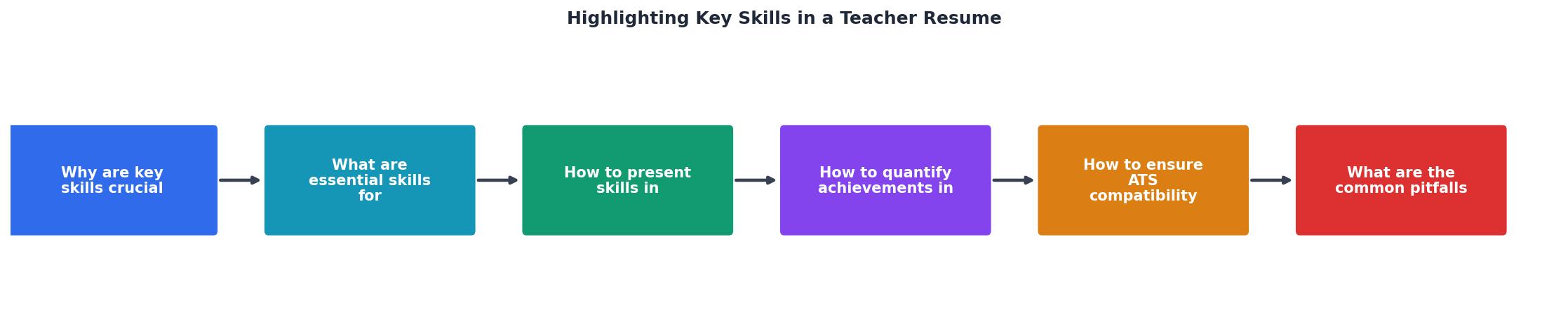
Common Pitfalls to Avoid
Teachers make predictable mistakes on resumes. Here are the ones that hurt most:
Generic job descriptions. "Taught mathematics to 150 students. Graded assignments. Communicated with parents." This could describe anyone. Every teacher does these things. You need to distinguish yourself with specifics: what you taught, how you taught it, what students achieved.
Focusing on duties instead of impact. "Responsible for creating lesson plans" is a duty. "Created 48 differentiated lesson plans that reduced learning gaps by 22% between advanced and struggling learners" is impact. Hiring managers care about results, not responsibilities.
Forgetting the soft skills. Teaching requires emotional intelligence, collaboration, communication, and resilience. But don't list these in a generic skills section. Show them through your achievements. "Collaborated with special education teacher to co-teach Algebra II, adjusting pacing and scaffolding for 7 students with IEPs; all 7 passed the end-of-course exam" demonstrates collaboration and inclusion work.
Overstating credentials. Teachers sometimes claim leadership experience they didn't actually have. Don't say you "led" a professional development initiative if you attended it. Be precise: "Attended," "Assisted," "Co-facilitated," "Led." Schools check references. Exaggeration gets caught.
Ignoring the job posting. Your resume should change slightly for each position. A posting for an international school values global perspective and cultural competency. One for a charter school might emphasize data-driven instruction and innovation. Customize your bullets and keywords. It takes 15 minutes and dramatically increases your chance of getting past the ATS and impressing the reader.
Burying recent work. Your most recent position should have the most bullet points and the strongest achievements. Older positions get shorter treatment. Hiring managers care most about what you're doing now.
Interactive Skills Assessment Dashboard
Here's a visual breakdown of how to balance different skill categories in your teacher resume. This shows an example of a strong distribution across essential teaching competencies:
Example: Strong Skills Distribution
This dashboard shows how a well-rounded teacher resume distributes emphasis across core competencies. Notice that no single skill dominates. You're demonstrating breadth while maintaining depth. Each skill should be supported by at least one strong achievement bullet point in your experience section. The percentages represent how prominently each skill appears across your entire resume (weighted by bullet points and evidence).
Teacher Resume Skills Checklist
Your progress is saved automatically in your browser.
FAQ
Frequently Asked Questions
Your resume is your first conversation with a school. Before you ever sit down for an interview, this document needs to prove you understand what matters: student growth, instructional quality, and measurable impact. When you weave specific skills into achievements backed by numbers, and you use the language the school is looking for, you move from the rejection pile to the interview schedule. The stronger your resume, the stronger your negotiating position when an offer comes.
Additional Resources
- Strong Teacher Resume Tips: Skills, Degrees & Certifications - 1. Highlight Your Educational Background. List your most advanced degrees first. consider listing your graduation dates. Describe one or two field trips and ...
- 15+ Teacher Skills You Need On Your Resume in 2025 - 15+ Teacher Skills You Need On Your Resume in 2025 · 1. Cultural Responsiveness · 2. Technology Integration · 3. Social-Emotional Learning (SEL) · 4 ...
- Teacher Resume Skills with Examples, Tips, and Guide - Top Teacher Skills To Include on Your Resume · Communication skills · Classroom management · Lesson planning and curriculum development.
