

You have led cross-functional teams, shipped products on time, and kept budgets from spiraling out of control. Yet your resume keeps vanishing into the void after you click Apply. The problem is rarely your experience. It is almost always how that experience is packaged for the automated systems and hiring managers scanning your application. This guide breaks down exactly how to build a project manager resume that gets past the ATS and onto a recruiter's desk.
Photo by Yan Krukau from Pexels
TL;DR:- Lead with quantified project outcomes (budget saved, time reduced, team size managed) rather than generic duty lists.
- Mirror the exact keywords from each job posting, especially certifications like PMP, Agile, and Scrum.
- Structure your resume in reverse-chronological format with a strong summary, a dedicated skills section, and achievement-driven bullet points.
- Use Resume Hedgehog to match your resume to each specific job description automatically.
Highlight the Right Skills
Not every skill deserves equal real estate on your resume. Hiring managers scanning project manager applications look for a specific cluster of competencies. Here are the ones that consistently appear in PM job descriptions across industries:
- Leadership: Demonstrated ability to guide teams of 5 to 50+ people toward a shared goal.
- Communication: Written and verbal skills, including stakeholder reporting, executive presentations, and cross-department coordination.
- Problem-solving: Concrete examples of identifying risks early and resolving blockers before they derailed timelines.
- Time management: Proven track record of delivering milestones on schedule.
- Risk management: Experience with risk registers, mitigation plans, and contingency budgeting.
- Budget oversight: Managing project budgets from $50K to multi-million dollar programs.
Quantify Your Project Outcomes

Numbers are the single fastest way to separate your resume from the pile. Recruiters skim. A percentage or dollar figure catches the eye in a way that a paragraph of text never will.
Here is a simple framework for turning vague duties into quantified achievements:
- Start with the action. What did you do? (Led, implemented, redesigned, negotiated)
- Add the scope. How big was it? (Team size, budget, number of stakeholders, project duration)
- State the result. What changed? (Cost reduction, time saved, revenue generated, error rate decreased)
"Designed accelerated program roadmap, saving 20% on expenditures and delivering completed implementation three months ahead of schedule.">, Your Step
That quote illustrates the pattern perfectly. Specific savings, specific timeline improvement. Recruiters remember numbers. They forget paragraphs.
Avoid Common Resume Pitfalls
Most project manager resumes fail for predictable reasons. Knowing these traps means you can sidestep them before clicking Submit.
Pitfall 1: The duty list. Copying your job description into your resume tells the reader what the role required, not what you accomplished. Every bullet should answer "So what?" If it does not, rewrite it.
Pitfall 2: One-size-fits-all. Sending the same resume to a construction PM role and a software PM role is a guaranteed way to get filtered out. The terminology, tools, and methodologies differ. Tailor every time.
Pitfall 3: Burying certifications. PMP, PRINCE2, CSM, and SAFe certifications belong near the top of your resume, either in the summary or in a dedicated certifications line. Do not hide them at the bottom.
Pitfall 4: Ignoring soft skills entirely. Technical PMs sometimes lean too hard on tools and frameworks. Hiring managers want to see stakeholder management, conflict resolution, and team mentoring alongside your Jira expertise.
Pitfall 5: Walls of text. If a section has more than five lines without a break, it will not get read. Use bullet points. Keep bullets to one or two lines each.
| Weak Resume Bullet | Strong Resume Bullet |
|---|---|
| Delivered 14 of 15 projects on or ahead of schedule in 2025 | |
| Presented weekly status reports to C-suite stakeholders across 4 business units | |
| Controlled $2.3M annual project budget with less than 3% variance | |
| Ran 2-week sprints for a 9-person dev team using Scrum, increasing velocity by 22% |
Use Keywords for ATS Optimization

Applicant Tracking Systems parse your resume for specific terms before a human ever sees it. If the job posting mentions "Agile project management" and your resume says "iterative development approach," the ATS may not make the connection.
Here is how to build a keyword strategy:
- Copy the job description into a plain text document.
- Highlight every skill, tool, certification, and methodology mentioned.
- Compare that list against your resume. For every match you are missing, add it where it honestly applies.
- Pay attention to variations: "PM" vs. "Project Manager," "Scrum Master" vs. "CSM." Include both forms when space allows.
- Project lifecycle management
- Stakeholder engagement
- Gantt charts / MS Project / Smartsheet
- Agile / Scrum / Kanban / Waterfall
- PMP / PRINCE2 / CAPM
- Resource allocation
- Change management
- KPI tracking and reporting
- Vendor management
- RAID logs (Risks, Assumptions, Issues, Dependencies)
Structure Your Resume for Impact
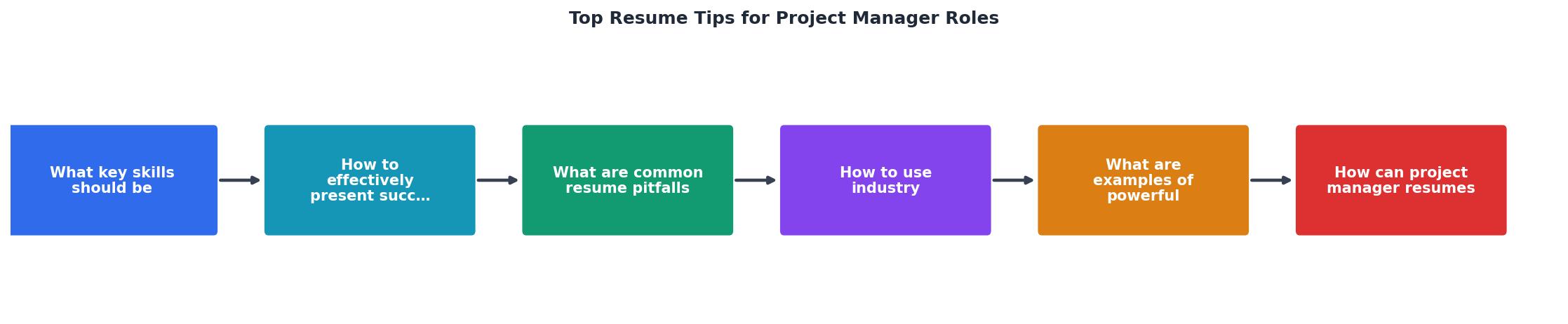
The ideal project manager resume follows a clear hierarchy. Here is the structure that works, section by section:
- Header: Name, phone, email, LinkedIn URL, city/state. No photo, no "References available upon request."
- Professional Summary: 3-4 sentences. State your years of PM experience, industries, biggest achievement, and target role. This is your elevator pitch.
- Core Competencies / Skills: A grid or two-column list of 10-15 relevant skills. Match these directly to the job posting.
- Professional Experience: Reverse chronological. Each role gets a one-line description of scope, then 4-6 achievement bullets with numbers.
- Certifications: PMP, CSM, PRINCE2, SAFe, or any relevant credentials. Include the issuing body and year obtained.
- Education: Degree, institution, graduation year. Add relevant coursework only if you have fewer than 5 years of experience.
- Tools & Technologies: Jira, Asana, Monday.com, MS Project, Confluence, Slack, Tableau, or whatever you actually use.
The following interactive card shows how a well-structured PM resume allocates space across sections. Use it as a reference when reviewing your own layout.
Ideal PM Resume Space Allocation
Sample Resume Template
Below is an annotated template you can adapt. Replace bracketed text with your own details.
[Your Name]
[City, State] | [Phone] | [Email] | [LinkedIn URL]
Professional Summary
Results-driven project manager with [X] years of experience delivering [industry] projects on time and under budget. PMP-certified with expertise in [Agile/Waterfall/Hybrid] methodologies. Led cross-functional teams of up to [number] members, consistently achieving [key metric, e.g., 95% on-time delivery rate].
Core Competencies
Stakeholder Management | Budget Control | Agile & Scrum | Risk Mitigation | Vendor Negotiation | Resource Planning | Change Management | KPI Reporting
Professional Experience
Senior Project Manager, [Company Name] (2022-Present)- Directed a $4.1M digital transformation program across 3 departments, delivering all 8 milestones within budget.
- Reduced project cycle time by 28% by implementing Kanban boards and daily standups.
- Managed a portfolio of 6 concurrent projects with a combined team of 35 engineers and designers.
- Led ERP system migration for 500+ end users, completing UAT 4 weeks ahead of schedule.
- Negotiated vendor contracts saving $180K annually on software licensing.
- Built and maintained RAID logs, escalating critical risks to the steering committee within 24 hours.
Education
B.S. in Business Administration, [University Name] (2018)
Tools
Jira, Confluence, MS Project, Smartsheet, Tableau, Slack, Monday.com
Project Manager Resume Checklist
Your progress is saved automatically in your browser.
FAQ
Frequently Asked Questions
What is the one achievement on your project manager resume that you think deserves a stronger spotlight? Share it below and let's workshop the bullet point together.
Additional Resources
- Project Manager Resume Examples and Template - In this guide, Kathy Gusich, executive recruiter, reviews elements to include in a project manager resume.
- Your Step-by-Step Guide to Writing a Great Project ... - Applying to a project manager job? Here's how to write a resume that showcases your skills and achievements.
- Build a Resume That Stands Out for Project Manager Roles - 1. Lead with a summary that speaks to the role · 2. Quantify everything you can · 3. Use the right project management language · 4. Make ...
