
Photo by cottonbro studio from Pexels
Career breaks don't have to be resume killers. Whether you stepped away to raise a family, handle health issues, travel, or simply recharge, you can reframe that gap as a period of growth and skill development. The key is connecting what you learned during that time directly to what employers are actually looking for. When done right, a career break becomes proof of initiative, adaptability, and self-awareness, qualities that make you more valuable, not less.
TL;DR
- Career breaks can be transformed into strengths by highlighting the skills and knowledge you gained during the gap
- Framing matters: focus on growth, learning, and how your experience makes you a stronger candidate
- Align break-acquired skills with the specific job description to demonstrate relevance
- Employers increasingly recognize that breaks are normal, 75% report positive career outcomes after returning
- The resume gap itself isn't the problem; the story you tell about it is
Understanding career breaks and why they happen
Career breaks are periods of time away from traditional employment. They come in many flavors: parental leave, sabbaticals, health recovery, career exploration, education, travel, caregiving responsibilities, or simply the need to step back and reset. The Bureau of Labor Statistics data shows that roughly 20-25% of the workforce has taken a significant career break at some point.

The stigma around career breaks has softened dramatically. Hiring managers have become more pragmatic: many have taken breaks themselves, and companies increasingly value candidates with real-world experience outside their industry. The economy is also forcing more honesty, recessions, layoffs, and burnout are normal, and employers know that.
What matters most is not whether you took a break, but what you do with that truth on your resume. A gap presented poorly looks like time wasted. A gap presented strategically looks like time invested. The difference is framing.
How to frame career breaks positively
The starting point is honesty. Don't fabricate experience or pretend the break didn't happen. Dishonesty catches up with you during background checks, reference calls, or on day one when you're asked about a role that doesn't exist on your LinkedIn.
Instead, reframe the break as intentional and productive. Here's the shift:
Instead of: "Took time off from 2021-2023."
Try: "Pursued advanced certification in project management and led volunteer coordination for community nonprofit (2021-2023)."
The second version tells a story. It answers the unspoken question: "What were you doing?" It shows agency, learning, and relevance.
Key strategies for framing:
- Own the reason without over-explaining. "Prioritized family caregiving 2022-2024" is complete. You don't need to justify it further on the resume.
- Quantify what you built or learned. "Managed household budget and logistics for family of five" is more concrete than "took time away."
- Connect skills to the role. If you coordinated volunteer work, you developed project management, communication, and leadership skills, all transferable.
- Use a functional or hybrid resume format. Skills-based resumes de-emphasize chronology and draw attention to what you can do, not when you did it.
Real case study: Personal struggles transformed into professional growth
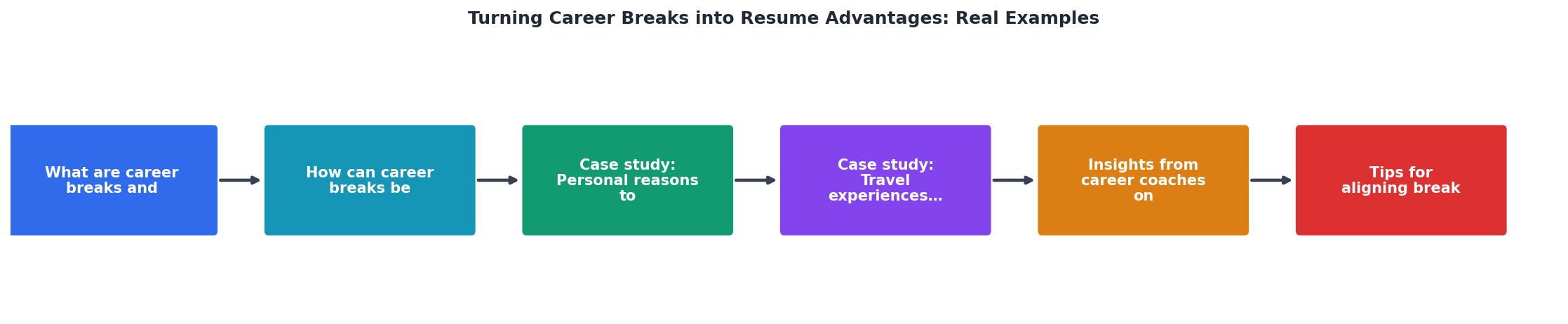
Take the example of Priya, a marketing manager who took an 18-month break after a burnout crash. She was terrified the gap would sink her candidacy. Her initial resume draft read: "Took time for personal recovery (2022-2023)."
Her revised version read: "2022-2023: Completed Google Digital Marketing Certificate while managing independent consulting projects for three small businesses, including content strategy and social media planning."
That's closer, but still not tied to what employers needed. When she tailored it to a specific job posting that emphasized "strategic thinking, cross-functional collaboration, and creative problem-solving in fast-paced environments," her break section became:
"2022-2023: Led independent marketing strategy and execution for three startup clients simultaneously. Developed data-driven content calendars, executed A/B testing on campaigns (resulting in 40% engagement improvement for one client), and collaborated with developers and designers to scale marketing infrastructure. This parallel project management strengthened ability to juggle multiple stakeholder needs and thrive in ambiguity."
Notice what changed: specific metrics, relevant skills, and language that mirrored the job posting. The break wasn't gone, it was now proof she could handle exactly what the role demanded.

Case study: Travel as skill acquisition
Another effective example: Marcus took a 10-month backpacking trip through Southeast Asia and Central America. His original resume just listed the dates as a gap. When we reframed it, it became:
"2023-2024: Independent travel and cross-cultural immersion across 12 countries. Managed budgets in multiple currencies, negotiated accommodations and services across language barriers, and documented experiences through content creation (blog: 50,000+ monthly readers). Developed crisis management and adaptability skills in unpredictable environments."
For a role emphasizing cultural intelligence, remote work autonomy, and creative communication, this became a competitive advantage. He wasn't a guy who traveled, he was a resourceful problem-solver who thrived when thrown into complexity.
The pattern is clear: translate the activity (travel, recovery, learning) into skills employers recognize (adaptability, resourcefulness, communication, project management, independent work, crisis handling).
How career coaches approach resume gaps
Career coaches consistently recommend a three-part strategy:
- Be factual but brief on the resume. One line is enough: "Independent project work" or "Professional development and family caregiving." You're not writing a novel; you're opening a door for the conversation.
- Own the narrative in the interview. When asked about the gap, have a 30-second answer ready that's honest and forward-looking. "I took time to recover from burnout and completed certification in X, which made me a stronger strategist" is far more effective than dodging the question.
- Highlight growth, not loss. Frame what the break gave you, clarity, skills, perspective, resilience, not what it took away. "Taking that break taught me how to manage my energy better and set boundaries that make me more effective now" shows maturity.

Aligning break-acquired skills with job requirements
The magic happens when you connect your break experience directly to the job description. Here's how:
Step 1: Extract keywords and skills from the job posting. If the role emphasizes "project management," "cross-functional collaboration," "budget oversight," or "remote work independence," highlight those phrases.
Step 2: Map your break activities to those keywords. Did you manage a household budget? That's "budget oversight" and "financial management." Did you coordinate volunteer work? That's "project management" and "stakeholder communication."
Step 3: Use the same language in your resume. Don't just say "took time off." Say "Managed project timelines" or "Oversaw operational coordination" or "Executed independent strategic initiatives."
This isn't lying, it's translation. You're converting what you actually did into the vocabulary your target employer uses.
Here's a practical example:
Job posting language: "Strong organizational skills, ability to manage multiple priorities, meticulous attention to detail."
Your break activity: Coordinated your child's school transition while managing your elderly parent's medical appointments and home renovations.
Resume translation: "Managed overlapping logistics for family operations including educational coordination, healthcare management, and home project oversight. Prioritized competing deadlines across three complex projects; developed systems to ensure zero missed appointments and timely execution."
Same reality, but now it reads like someone who can handle the role's demands.
Your Break Framing Strategy
List everything you did: learning, projects, responsibilities, volunteer work, skills developed.
Pull out every skill and responsibility mentioned in your target role.
Match your activities to job keywords using employer language.
Add metrics: managed 3 projects, saved $X, improved Y metric.
This interactive strategy card walks you through the core process. When you follow these steps methodically, the resume gap stops being a liability and becomes proof that you've already demonstrated the exact skills the employer needs.
Building your resume narrative
Your overall resume narrative should flow like this:
- Contact and headline that reflects your target role
- Professional summary or objective that acknowledges your path and positions you confidently
- Recent relevant experience (including break-era projects or learning)
- Skills section that matches the job posting
- Education and certifications
Example structure for someone returning after a career break:
Skills: Project Management, Budget Oversight, Remote Collaboration, Cross-functional Communication, [match to job posting]

Experience:
    Senior Marketing Consultant | Independent (2022-2023)
    [2-3 accomplishments with metrics]

    Marketing Manager | Previous Company Name (2019-2022)
    [key achievements]
This format makes clear that you stayed productive and learned during the break, without making it seem like you're hiding anything.
Checklist: Presenting your career break positively
Career Break Resume Presentation Checklist
Your progress is saved automatically in your browser.
FAQ
Frequently Asked Questions
The bottom line
Career breaks are a normal part of professional life. The only real mistake is leaving your resume with a blank gap and no story. When you reframe your break as a period of learning, skill development, and intentional growth, and connect those gains directly to what your target employer needs, the gap becomes an advantage, not a liability.
You're not hiding anything. You're translating your reality into the language of value. That's what strong resumes do.
Additional Resources
- How to Explain a Resume Gap in 2026 (Examples + ... - Returning to work after a career break? Learn how to rebuild confidence, refresh your résumé, explain gaps, and explore beginner-friendly ...
- Benefits of Taking a Career Break - Gain clarity: Use your break to reassess your priorities and discover what you truly want in your career and life. · Recharge and reconnect: Make space for rest, ...
- Coming Back from a Career Break - Use a functional resume to your advantage; highlight relevant skills acquired during a career break, such as volunteer work, freelance ...
