Photo by Tima Miroshnichenko from Pexels
Cybersecurity analyst roles are flooded with applications, but most resumes never make it past the ATS screening. The difference between a generic resume and one that lands interviews often comes down to a few critical elements: the right keywords, specific certifications, and concrete examples of threat analysis or incident response work. If you're applying to cybersecurity analyst positions and hitting silence from recruiters, your resume is probably missing the language hiring managers and automated systems are actually looking for.
TL;DR:- Focus on threat intelligence, risk assessment, and hands-on cybersecurity tools (SIEM systems, intrusion detection, vulnerability management)
- Prominently list relevant certifications like CISSP, CEH, Security+, or GIAC credentials
- Quantify your security wins (vulnerabilities patched, incidents detected, time to response improved)
- Use job description keywords throughout your experience section and skills list
- Highlight projects where you implemented security controls or responded to live threats
Why cybersecurity resumes get rejected

Before we talk about what makes a cybersecurity resume work, understand what breaks one. Most resumes in this field fail for the same three reasons.
First, they're too generic. Phrases like "responsible for network monitoring" or "worked on security projects" don't cut it. Hiring managers and ATS systems are hunting for specific keywords: SIEM, threat intelligence, penetration testing, incident response, risk assessment, vulnerability scanning. If your resume doesn't contain the exact terms from the job posting, it gets filtered out automatically.
Second, they bury the credentials. In cybersecurity, certifications carry real weight. CISSP, CEH, Security+, and GIAC certifications aren't just resume padding, they're job requirements at many companies. If you have them, they should be visible in your skills or credentials section, not hidden in a paragraph.
Third, they lack proof of impact. Security work is measurable. How many vulnerabilities did you identify? What was your average time to detect and respond to threats? Did you reduce incident response time from hours to minutes? Numbers make you memorable and real to hiring managers who see hundreds of similar roles.
Essential cybersecurity skills to highlight
Your skills section needs to speak the language of cybersecurity. This isn't just a list, it's your primary keyword real estate on the resume.
The must-have core skills are threat intelligence, risk assessment, and incident response. These three appear in almost every cybersecurity analyst job posting. Threat intelligence means you can identify, research, and analyze threat actors, malware, and attack patterns. Risk assessment means you evaluate vulnerabilities and prioritize what gets fixed first. Incident response means you can handle active security events, detecting them, containing them, and learning from them.
Beyond those, include technical depth in areas the job posting emphasizes:
- SIEM platforms: Splunk, ArcSight, IBM QRadar, Elastic Stack, these are tools that aggregate and analyze security events
- Intrusion detection and prevention: Snort, Suricata, Zeek, systems that catch unauthorized access attempts
- Vulnerability management: Qualys, Tenable Nessus, Rapid7 InsightVM, tools that scan networks and patch systems
- Endpoint detection and response (EDR): CrowdStrike Falcon, Microsoft Defender, Carbanak, modern tools that hunt threats on individual machines
- Network analysis: Wireshark, tcpdump, packet analysis, critical for understanding how attacks move across the network
- Forensics and malware analysis: If you have hands-on experience pulling apart infected files or reconstructing attack timelines, this sets you apart
Certifications that open doors

Certifications in cybersecurity are filters. Many organizations use them as hard requirements, your resume simply won't be considered without them. Others value them as a tie-breaker when candidates are otherwise similar.
The CISSP (Certified Information Systems Security Professional) is the gold standard if you have five years of security experience. It carries the highest prestige and typically opens doors to senior roles and leadership tracks. If you're early-career, CISSP is a long play, not an immediate goal.
The CEH (Certified Ethical Hacker) is worth getting if you focus on penetration testing, vulnerability assessment, or offensive security work. It proves you understand attack methodologies from the attacker's perspective. Employers in security-conscious industries heavily value it.
Security+ (CompTIA Security+) is the entry point. It's vendor-neutral, affordable, and respected across government and defense sectors. If you're early-career or switching into security, this is a smart first cert.
GIAC certifications (GCIA, GCIH, GPEN, GCES) are held in high regard because they come from SANS, which offers intense hands-on training. They're expensive but carry weight with serious security teams.
Include the cert name, the issuing organization, and your credential ID (if public). Add the expiration date if it's valid for years. On your resume, place these in a dedicated "Certifications" section near the top, or integrate them directly into your "Technical Skills" section if space is tight.
Practical tools and platforms to mention
Your experience section should name the actual tools you've used. Here's why: the hiring manager reading your resume has probably used the same tools. When they see you've worked with Splunk or QRadar, they immediately know what you can do. Generic phrases like "security monitoring" leave them guessing.
If you've used a SIEM (Security Information and Event Management) system like Splunk, ArcSight, or QRadar, describe what you did with it. For example: "Developed correlation rules in Splunk to detect lateral movement attempts, reducing time-to-detection from 4 hours to 12 minutes." That's concrete, specific, and impressive.
If you've done vulnerability scanning with Tenable Nessus or Qualys, talk about scale and outcome. "Performed quarterly vulnerability scans across 200+ corporate assets, prioritized findings by risk, and tracked remediation to 92% closure within SLA."
If you've worked with firewalls (Cisco ASA, Palo Alto Networks, Fortinet FortiGate), describe policies you've built or incidents you've prevented. "Configured and maintained firewall rules for a hybrid cloud environment, blocking 10,000+ malicious IP addresses monthly."
If you've used endpoint detection and response tools like CrowdStrike or Microsoft Defender, talk about hunts, detections, or response times. "Proactively hunted for advanced threats using EDR telemetry, uncovering C2 callbacks on three systems before lateral spread."
The pattern is: tool name + what you did + measurable result. That formula works every time.
Showcasing real experience and projects

Your job experience and past projects are where you prove you can actually do the work. This is where most resumes fall short. They describe responsibilities instead of results.
Don't write: "Responsible for monitoring security alerts and responding to incidents."
Write: "Investigated and resolved 45+ security incidents monthly, achieving average MTTD (mean time to detect) of 18 minutes and MTTR (mean time to response) of 42 minutes, 40% faster than team baseline. Documented incident timelines and lessons learned in post-incident reviews, which led to three new detection rules preventing recurrence."
See the difference? The second version shows scale (45+ incidents), methodology (MTTD/MTTR metrics), and impact (faster response, new rules implemented). Hiring managers and ATS systems both respond to this because it's concrete, measurable, and relevant.
Here's how to structure your experience bullets for security analyst roles:
- Start with the action verb: Investigated, designed, implemented, automated, developed, discovered, mitigated
- Name the tool or technology: SIEM, EDR, firewall, vulnerability scanner, forensic tool
- Describe the scope: How many systems, users, or events? What was the scale?
- Include the outcome: What changed? What improved? What was prevented?
- Add the metric: Time saved, incidents prevented, speed improved, percentage reduced
Good example: "Designed and implemented firewall security policies for 15 office locations and 300+ remote employees, reducing unauthorized access attempts by 78% within the first quarter. Created runbook for firewall rule requests, reducing approval time from 5 days to 1 day."
If you've worked on a specific security project, like deploying a new SIEM, standing up a security monitoring center, responding to a breach, or building an incident response playbook, give it its own bullet. Projects show initiative and technical depth beyond day-to-day tasks.
Example: "Led migration from legacy ArcSight SIEM to Splunk across three data centers. Rebuilt 200+ correlation rules, trained 12 analysts on new platform, and achieved full production readiness 2 weeks ahead of schedule."
Resume structure and layout for analysts
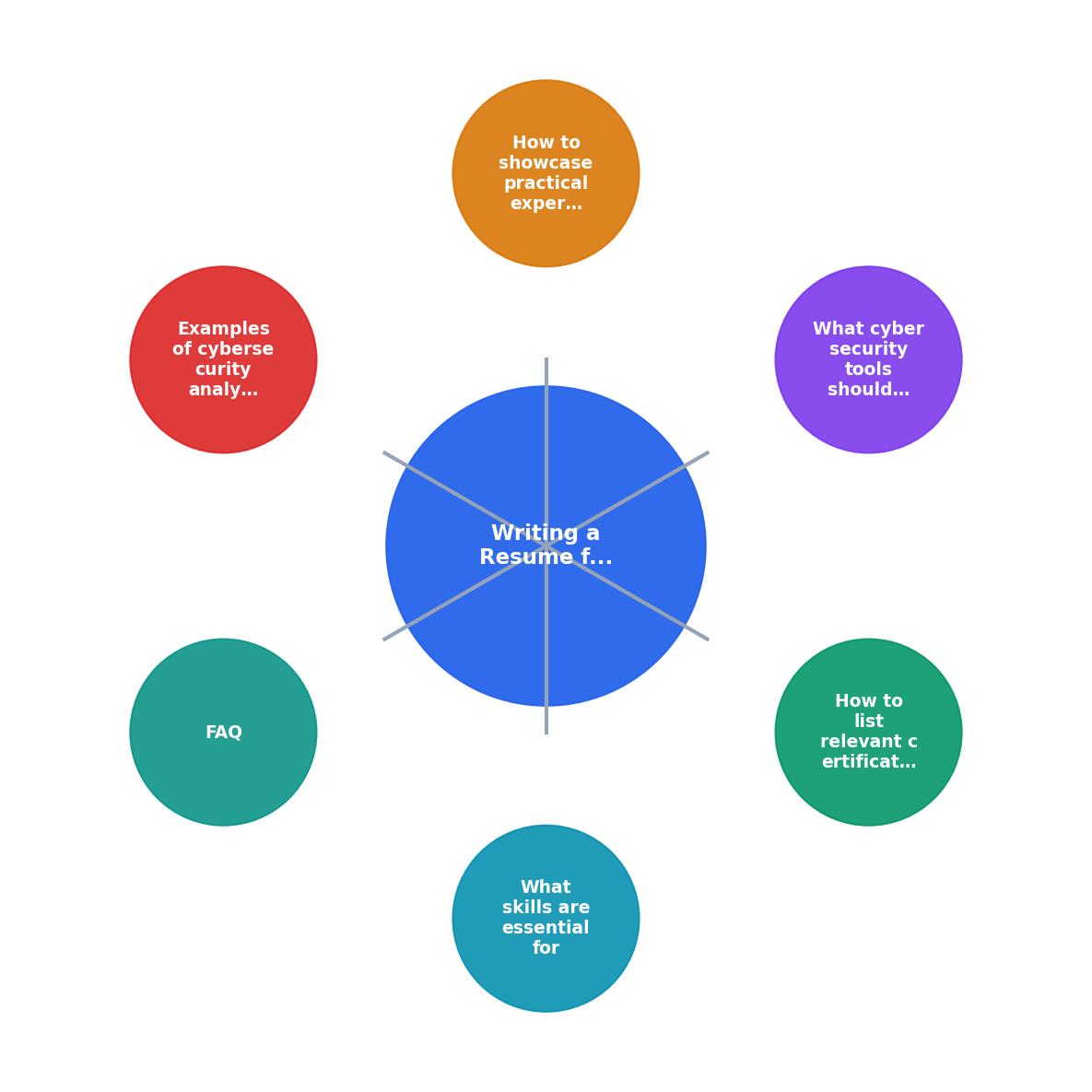
Your resume structure should guide the ATS and hiring manager to your strongest cybersecurity credentials as quickly as possible. Here's the optimal order:
Header and Summary (or skip the summary): Name, email, phone, LinkedIn profile. If you include a professional summary, keep it to 2-3 lines and lead with your strongest credential. Example: "Cybersecurity analyst with 4 years of SIEM and incident response experience. CISSP and CEH certified. Proven track record detecting advanced threats and leading response efforts."
Certifications: List first if you have tier-1 certs (CISSP, CEH). If they're entry-level (Security+, CompTIA), you can place them after skills.
Technical Skills: Organize by category. Use the keywords from the job posting. Example:
- SIEM Platforms: Splunk, ArcSight, Elastic Stack
- Threat Analysis: Threat intelligence platforms (Mandiant, Recorded Future), malware analysis (Cuckoo, YARA)
- Incident Response: Forensic tools (EnCase, FTK), playbook development, rootcause analysis
- Vulnerabilities: Qualys, Nessus, Tenable, InsightVM, remediation workflows
Education: Degree, school, graduation date. If you're early-career, include GPA if it's 3.5 or above; skip it otherwise.
Projects or Additional Training: If you've completed security bootcamps, built home labs, or contributed to open-source security tools, list them. These show initiative.
Keyword strategy for ATS success
The ATS is a gatekeeper. It scans your resume for keywords from the job posting, and if the match score is below a threshold, a human never sees your work. Your job is to close the gap between the job posting and your resume.
Step one: Copy the job description into a document. Go through it and extract every technical term, tool name, certification, and keyword. Don't just look at job titles or required qualifications, read the full description. Look for phrases like "experience with SIEM platforms," "threat hunting," "incident response," "vulnerability assessment," "compliance frameworks," "network segmentation."
Step two: Audit your resume. Does it contain these keywords? In your skills section? In your experience descriptions? If the job posting mentions "Splunk" and your resume doesn't, you're missing an easy win.
Step three: Weave them in authentically. Don't keyword-stuff your resume with words you don't actually have experience with, that's fraud and will be caught in an interview. But if you've used a tool and haven't mentioned it, add it to your description.
Example: Job posting emphasizes "SIEM configuration, threat detection, and incident timeline documentation."
Your resume should include: "Configured correlation rules in Splunk SIEM to detect lateral movement and data exfiltration attempts. Documented incident timelines and forensic findings in accordance with incident response procedures."
That hits all three keywords while sounding natural.
Common mistakes to avoid
Most cybersecurity resumes make the same errors. Here's what not to do:
Don't be vague about tools. "Proficient in security tools" tells the hiring manager nothing. "Splunk, ArcSight, Qualys, and EnCase" tells them exactly what you can do.
Don't confuse job titles with accomplishments. "Security Analyst" is your title. "Implemented 12 new detection rules that caught three advanced persistent threats before lateral spread" is an accomplishment.
Don't undersell your certifications. If you have CISSP, CEH, or GIAC, they go near the top. Don't bury them in a wall of text or omit them.
Don't use buzzwords without evidence. Don't claim you're an expert in "cutting-edge threat intelligence" without naming the platform you used or the threat type you analyzed.
Don't ignore metrics. Security work is measurable. Time, volume, percentage, count, use them. If you can't quantify it, ask yourself if it's worth mentioning.
Don't list outdated tools or expired certs without context. If you haven't used a tool in three years, consider whether it's still relevant. If a cert expired, say so and note your plan to renew it.
Cybersecurity Resume Checklist Impact
Cybersecurity Analyst Resume Optimization Checklist
Your progress is saved automatically in your browser.
Examples of effective cybersecurity analyst resumes
Real examples ground abstract advice. Here's what a strong cybersecurity analyst experience section looks like:
Example 1: Mid-level analyst with incident response focus
"Investigated 35+ security incidents monthly using EDR (CrowdStrike Falcon) and SIEM (Splunk), achieving MTTD of 16 minutes and MTTR of 38 minutes. Performed rootcause analysis on critical incidents and documented findings in incident tracking system. Developed three new Splunk correlation rules to detect command-and-control callbacks, preventing lateral spread of two confirmed advanced persistent threats."
Example 2: Analyst with vulnerability management background
"Managed vulnerability scanning and remediation program across 400 corporate assets using Qualys and Tenable Nessus. Prioritized findings by CVSS score and business context, tracking remediation to 85% closure rate within 30 days. Collaborated with infrastructure and development teams on patching workflows, reducing average time-to-patch from 45 days to 18 days."
Example 3: Analyst with threat intelligence work
"Spearheaded a project to implement a new SIEM system. Researched emerging malware families and threat actors relevant to our industry using Recorded Future and open-source intelligence. Presented monthly threat briefings to leadership and contributed to incident response playbook updates based on observed TTPs (tactics, techniques, and procedures)."
Notice the specificity: tool names, metrics, scope, and outcome. Each bullet answers the question, "What did you do, and why does it matter?" That's the formula hiring managers recognize instantly.
FAQ
Frequently Asked Questions
Writing a cybersecurity analyst resume that cuts through noise means understanding what hiring managers and ATS systems actually look for: specific tools, relevant certifications, measurable outcomes, and keywords from the job posting. You're not trying to impress with flowery language or generic responsibilities. You're trying to answer one question clearly: "Can this person do the work?" Your resume succeeds when it makes that answer obvious in the first 30 seconds.
The difference between silence and interviews often isn't your qualifications, it's how you present them. Audit your resume against the checklist above, add the specific tools and metrics you've been leaving out, and tailor it to each job posting's keywords. That focused effort typically yields 2-3 times more callbacks than a generic resume.
Additional Resources
- 13 Cyber Security Resume Examples for 2026 - When writing your resume for a cyber security role, remember to research the role and include core skills that are relevant to the specific position you are ...
- 22 Cybersecurity Analyst Resume Examples & Guide for ... - Craft the perfect cybersecurity analyst resume with expert tips, examples, and strategies to impress in 2026's competitive job market.
- Cyber Security Resume Examples and Tips to Get You Hired - Analysts need to know how to work with diverse network types. Mention experience or coursework that has to do with networks and network security ...