Adapting Your Resume for Remote Customer Service Jobs
Remote customer service roles have exploded in availability, but the competition has grown just as fast. If you are transitioning from a different career or returning to work after a break, your resume probably reads like a history of your old life rather than a pitch for the new one. The good news is that the skills you already have translate directly into remote customer service, and this guide shows you exactly how to prove it on paper.

Remote customer service roles have exploded in availability, but the competition has grown just as fast. If you are transitioning from a different career or returning to work after a break, your resume probably reads like a history of your old life rather than a pitch for the new one. The good news is that the skills you already have translate directly into remote customer service, and this guide shows you exactly how to prove it on paper.
TL;DR:- Emphasize communication, problem-solving, and empathy as your core skill trio.
- Highlight hands-on experience with customer service platforms (Zendesk, Freshdesk, Intercom) and remote communication tools (Slack, Zoom, Microsoft Teams).
- Pull exact keywords from each job description and weave them into your summary, skills section, and bullet points so ATS software ranks you higher.
Why remote customer service fits career changers
You spent years solving problems for people in a different context. Teaching, retail management, healthcare coordination, military logistics: every one of those roles required you to listen, diagnose an issue, and deliver a resolution under pressure. Remote customer service hiring managers know this. Your job is to make the connection obvious.
The biggest mistake career changers make is burying transferable experience under old job titles. Instead of listing "Managed classroom of 30 students," reframe it: "Resolved 30+ daily inquiries from diverse stakeholders, maintaining a 95% satisfaction rate." Same experience, completely different signal.
Start your resume with a professional summary that names the target role explicitly. Something like this works:
"Customer service professional with 5+ years of experience providing exceptional support to clients in remote settings.">, Remote Customer Service Rep Resume Examples for 2026
Even if your five years were not technically "remote customer service," the summary frames your trajectory. Hiring managers spend about six seconds on an initial scan. That summary is your six-second pitch.
Skills that actually get you hired

Remote customer service postings repeat the same skill clusters. Here are the ones that show up most often, grouped by category:
Communication skills:- Written communication (email, live chat, ticket responses)
- Verbal communication (phone, video calls)
- Active listening
- Tone management across channels
- Troubleshooting product or billing issues
- De-escalation techniques
- Root cause analysis
- Decision-making under time constraints
- Reading customer frustration through text
- Personalizing responses instead of copying templates
- Following up after resolution
Bold the skill names in your resume's skills section. Use the exact phrasing from the job posting whenever possible. If the listing says "conflict resolution," do not write "handling disagreements." Mirror the language.
Tools hiring managers expect to see
Knowing the right software separates a generic applicant from a credible one. Here are the tools remote customer service teams actually use daily:
Help desk and ticketing platforms:- Zendesk (most commonly requested)
- Freshdesk
- Intercom
- Help Scout
- Salesforce Service Cloud
- Slack or Microsoft Teams for internal chat
- Zoom or Google Meet for video calls
- Confluence or Notion for knowledge bases
- HubSpot CRM
- Salesforce
- Zoho CRM
The visual below shows how these skills and tools fit into a resume structure from start to finish:
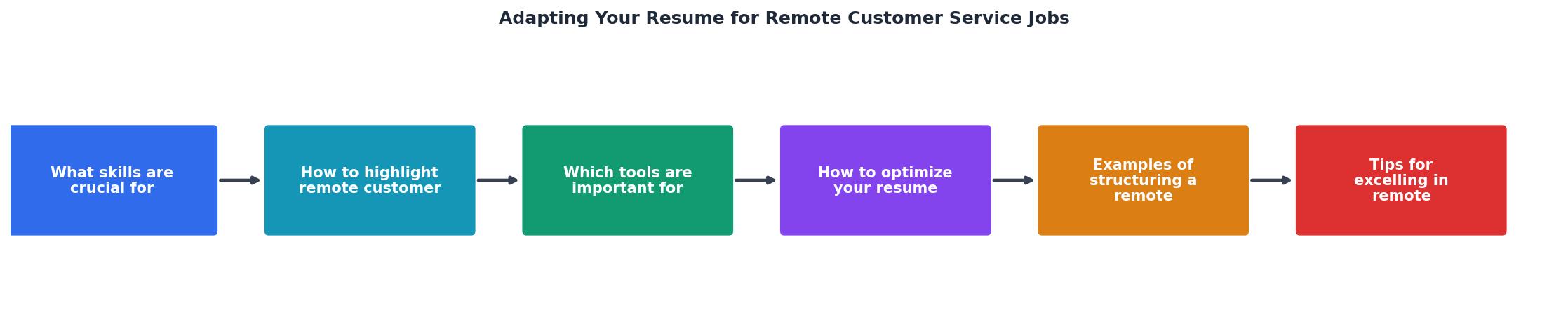
Follow the flow: Identify target role → Extract keywords → Reframe experience → Add tools → Optimize for ATS → Review and submit. Each step builds on the previous one, so skipping "Extract keywords" means the rest falls flat.
Optimize your resume for ATS

Applicant Tracking Systems filter resumes before a human ever sees them. Most large employers and staffing agencies use one. The system scans for keyword matches between your resume and the job description, then scores you.
Here is what that means in practice:
- Copy the job description into a plain text document.
- Highlight repeated nouns and phrases: "remote support," "ticket resolution," "customer satisfaction," "CRM," "multitasking."
- Count frequency. If "customer satisfaction" appears three times, it matters more than a term mentioned once.
- Place high-frequency terms in your professional summary, skills section, and at least two bullet points in your experience section.
- Use standard section headings: "Professional Experience," "Skills," "Education." Creative headings like "My Journey" confuse ATS parsers.
Roughly three out of four resumes never reach a recruiter's desk. That statistic alone should convince you to spend the extra ten minutes on keyword alignment. Tools like Resume Hedgehog can automate this step: upload your resume, paste the job description, and get an optimized version that matches the posting's language.
| Generic Resume | ATS-Optimized Resume |
|---|---|
| "Resolved 40+ daily customer inquiries via Zendesk, achieving 97% first-contact resolution" | |
| "Delivered written and verbal support across live chat, email, and phone channels" | |
| "Collaborated with cross-functional teams in Slack and Zoom to escalate complex tickets" | |
| Skills mirrored from job description keywords |
Structure your resume for impact

A clean structure makes your resume scannable for both ATS and humans. Here is a proven layout for remote customer service applications:
1. Professional Summary (3-4 lines)
State your target role, years of relevant experience (including transferable), and one or two measurable achievements.
2. Core Skills (8-12 keywords)
Two-column or three-column layout. Include both soft skills (empathy, active listening) and hard skills (Zendesk, Salesforce).
- "Managed a queue of 50+ daily support tickets with a 4.8/5 customer satisfaction rating"
- "Reduced average response time from 24 hours to 4 hours by implementing canned response templates in Freshdesk"
- "Trained 8 new hires on remote support protocols and Zendesk workflows"
5. Education and Certifications
Include any customer service certifications: HDI Customer Service Representative, ICMI, or even free courses from HubSpot Academy or Coursera.
Here is an example dashboard showing how a well-structured remote customer service resume might score across key dimensions:
Example Resume Score: Remote CS Role
Excel at remote communication
Remote customer service lives and dies by written communication. You will spend most of your day typing, not talking. That changes what "good communication" means on a resume.
Demonstrate written communication skills by:
- Mentioning specific channels you have used (live chat, email, social media DMs)
- Noting your typing speed if it is above 50 WPM
- Referencing experience writing knowledge base articles, FAQs, or canned responses
- Highlighting any experience managing multiple conversations simultaneously
For video and phone communication, mention experience with screen sharing, remote troubleshooting walkthroughs, or conducting virtual training sessions. These details signal that you understand the remote work environment, not just customer service in general.
Remote Customer Service Resume Checklist
Your progress is saved automatically in your browser.
FAQ
Frequently Asked Questions
What part of your resume feels hardest to adapt for remote customer service? Drop your specific challenge below and let's work through it.
Additional Resources
- Remote Customer Service Rep Resume Examples for 2026 - Tailor your resume to the specific remote customer service rep job you're applying for. Paste the job description into Targeted Resume to see how well your ...
- Remote Customer Service Resume Example - Emphasize Adaptability and Self-Motivation Highlight your ability to work independently and adapt ensure your resume is error-free and tailored to each job ...
- How to Tailor Your Resume for Remote Jobs - “So, how do I tailor my resume for a remote job?” · 1. List your past remote experience · 2. Include remote-related keywords · 3. Describe how you ...

Get the 356 complete recruitment audit (free PDF)
Download the free PDF with 356 reasons hiring stalls, plus optional daily email tips. No credit card.
Get the free PDF 356 reasons · Free download