Addressing Irrelevant Experience in Career Change Resumes
You spent years building expertise in one field, and now your resume reads like a love letter to a career you are leaving behind. Hiring managers in your target industry scan your experience section, see job titles that mean nothing to them, and move on. The fix is not deleting your past but restructuring how you present it so every line points toward where you are headed.

You spent years building expertise in one field, and now your resume reads like a love letter to a career you are leaving behind. Hiring managers in your target industry scan your experience section, see job titles that mean nothing to them, and move on. The fix is not deleting your past but restructuring how you present it so every line points toward where you are headed.
Photo by cottonbro studio from Pexels
TL;DR:- Downplay irrelevant roles by trimming bullet points, removing jargon from the old field, and grouping them under a single "Additional Experience" heading.
- Reframe every past accomplishment through the lens of transferable skills like leadership, data analysis, project management, or client communication.
- Write a targeted summary statement at the top of your resume that bridges your old career and your new goal in three to four sentences.
Why Irrelevant Experience Hurts
A resume stuffed with unrelated job titles creates cognitive friction. The recruiter has to do extra work to figure out why a restaurant manager is applying for a project coordinator role. Most will not bother.
"According to iHire's 2020 Talent Retention Report, 66 percent of survey respondents have recently considered changing careers.">, How to Write a Career Change Resume
That statistic means recruiters see career-change resumes constantly. They are not surprised by them. But they still need a clear reason to keep reading. If your experience section looks like it belongs to someone applying for a completely different job, the Applicant Tracking System (ATS) will score you low on keyword relevance, and the human reviewer will lose interest within seconds.
The goal is not to hide your history. It is to control the narrative so every section of your resume answers one question: "What can this person do for us?"
Recruiters spend roughly six to seven seconds on an initial resume scan. If 70% of your bullet points describe tasks from an unrelated field, you are burning most of that window on content that does not help you.
How to Downplay Past Roles

Downplaying does not mean lying. It means adjusting the volume. Here are concrete techniques:
- Reduce bullet points. Give irrelevant roles one or two bullets instead of five. Keep only the accomplishments that translate.
- Group older roles. Create an "Additional Experience" or "Earlier Career" section. List company, title, and dates on a single line with no bullets at all.
- Strip field-specific jargon. If you were a nurse applying for a health-tech product role, replace "administered IV medications per physician orders" with "executed time-sensitive protocols in high-pressure environments."
- Remove irrelevant certifications. A forklift license does not belong on a UX design resume unless the job description specifically asks for warehouse domain knowledge.
- Shorten date ranges visually. Use years only (2018-2021) instead of month/year to reduce the visual weight of long tenures in unrelated fields.
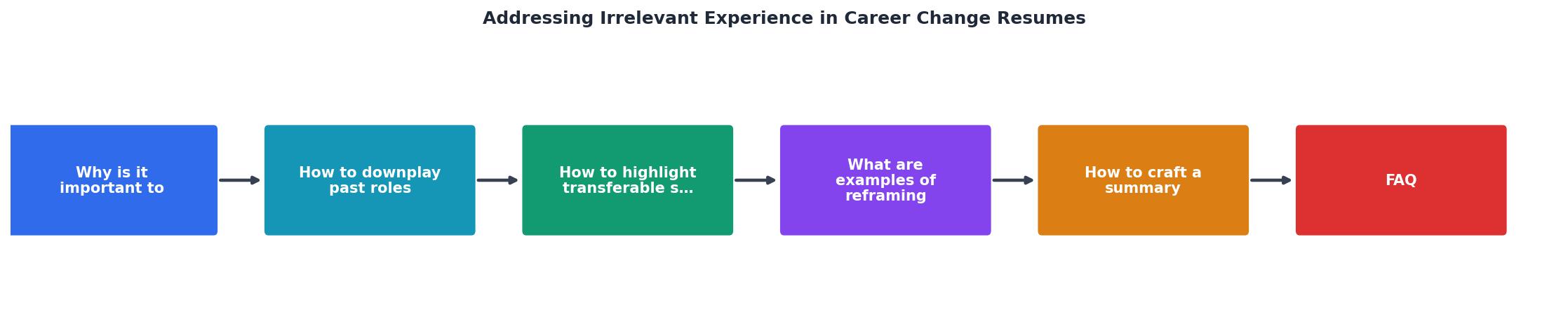
The diagram above shows the core flow: Audit old roles, Identify transferable skills, Reframe bullets, Build summary, Tailor to job posting. Follow those steps in order and your resume transforms from a career history into a targeted pitch.
Highlight Transferable Skills

Transferable skills are abilities that work across industries. They are the bridge between your old career and your new one. The trick is naming them in the language your target field actually uses.
Here is a quick mapping for common career changes:
| Old Career Skill | Reframed for New Field |
|---|---|
| Managed a team of 12 servers (hospitality) | Led a cross-functional team of 12, coordinating schedules and resolving conflicts |
| Taught 30 students per class (education) | Delivered structured presentations to groups of 30+, adapting content to varied skill levels |
| Processed insurance claims (finance) | Analyzed documentation for accuracy, resolved discrepancies, and maintained compliance standards |
| Coordinated patient care plans (healthcare) | Managed multi-stakeholder projects with strict deadlines and regulatory requirements |
Notice the pattern: remove the industry-specific noun and replace it with a universal action. "Servers" becomes "cross-functional team." "Students" becomes "groups." "Insurance claims" becomes "documentation."
Where to place transferable skills
- Summary statement at the top of the resume.
- A dedicated "Core Competencies" or "Key Skills" section right below the summary, formatted as a two- or three-column list of keywords pulled from the job description.
- Inside bullet points of your most recent roles, even if those roles were in the old field.
Skill Extraction Example
Each row maps a task from the old career to a skill label that a hiring manager in instructional design, corporate training, or ed-tech would recognize instantly.
Reframing Past Experiences
Reframing is the single most valuable technique for career changers. It takes the same facts and tells a different story.
Scenario 1: Retail manager to operations analyst
Before: "Managed daily store operations including inventory, staffing, and customer complaints."
After: "Oversaw operational workflows for a $2.4M revenue location, optimizing inventory turnover by 18% and reducing staffing costs through data-driven scheduling."
The second version uses numbers, focuses on outcomes, and speaks the language of operations and analytics.
Scenario 2: Military officer to corporate project manager
Before: "Led a platoon of 40 soldiers during overseas deployment."
After: "Directed a 40-person team through complex, time-critical projects in high-stakes environments, managing logistics, risk assessment, and cross-departmental coordination."
No military jargon. Every word maps to project management vocabulary.
Scenario 3: Freelance graphic designer to marketing coordinator
Before: "Created logos, brochures, and social media graphics for small businesses."
After: "Developed brand identity assets and multi-channel marketing collateral for 15+ clients, aligning visual strategy with business objectives and increasing client engagement metrics."
The reframe adds scope (15+ clients), strategic language (brand identity, multi-channel), and results orientation (engagement metrics).
Craft a Summary Statement

The summary statement sits at the top of your resume and does the heavy lifting for career changers. It tells the reader three things in three to four sentences: who you are now, what relevant skills you bring, and what role you are targeting.
Here is a template you can adapt:
[Target role descriptor] with [X years] of experience in [transferable skill area]. Proven track record in [specific accomplishment or skill relevant to new field]. Skilled in [2-3 keywords from the job description]. Seeking to leverage [bridge skill] in a [target industry/role] position.
Filled-in example for a teacher moving into instructional design:
Instructional design professional with 8 years of experience creating curriculum, assessing learner outcomes, and facilitating group training. Designed and delivered 200+ lesson plans aligned with state standards and measurable learning objectives. Skilled in needs analysis, content development, and LMS administration. Seeking to apply evidence-based instructional strategies in a corporate learning and development role.
That summary never mentions "teacher" or "classroom." It translates every teaching task into L&D terminology.
Summary statement mistakes to avoid
"Seeking a challenging position where I can grow."Too vague. Name the specific role."Career changer looking for an opportunity."Labels you as unqualified before you start.Listing every skill from every job you have ever held.Pick only the three to five most relevant.
Career Change Resume Restructuring Checklist
Your progress is saved automatically in your browser.
FAQ
Frequently Asked Questions
What is the one past experience you are struggling most to reframe for your new career direction? Share it below and let's work through it together.
Additional Resources
- How to Write a Career Change Resume - Template - Wharton - When you're changing careers, your resume needs to emphasize relevant skills. Learn how to write a career change resume & download our example template.
- Should You Include Irrelevant Work Experience on Your ... - The key to making irrelevant experience relevant lies in translating your accomplishments into universal business language. Start by analyzing ...
- Making a career change? | Adrienne Tom - Remove roles that are irrelevant to the job posting or make them align. ... Here's what really works when writing a career change resume 1. Use ...

Get the 356 complete recruitment audit (free PDF)
Download the free PDF with 356 reasons hiring stalls, plus optional daily email tips. No credit card.
Get the free PDF 356 reasons · Free download