Adjusting Your Resume for Remote Project Management Roles
Remote project management isn't just traditional project management done from home. Employers hiring for these roles want to see proof that you can lead teams across time zones, communicate through digital channels, and adapt to the unpredictability of distributed work. Your resume needs to speak that language, highlighting the tools, skills, and outcomes that matter most in a virtual environment.


Remote project management isn't just traditional project management done from home. Employers hiring for these roles want to see proof that you can lead teams across time zones, communicate through digital channels, and adapt to the unpredictability of distributed work. Your resume needs to speak that language, highlighting the tools, skills, and outcomes that matter most in a virtual environment.
Photo by Ketut Subiyanto from Pexels
TL;DR
- Emphasize digital communication, virtual team leadership, and adaptability as core competencies
- Use action verbs tied to remote-specific outcomes: "coordinated across time zones", "managed asynchronous workflows", "reduced meeting time by X%"
- Feature the tools and methodologies you've mastered: Asana, Monday.com, Jira, Slack, Agile, Scrum, Kanban
- Mirror keywords directly from job descriptions to pass ATS filters and align with recruiter expectations
- Quantify your impact with metrics that matter: team size managed, projects delivered on schedule, communication efficiency gains
Why Remote Project Management Resumes Demand a Different Approach
Remote work changes everything about how projects succeed or fail. Synchronous meetings become costly. Written communication replaces hallway conversations. Time zones matter. Trust must be built through consistency and clarity, not proximity. When hiring managers or ATS systems scan a remote project management resume, they're not just looking for "project management experience", they're looking for proof that you understand these realities.
The statistic is stark: most Applicant Tracking Systems eliminate candidates whose resumes lack remote-specific language and tools. If your resume reads like a traditional office-based PM role, the ATS may reject it before a human ever sees it. The recruiter won't know you've built distributed teams or managed asynchronous sprints because you didn't tell them in the language they scan for.
Critical Skills for Remote Project Management

Remote project managers succeed on four core skill sets. Your resume should reflect all of them, not just one.
Digital Communication: In a remote setting, your ability to write clearly, set expectations in writing, and keep stakeholders informed asynchronously is as important as your project schedule. Employers want to see that you can communicate complex ideas through Slack, email, and documents without losing detail or creating confusion.
Virtual Team Leadership: Managing people you never see in person requires intentional trust-building and emotional intelligence. This means regular check-ins, transparent decision-making, and the ability to keep team morale high across time zones. Your resume should showcase examples of teams you've led, how large they were, and what they delivered.
Adaptability: Remote work throws curveballs, time zone overlaps are limited, people get sick and disconnect, asynchronous work requires different workflows. Employers need proof that you adjust your approach based on the situation, not rigidly follow a single process.
Technical Tool Proficiency: You should be fluent in at least two or three of the tools your target role uses. Don't just list them; show what you accomplished using them. "Implemented Asana to reduce status update meetings by 60%" beats "Proficient in Asana."
Include these skills in your resume summary, in your experience bullets, and in your skills section. Don't bury them, make them visible.
How to Highlight Remote Project Management Experience

The way you write your experience bullets matters more than the roles themselves. Here's how to reframe traditional PM experience for remote roles.
Bad bullet (generic, no remote context):
"Managed project timelines and coordinated with stakeholders."
Better bullet (remote-specific, quantified):
"Led cross-functional team of 8 across 4 time zones, coordinating asynchronous standups and real-time meetings to deliver quarterly roadmap 2 weeks early, using Asana to reduce status update meetings by 60%."
Notice what changed: specificity about remote challenges (time zones), quantified team size, clear outcome (2 weeks early), tool mentioned (Asana), and a second metric (60% meeting reduction). Recruiters and ATS systems pull out these details.
Here's a template to follow:
- Action verb + remote context (coordinated across, managed asynchronously, led virtually)
- Team size and scope (8-person team, 4 departments, global org)
- The challenge (across time zones, with no co-location, in a fully distributed org)
- The tool(s) (using Asana, via Slack, in Jira)
- The outcome (delivered X weeks early, 40% faster, 95% on-time)
Tools and Methodologies That Matter

Remote project management relies on specific tools and frameworks. The job posting will hint at which ones matter for that role. Pay attention and mirror them back.
Project Management Tools: Asana, Monday.com, Jira, ClickUp, Notion, Basecamp, Trello. Each has a slightly different philosophy. Asana emphasizes task dependencies and timeline views; Monday.com focuses on visual workflow management; Jira is built for agile development teams. Know which one matches the job you're applying to.
Communication Platforms: Slack, Microsoft Teams, Discord, Loom. Being fluent in async communication, knowing when to send a message vs. schedule a call, how to document decisions, is a skill in itself. Mention it if you've used these to reduce meeting overhead or improve transparency.
Methodologies: Agile, Scrum, Kanban, Waterfall, hybrid approaches. Remote teams often lean hard on Agile because it forces regular sync points and clear iteration cycles. If you've run sprints, managed backlogs, or facilitated retros in a distributed setting, that's gold for your resume.
Documentation Platforms: Confluence, Notion, Google Workspace, SharePoint. Remote teams live and die by documentation. If you've built processes that allow new team members to ramp up without endless meetings, that's a huge selling point.
The key: don't just list tools. Show what you did with them. Instead of "Proficient in Jira, Asana, Slack," write "Managed sprint cycles in Jira for 3-person engineering team across US/EU time zones, reducing backlog refinement meetings by 50% through Confluence documentation."
Optimizing for ATS: Keywords and Alignment
"Most employers today use a combination of Applicant Tracking Systems (ATS) and human review.">, How to Tailor Your Resume for Different Roles Without Starting From Scratch
An ATS doesn't read your resume the way a human does. It scans for keywords, title matches, and formatting that fits its parsing rules. If you want your resume to survive the ATS filter and land in a recruiter's inbox, you need to be intentional about keyword placement and phrasing.
Extract keywords from the job description. When you see a job posting, copy the core skills and tools mentioned. Look for exact phrases like "manage distributed teams," "remote-first environment," "asynchronous communication," "Agile/Scrum," or specific tool names. These are your targets.
Mirror them back in your resume. Use the same language in your summary, your experience bullets, and your skills section. If the job posting says "manage globally distributed teams," don't just say "team leadership", say "manage globally distributed teams." The ATS will match it directly.
Placement matters. ATS systems weight content at the top of your resume more heavily. Put your remote PM summary statement first, then your most relevant remote experience. Don't bury remote credentials halfway down the page.
Avoid formatting that breaks ATS parsing. Stick to standard fonts, clear section headers, and straightforward bullet lists. Avoid tables, graphics, unusual symbols, or multiple columns. The ATS needs to read your resume as plain text; if it can't parse the formatting, it skips content or rejects the application.
Real-World Remote PM Resume Examples
Let's look at how these principles work in practice.
Example 1: Traditional PM Transitioning to Remote
Instead of:
"Project Manager at Acme Corp | Managed multiple projects | Worked with cross-functional teams"
Write:
"Remote Project Manager at Acme Corp | Led 5-person distributed team across US/Canada spanning 3 time zones using Asana and Slack | Delivered 12 projects on-time in FY2025 by implementing async-first standups and reducing synchronous meetings by 40%"
Example 2: Technical PM with Remote Experience
Instead of:
"Technical Project Manager | Proficient in Jira, Agile, and stakeholder management"
Write:
"Technical Project Manager | Managed 8-person engineering team in 100% remote environment using Jira, Confluence, and GitHub; implemented Scrum framework with 2-week sprints; improved sprint velocity 30% and reduced production incidents 25% through better documentation and async communication protocols"
Example 3: Early-Career PM Getting Into Remote Work
Instead of:
"Project Coordinator | Assisted with scheduling and communication"
Write:
"Project Coordinator | Coordinated 4-person project team across remote and hybrid settings using Monday.com; maintained project timeline and documentation in Notion; facilitated weekly async standups reducing in-person meetings by 50%; supported successful Q1 product launch with zero deadline slips"
The pattern is clear: context (remote, distributed, async), team size, specific tools, clear metrics.
Virtual Team Leadership and Your Resume
Hiring managers for remote roles are skeptical about one thing above all: can you actually lead without physical presence? Your resume needs to answer this concern directly.
Show that you've built trust, not just completed tasks. Examples:- "Built and onboarded 12-person remote team with 95% first-year retention"
- "Led monthly all-hands meetings for 50+ person global organization"
- "Mentored 3 junior PMs through distributed work model"
- "Established team culture and rituals in fully remote startup"
Also mention any recognition or feedback you've received about your remote leadership style. If you've received positive reviews about your communication clarity, your ability to keep teams motivated, or your transparency, that's resume-worthy. Not as a quote, but as context: "Rated 4.9/5 by team members for clarity of communication and trust-building in distributed setting."
Building Your Customized Remote PM Resume
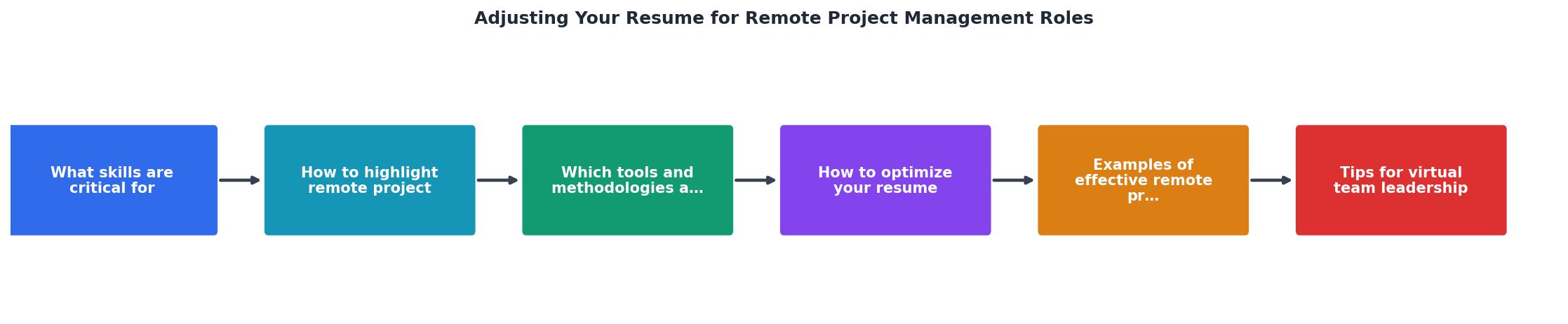
Follow this process to build a resume that works for remote PM roles:
Step 1: Identify your target role and company. Read the job posting carefully. Highlight keywords, tools, and skills mentioned. Note the seniority level, team size, industry.
Step 2: Reframe your experience through a remote lens. Go through your work history. Even if you worked on-site, extract the parts that are relevant to remote work, any distributed team leadership, async communication, tool use, or successful navigation of change.
Step 3: Rewrite your summary. Make it clear you're a remote-ready project manager. Include key skills (remote leadership, async communication, specific tools), a metric or two (team size managed, projects delivered), and your philosophy on distributed work.
Step 4: Rewrite experience bullets. Use the template above: action verb + remote context + team scope + tool + outcome. Do this for your last 3-4 roles or all roles if they're recent and relevant.
Step 5: Update your skills section. List the tools and methodologies from the job posting. Be honest, only list tools you've actually used, but include the ones most relevant to the role.
Step 6: Test against the job description. Reread the posting. Can you find evidence on your resume for each major skill or requirement mentioned? If not, add it or adjust phrasing.
Step 7: Check for ATS compatibility. Use simple formatting, clear section headers, standard fonts, and straightforward structure. Avoid columns, tables, or graphics.
Key Takeaway
Remote PM Resume Optimization Metrics
When you prepare your resume for remote project management roles, you're not just updating your title or adding a few keywords. You're reframing your entire professional narrative around the realities of distributed work. The tools change, the communication style changes, the leadership approach changes. Your resume should reflect that. Get it right, and you'll make it past the ATS and into the hands of a hiring manager who recognizes exactly what you bring to a remote team.
Resume Optimization Checklist for Remote PM Roles
Your progress is saved automatically in your browser.
FAQ
Frequently Asked Questions
Additional Resources
- How to Tailor Your Resume for Different Roles Without ... - This guide breaks down how to efficiently tailor your resume for different roles without starting from scratch, while still keeping it ...
- How to TAILOR Your RESUME to Any JOB (2-Minute ... - In this video, I'll show you how to tailor your resume in just 2 minutes—without rewriting it from scratch. Tailor Your Resume to a Specific ...
- How to Tailor Your Resume for Remote Jobs - 1. List your past remote experience · 2. Include remote-related keywords · 3. Describe how you succeeded in a remote setting · 4. Showcase ...

Get the 356 complete recruitment audit (free PDF)
Download the free PDF with 356 reasons hiring stalls, plus optional daily email tips. No credit card.
Get the free PDF 356 reasons · Free download