Aligning Cover Letter Themes with a Tailored Tech Resume
Your resume and cover letter are not separate documents. They're a team. When a hiring manager reads them together, they should tell the same story, one where your technical skills, achievements, and problem-solving abilities align perfectly with what the company needs. A mismatch between the two signals confusion or worse, inattention to detail. Get them working in sync, and you improve your odds of making it past both the ATS and human screeners.

Photo by Jakub Pabis from Pexels
Your resume and cover letter are not separate documents. They're a team. When a hiring manager reads them together, they should tell the same story, one where your technical skills, achievements, and problem-solving abilities align perfectly with what the company needs. A mismatch between the two signals confusion or worse, inattention to detail. Get them working in sync, and you improve your odds of making it past both the ATS and human screeners.
TL;DR:
- Emphasize the same technical skills and keywords in both your resume and cover letter to signal coherence and pass ATS filters.
- Use industry-specific terminology consistently to demonstrate fluency in your target field.
- Highlight 2-3 signature project achievements in both documents, expanding on them differently to create narrative depth.
- Structure your cover letter to reinforce resume points without simply repeating them verbatim.
- Ensure ATS compatibility by matching job posting language while maintaining authenticity.
Why alignment matters for tech applications
Recruiters and hiring managers spend seconds scanning. If your resume lists "Kubernetes orchestration" and your cover letter mentions "container deployment," they see inconsistency, even if you mean the same thing. More importantly, if your resume hits the ATS with the right keywords but your cover letter reads like a generic template, you've wasted half your application.
When your cover letter and resume share the same technical vocabulary and reinforce the same achievements, three things happen:
- ATS systems recognize you as a strong match. Keywords repeated across documents signal relevance to algorithmic screeners.
- Hiring managers get a coherent narrative. They see a candidate with clear expertise, not scattered experience.
- You build confidence in your positioning. Alignment forces you to clarify what you actually bring to the role.
The stakes are high. Most tech applications are filtered by ATS software before a human sees them. Misalignment between resume and cover letter doesn't just hurt readability, it can cause the ATS to downrank or reject your application entirely if the cover letter dilutes the keyword density your resume worked hard to build.
How to emphasize technical skills in both documents
Start with your resume. Pull out your core technical competencies, the skills listed in the job posting that match your background. These become your anchor keywords.
If the job posting emphasizes "React, Redux, and REST APIs," and you have that experience, these terms appear in both your resume and your cover letter. Not awkwardly shoehorned in, but naturally integrated into concrete examples.
Resume approach: List skills cleanly in a dedicated section. Be specific. Instead of "Full-Stack Development," write "React, Node.js, PostgreSQL, REST APIs, CI/CD with GitHub Actions." Each term is exact, searchable, and ATS-friendly.
Cover letter approach: Don't repeat the resume's skill list. Instead, weave those same skills into a narrative about what you've built. For example:
"In my previous role, I architected a real-time notification system using React on the frontend and Node.js on the backend, leveraging Redux for state management and consuming REST APIs to integrate third-party services. This project reduced notification latency from 2 seconds to under 200ms."
You've used React, Node.js, Redux, and REST APIs, the same keywords, but in context. The hiring manager sees that you don't just know these tools; you've applied them to solve real problems.
Pro tip: When listing technologies in your resume, use the exact terminology from the job posting. If they say "TypeScript" and you use "TS," you've broken keyword alignment. Match their language precisely.
How to showcase project achievements and problem-solving
Projects are where alignment becomes effective. Pick 2-3 signature achievements that directly relate to the role you're applying for. Include them in both documents, but serve them differently.
In your resume: Achievements are concise and metric-driven. "Built microservices architecture serving 50K daily users, reducing API response time by 40%." That's one line. It proves impact.
In your cover letter: Expand on one of those achievements to show your problem-solving process. "When our monolithic API hit performance bottlenecks during traffic spikes, I proposed breaking it into microservices. I led the migration of the user authentication service first, implemented load balancing, and monitored the results. The change cut response times by 40% and enabled our platform to scale to 50K daily active users without additional infrastructure costs."
The cover letter version answers the unspoken question: How did you think through the problem? Hiring managers want to understand your approach, not just your results.
For a full-stack example, if you worked on a web application redesign:
Resume: "Refactored legacy Angular codebase to modern React architecture, improving bundle size by 35% and page load time by 2.1 seconds."
Cover letter: "Our Angular application had grown unwieldy. I analyzed the codebase, identified dead code and redundant dependencies, and made a case to management for a gradual migration to React. I led the effort by creating a module-by-module migration plan, ensuring we could deploy incrementally without blocking feature development. The result was a 35% reduction in bundle size and measurable improvements to page load performance."
The resume shows the what. The cover letter shows the why and the how.
Using industry-specific keywords effectively
Tech hiring is keyword-sensitive. Not because hiring managers are robots, but because they use specific terminology for a reason. A backend engineer talks about "database optimization"; a junior developer might say "making the database faster."
Keyword Integration Flow
The keyword integration flow above shows how to systematically use industry language. Keywords aren't just for the ATS, they signal that you belong in that field.
Create a keyword map for each application:
- Job posting keywords: "Docker, Kubernetes, AWS, CI/CD, Infrastructure as Code"
- Your resume equivalent: "containerization," "orchestration," "cloud deployment," "automation"
- Your cover letter: Mention Docker when discussing how you containerized a legacy application; reference Kubernetes when explaining how you managed service scaling
"The only exception is the header, which can vary in alignment depending on the template design.">, Cover Letter Templates for 2026 (Customize & Download)
Examples of aligned tech resumes and cover letters
Here's a real-world scenario. Suppose you're applying for a Senior Frontend Engineer role at an e-commerce company. The job posting emphasizes React, performance optimization, and cross-functional collaboration.
Resume bullet (current role):
"Led migration of product pages from jQuery to React, improving Time to Interactive by 1.8s and reducing JavaScript bundle size by 42%."
Cover letter paragraph (same achievement, different angle):
"I noticed our product pages were underperforming on slower networks. Users on 3G connections saw a 4-second delay before the page became interactive. I conducted a performance audit and proposed migrating our jQuery-based pages to React with code splitting. Working with our backend team to optimize API payloads and our design team to ensure consistency, I rolled out the migration incrementally. The result exceeded our goals: Time to Interactive dropped by 1.8 seconds, and our JavaScript bundle shrank by 42%. Conversion rates on mobile increased by 3.2% in the first quarter after launch."
Notice:
- Both mention React, performance, and bundle size (keyword alignment).
- The resume is metric-focused and scannable.
- The cover letter adds context: why you did it, how you collaborated, and business impact (conversion rate).
- The cover letter doesn't parrot the resume; it deepens it.
Resume bullet:
"Automated infrastructure provisioning using Terraform, reducing deployment time from 45 minutes to 8 minutes and enabling consistent staging/production environments."
Cover letter paragraph:
"Our team deployed infrastructure manually, which meant every environment was slightly different, a major source of 'works on my machine' bugs. I introduced Terraform to codify our AWS infrastructure. I created modular, reusable configurations for VPCs, security groups, RDS instances, and Lambda functions. Within two months, every team member could spin up a complete staging environment in minutes. This consistency reduced deployment bugs by 60% and freed us to focus on features instead of infrastructure troubleshooting."
Again: same technical keywords (Terraform, AWS), different depth and storytelling angle.
How to create a cohesive narrative for tech roles

A cohesive narrative doesn't mean your resume and cover letter are identical. It means they tell the same story from different angles.
Start with your core positioning statement. This is the central idea about what you bring to the table. For example: "I build scalable systems that solve real business problems." or "I bridge backend infrastructure and frontend user experience to optimize performance." Choose one that's genuine and relevant to the role.
Use this positioning consistently:
- Resume: Every bullet point supports this positioning. Achievements emphasize scalability, performance, or problem-solving depending on your statement.
- Cover letter: Open and close with this theme. Your examples reinforce it.
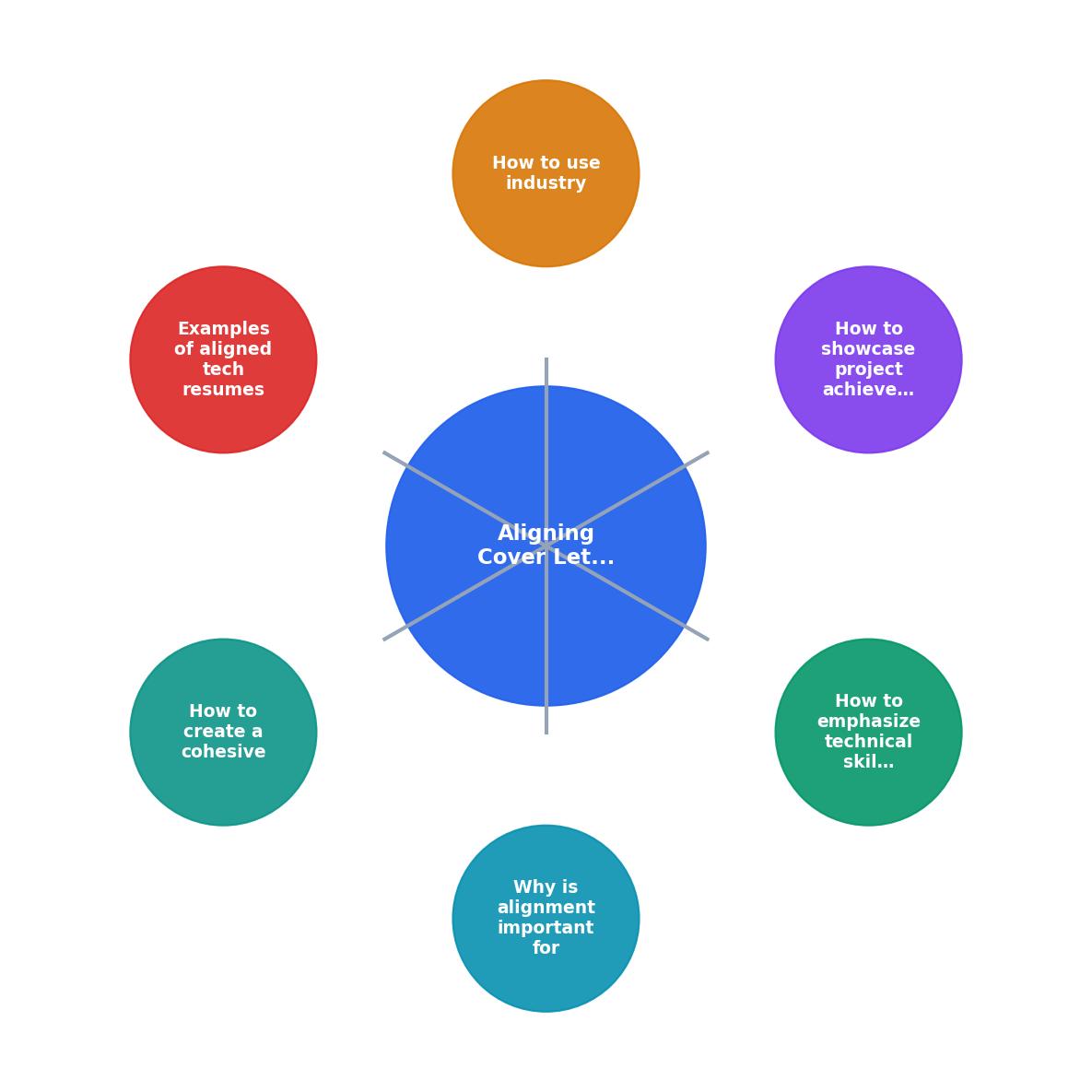
The process diagram above walks through the alignment steps. Each phase reinforces the previous one.
Avoid these misalignment traps:
- Resume focuses on technical depth; cover letter on soft skills. They should complement each other. Your resume shows you know Docker; your cover letter shows you led the Docker adoption across the team.
- Resume uses buzzwords; cover letter sounds generic. If your resume emphasizes "serverless architecture," your cover letter should explain how you've worked with Lambda, API Gateway, or managed serverless platforms. Specificity builds credibility.
- Resume is achievements-heavy; cover letter is responsibility-heavy. Both should include achievements. Responsibilities are context; achievements prove impact.
- Different keywords in each. This is an ATS killer. Consistency is precision.
Why alignment drives results
When your resume and cover letter align, you move faster through screening. ATS systems recognize coherence. Hiring managers see focus. You stand out as someone who does their homework and communicates clearly.
The alignment also forces you to be honest about your experience. You can't claim expertise in your resume and then tell a different story in your cover letter. This discipline sharpens your positioning and helps you apply only to roles where you're genuinely qualified.
Create your aligned application
Use this checklist to verify your resume and cover letter work as a team:
Alignment Verification Checklist
Your progress is saved automatically in your browser.
FAQ
Frequently Asked Questions
Additional Resources
- Cover Letter Templates for 2026 (Customize & Download) - Create your cover letter with tailored content ideas, or generate one based on your resume. Build my cover letter. CVs. CVs. CV Templates.
- This Cover Letter Formula Actually Gets Interviews - This video breaks down how to write a cover letter for a job using fewer than 7 sentences and 2 critical details most applicants miss.
- Tech Cover Letter Examples That Get You Hired - Professional Tech cover letter samples from real job applications. Including a writing template that you can use for your Tech cover letter.

Get the 356 complete recruitment audit (free PDF)
Download the free PDF with 356 reasons hiring stalls, plus optional daily email tips. No credit card.
Get the free PDF 356 reasons · Free download