Strategically Presenting a Career Change from HR to Tech
Your resume still reads like an HR generalist's playbook, but you want a recruiter at a SaaS company to see a future product manager, data analyst, or UX researcher. The gap between what you have done and what you want to do next is smaller than it looks. The trick is translating years of people operations, workforce analytics, and process improvement into the vocabulary tech hiring managers actually scan for. This guide walks you through that translation step by step.

Your resume still reads like an HR generalist's playbook, but you want a recruiter at a SaaS company to see a future product manager, data analyst, or UX researcher. The gap between what you have done and what you want to do next is smaller than it looks. The trick is translating years of people operations, workforce analytics, and process improvement into the vocabulary tech hiring managers actually scan for. This guide walks you through that translation step by step.
TL;DR:- Identify transferable skills like stakeholder management, data analysis, and project coordination that map directly to tech roles.
- Rewrite every bullet point using tech-industry language: swap "onboarding" for "user adoption," "headcount planning" for "capacity modeling."
- Fill experience gaps with certifications (Google Data Analytics, CompTIA, Scrum), side projects, and volunteer tech work.
- Use a tool like Resume Hedgehog to match your rewritten resume against specific tech job descriptions so nothing gets lost in ATS filtering.
Why HR experience transfers to tech
The instinct is to think HR and tech live on different planets. They don't. HR professionals spend their days solving problems that tech companies pay top dollar for: understanding user needs (employees are internal users), analyzing workforce data, managing cross-functional projects, and communicating complex policies in plain language.
That number reflects how deeply analytical modern HR work already is. If you have built dashboards in Workday, run turnover-prediction models in Excel, or designed engagement surveys with statistical rigor, you already operate in the same mental framework as a junior data analyst or product operations specialist.
"The HR department handles a huge variety of tasks and functions, but the core of these is making a work environment better for the people who work there.">, Considering a Career Change to HR? Do This First
That "making things better for people" instinct is exactly what user-centric tech roles demand. The difference is the label, not the skill.
Transferable skills from HR to tech

Here is a concrete list of skills you already have and where they land in tech:
- Stakeholder management: You mediated between executives, managers, and employees. In tech, that is product management, customer success, or solutions consulting.
- Data analysis: Compensation benchmarking, turnover analytics, headcount forecasting. Tech calls this business intelligence or people analytics.
- Project management: Rolling out a new HRIS across 12 offices is no different from a SaaS implementation project. Timelines, dependencies, change management, all the same.
- Process design: You built onboarding workflows, performance review cycles, and compliance checklists. Tech calls this operations, process engineering, or program management.
- Communication and training: Writing policy docs, running workshops, creating e-learning modules. Tech calls this technical writing, enablement, or instructional design.
- Compliance and risk assessment: GDPR, EEOC, SOX. Tech companies need people who understand regulatory frameworks, especially in privacy, security, and AI governance.
- Vendor evaluation: Selecting an ATS or benefits platform means you already know how to evaluate SaaS products, run demos, negotiate contracts, and manage implementations.
The overlap is significant. Most career changers underestimate it because they have never seen their work described in tech terminology.
Reframe HR experience in tech language

This is where the real resume surgery happens. Every bullet on your resume needs to speak the language of the job posting you are targeting. Here is how to do it:
1. Replace HR jargon with tech equivalents.
| HR Term | Tech Equivalent |
|---|---|
| Employee onboarding | User onboarding / adoption |
| Headcount planning | Capacity modeling / resource planning |
| Performance reviews | OKR tracking / feedback loops |
| HRIS implementation | SaaS platform deployment |
| Benefits administration | Vendor management / procurement |
| Employee engagement survey | User research / NPS measurement |
| Training program design | Enablement / L&D content strategy |
| Compliance audit | Risk assessment / governance review |
"Managed onboarding for new hires."
Instead: "Designed and deployed onboarding workflow for 200+ new hires annually, reducing time-to-productivity by 30% through automated task sequencing in Workday."
3. Emphasize tools and platforms.
Tech recruiters scan for tool names. If you used Workday, SAP SuccessFactors, BambooHR, Tableau, Power BI, Slack, Jira, Confluence, or Google Workspace, name them explicitly. These are the same tools tech teams use daily.
Certifications that bridge the gap
You do not need a computer science degree. You need targeted credentials that signal commitment and baseline competency. Here are the ones that carry weight for HR-to-tech transitions:
- Google Data Analytics Professional Certificate (Coursera): Six months, covers spreadsheets, SQL, R, Tableau. Directly relevant for people analytics or business intelligence roles.
- Google Project Management Professional Certificate (Coursera): Maps your existing PM skills to Agile and Scrum frameworks.
- CompTIA Project+: Vendor-neutral project management certification recognized across tech.
- Certified ScrumMaster (CSM): If you are targeting product or engineering-adjacent roles, Scrum certification shows you understand how tech teams ship software.
- SHRM-CP or PHR + a tech cert combo: Keeping your HR credential while adding a tech cert signals a deliberate, strategic pivot rather than a random jump.
- HubSpot Inbound Marketing Certification (free): Useful if you are moving toward marketing ops or growth roles.
- Salesforce Administrator Certification: Valuable for operations, RevOps, or customer success roles at SaaS companies.
Align your resume with tech expectations

Tech resumes follow specific conventions that differ from traditional HR or corporate formats:
- Summary statement, not objective. Write 2-3 sentences that position you as a tech professional with HR domain expertise. Example: "Operations professional with 6 years of experience in workforce analytics, HRIS deployment, and cross-functional program management. Transitioning to product operations with a focus on data-driven process optimization."
- Skills section with hard skills first. SQL, Tableau, Jira, Agile, HRIS platforms, data visualization. Soft skills go at the end or get woven into bullet points.
- Reverse chronological, one page. Tech recruiters spend an average of 7.4 seconds on a resume. One page. No exceptions for career changers.
- No "References available upon request." That line wastes space. Everyone knows references exist.
- GitHub or portfolio link. Even a simple GitHub repo with a data analysis project or a Notion portfolio showing process documentation adds credibility.
Seven seconds. That is your window. Every word on the page needs to earn its spot.
Address gaps in tech experience
The biggest fear: "But I have never worked in tech." Here is how to close that gap before it becomes a rejection:
- Side projects. Build a people-analytics dashboard using public HR datasets on Kaggle. Clean the data in Python or R, visualize it in Tableau, publish it on GitHub. One project like this is worth more than a paragraph explaining your "passion for technology."
- Volunteer work. Nonprofits constantly need help with CRM setup, data migration, website management, and process automation. Offer 10 hours a week to a local nonprofit and put the work on your resume under "Projects" or "Volunteer Experience."
- Freelance consulting. Offer to help a small business set up their HR tech stack (Gusto, Rippling, BambooHR). You already know these platforms. Now you are a "tech consultant."
- Open-source contributions. Some HR-tech open-source projects on GitHub welcome documentation contributions. Writing clear docs is a skill tech teams value enormously.
- Internal transfers. If you are still employed, volunteer for cross-functional projects with engineering or product teams. A three-month stint on an HRIS migration project team gives you a legitimate tech project to reference.
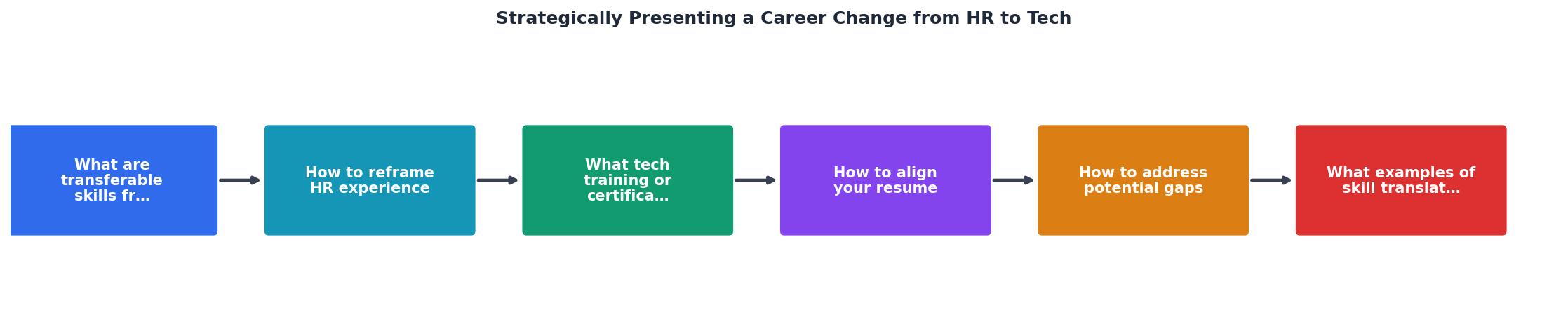
Follow the steps in order: Audit Skills, Reframe Bullets, Add Certifications, Build Projects, Tailor to Job, Submit and Iterate. Each step builds on the previous one.
Skill translation examples
Here is what the actual rewrite looks like, bullet by bullet:
The following interactive card shows three real before-and-after transformations you can use as templates for your own resume bullets.
Notice the pattern: every rewritten bullet starts with a strong action verb, includes a number, names a tool or methodology, and ends with a measurable outcome. That is the formula.
More quick translations:
"Handled employee relations issues"→ "Resolved cross-functional stakeholder conflicts, maintaining 95% internal satisfaction score across engineering and operations teams.""Created training materials"→ "Developed enablement content library (40+ modules) in Confluence, reducing support ticket volume by 25%.""Managed HRIS system"→ "Administered Workday platform for 800+ users, owned data integrity, built custom reports, and led quarterly system audits."
Step-by-step adaptation guide
HR-to-Tech Resume Adaptation Checklist
Your progress is saved automatically in your browser.
| Generic HR Resume | Tech-Optimized Resume |
|---|---|
| Lists responsibilities | Leads with measurable outcomes |
| Uses HR jargon | Uses tech-industry vocabulary |
| No tools mentioned | Names specific platforms and tools |
| Two pages, dense text | One page, scannable sections |
| Objective statement | Summary with target role positioning |
| No portfolio or projects | Links to GitHub, Notion, or case studies |
That number jumps significantly when you combine a rewritten resume with targeted applications rather than mass-applying with a generic document.
FAQ
Frequently Asked Questions
Additional Resources
- Considering a Career Change to HR? Do This First - Steps for a successful transition into human resources · Identify your transferable skills: · Build HR knowledge: · Join professional associations ...
- Career Change to Tech: Step-by-Step Transition - CIAT - Explain your career change as a strategic decision; Connect your existing skill set to the specific tech role; Demonstrate knowledge of the tech ...
- "Transitioning”… from TA to HR that is. | Matthew Beath - My advice is to consider a specialism within HR where there are constant challenges; natural leaps are via learning and development, or talent ...
Get the 356 complete recruitment audit (free PDF)
Download the free PDF with 356 reasons hiring stalls, plus optional daily email tips. No credit card.
Get the free PDF 356 reasons · Free download