Highlighting a Career Pivot Towards Environmental Sciences
You spent years building expertise in one field, and now you want to channel that experience into environmental sciences. The challenge is that your resume still speaks the language of your old career, and hiring managers in sustainability roles scan for very specific terminology. This guide walks you through reframing your background, choosing the right keywords, and structuring a resume that makes your pivot look intentional and credible.

You spent years building expertise in one field, and now you want to channel that experience into environmental sciences. The challenge is that your resume still speaks the language of your old career, and hiring managers in sustainability roles scan for very specific terminology. This guide walks you through reframing your background, choosing the right keywords, and structuring a resume that makes your pivot look intentional and credible.
Photo by Yaroslav Shuraev from Pexels
TL;DR:- Identify transferable skills like data analysis, project management, and regulatory compliance, then translate them into environmental science language.
- Reframe every bullet point on your resume to connect past accomplishments with sustainability outcomes.
- Add relevant certifications, coursework, and personal projects to fill perceived experience gaps.
- Use targeted keywords such as "environmental impact assessment," "GIS," and "sustainability reporting" to pass ATS filters.
The short answer
Your old career gave you skills that environmental employers actually need. Data analysis, stakeholder communication, regulatory knowledge, budget management, and report writing all transfer directly. The trick is not to list them in generic terms but to rewrite each bullet so it connects to environmental outcomes. A project manager who "coordinated cross-functional teams to deliver $2M infrastructure projects on time" becomes someone who "led multi-stakeholder coordination for large-scale infrastructure projects, ensuring compliance with environmental review timelines." Same experience, different framing, completely different impression on a hiring manager at an environmental consultancy.
The environmental sciences sector is growing fast, and it pulls talent from engineering, policy, finance, healthcare, and education. You do not need a PhD in ecology to land your first role. You need a resume that proves you can do the work.
Skills that environmental employers want

Environmental sciences is broad. It covers everything from air quality monitoring to corporate sustainability strategy. But certain skills show up across nearly every job posting:
- Data analysis and interpretation - collecting field data, running statistical models, working with GIS software
- Regulatory compliance - understanding EPA regulations, state environmental laws, permitting processes
- Project management - coordinating timelines, budgets, and teams for environmental assessments or remediation projects
- Technical writing and reporting - producing environmental impact statements, sustainability reports, grant proposals
- Stakeholder engagement - communicating findings to non-technical audiences, community outreach, public comment processes
- Research methodology - designing studies, literature reviews, peer review processes
How to reframe past experience
This is where most career changers struggle. You know your old job inside out, but you describe it in the language of your old industry. Environmental hiring managers do not care that you "increased quarterly sales by 18%." They care that you "developed client relationships and communicated complex technical information to drive adoption of new solutions."
Here is a practical framework for rewriting each bullet point:
- Start with the transferable action - What did you actually do? (analyzed, coordinated, reported, monitored, assessed)
- Add the environmental connection - How does this action relate to environmental work? (compliance, sustainability, resource management)
- Include a measurable result - What was the outcome? (reduced costs by X%, completed Y assessments, managed Z stakeholders)
Before and after examples
Managed a team of 8 sales representatives across the Northeast regionbecomes "Led cross-functional team of 8 professionals, coordinating project deliverables and stakeholder communications across multiple geographic regions"Created monthly financial reports for executive leadershipbecomes "Produced detailed analytical reports synthesizing complex datasets for senior decision-makers, ensuring accuracy and regulatory alignment"Reduced operational costs by 22% through process optimizationbecomes "Identified and implemented resource efficiency improvements, reducing operational waste by 22% through systematic process analysis"
Environmental science keywords
Keywords determine whether your resume survives the Applicant Tracking System (ATS) screening. Environmental science roles use specific terminology, and if your resume lacks it, automated filters will reject you before a human ever reads it.
Here is a curated list of high-value keywords organized by category:
Technical skills:- Environmental impact assessment (EIA)
- Geographic Information Systems (GIS)
- Environmental site assessment (Phase I/Phase II)
- Air quality monitoring
- Water quality analysis
- Soil sampling and remediation
- Life cycle assessment (LCA)
- Carbon footprint analysis
- NEPA (National Environmental Policy Act)
- Clean Water Act (CWA)
- Clean Air Act (CAA)
- RCRA (Resource Conservation and Recovery Act)
- CERCLA/Superfund
- ISO 14001
- ESG reporting
- Sustainability reporting (GRI, SASB)
- Circular economy
- Renewable energy integration
- Climate adaptation planning
- Environmental justice
- Net-zero strategy
- Biodiversity assessment
- ArcGIS / QGIS
- R / Python for environmental data
- AutoCAD (environmental engineering)
- EPA databases (ECHO, Envirofacts)
"Most of our content – other than images – is available to republish for free under a Creative Commons license (CC BY-NC-ND 4.0).">, 'How do I start a new career in a green job?' » Yale Climate Connections
You do not need every keyword on this list. Pick the ones that match your target role and weave them naturally into your experience bullets, skills section, and summary statement.
Showcasing education and certifications

If you have completed any environmental coursework, certifications, or training, put it near the top of your resume. For career changers, education signals commitment to the new field.
Certifications worth pursuing:- LEED Green Associate or LEED AP (U.S. Green Building Council)
- Certified Environmental Professional (CEP) through the Academy of Board Certified Environmental Professionals
- ISO 14001 Lead Auditor
- HAZWOPER 40-Hour Training (required for many remediation roles)
- GIS Certificate programs (offered by many universities online)
- Sustainability certificates from programs like Harvard Extension, University of Michigan, or Coursera/edX partnerships
- Place certifications in a dedicated "Certifications" section right after your summary
- Include the issuing organization and completion date
- If you are currently enrolled, write "Expected completion: [month/year]"
- Online courses from recognized institutions count, especially when paired with a capstone project
Presenting projects and initiatives
Personal projects, volunteer work, and side initiatives fill the gap between your old career and your new target. Environmental employers value hands-on experience, even if it was unpaid.
Types of projects that strengthen your resume:- Volunteering with local conservation organizations (trail restoration, water monitoring, tree planting programs)
- Conducting an independent sustainability audit for a small business or nonprofit
- Building a GIS mapping project using publicly available environmental data
- Writing a blog or report analyzing local environmental issues
- Participating in citizen science programs (eBird, iNaturalist, local water quality monitoring)
- Organizing community clean-up events or environmental education workshops
Structuring your environmental resume
Here is the step-by-step process for building a resume that supports your career pivot:
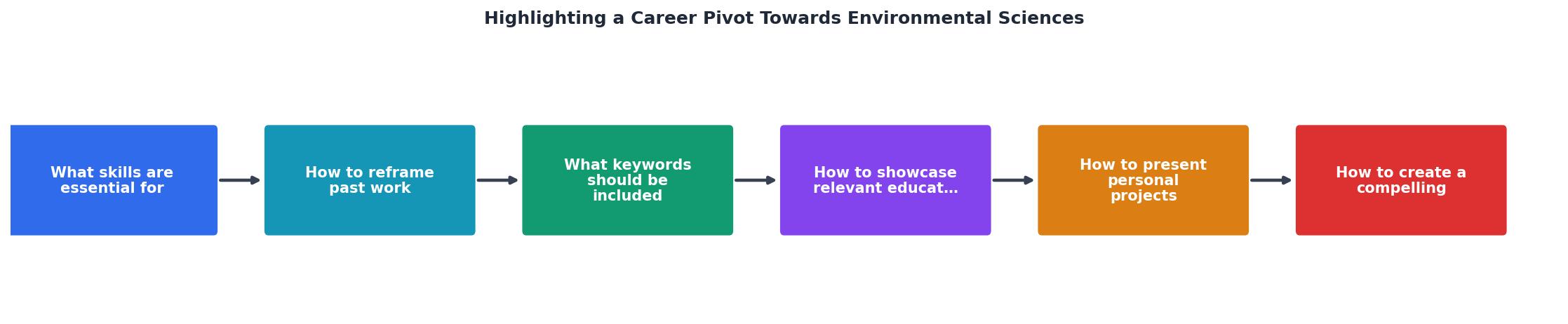
Step 1: Write a targeted summary statement. Two to three sentences that name your target role, highlight your strongest transferable skills, and mention any environmental credentials. Example: "Project manager with 8 years of experience in cross-functional team leadership and regulatory compliance, transitioning to environmental consulting. LEED Green Associate with coursework in environmental impact assessment and GIS analysis."
Step 2: Create a skills section with environmental keywords. Pull directly from job postings. Group skills into categories (Technical, Regulatory, Software, Communication).
Step 3: Reframe your work experience. Use the before-and-after method described above. Every bullet should connect to an environmental competency.
Step 4: Add education, certifications, and training. Place this high on the page if your credentials are recent and relevant.
Step 5: Include projects and volunteer work. Treat these with the same rigor as paid experience.
Step 6: Run your resume through an ATS check. Tools like Resume Hedgehog can match your resume against a specific environmental job posting, identifying missing keywords and suggesting improvements. This is especially useful when you are learning a new field's vocabulary.
The following interactive card shows how a typical career changer's skill set maps to environmental science competencies:
Skill Translation Map
| Generic Resume Bullet | Reframed for Environmental Sciences |
|---|---|
| Managed team of 12 across 3 departments | Led cross-functional teams on multi-stakeholder environmental projects |
| Created quarterly financial reports | Produced analytical reports synthesizing environmental compliance data |
| Reduced costs by 15% through vendor negotiations | Achieved 15% resource efficiency gains through sustainable procurement |
| Trained new employees on company procedures | Developed training programs on environmental health and safety protocols |
| Conducted market research for product launches | Conducted research and literature reviews supporting environmental assessments |
Environmental Career Pivot Resume Checklist
Your progress is saved automatically in your browser.
FAQ
Frequently Asked Questions
What was the biggest challenge you faced when reframing your experience for a new field? Share your approach in the comments.
Additional Resources
- 'How do I start a new career in a green job? ... - You asked which careers related to the environment are open to entry-level job seekers. The answer is: many of them! So start zeroing in on jobs ...
- Landing the Job of a Lifetime: 5 Tips to Build a Career in ... - Landing the Job of a Lifetime: 5 Tips to Build a Career in Environmental Fields · Employers want to see a mix of theoretical training and real-world experience.
- Explore Career Opportunities in Environmental Science - An environmental science career might mean working in an office, out in nature, or a combination of both. Your focus could be on math, writing, or studying the ...
Get the 356 complete recruitment audit (free PDF)
Download the free PDF with 356 reasons hiring stalls, plus optional daily email tips. No credit card.
Get the free PDF 356 reasons · Free download