Emphasizing a Career Shift into Data Analytics
Your resume still reads like a marketing coordinator, a teacher, or an operations manager. But the job you want says Data Analyst. The disconnect between your past titles and your target role is the single biggest reason career changers get filtered out before a human ever sees their application. The fix is not starting over.


Your resume still reads like a marketing coordinator, a teacher, or an operations manager. But the job you want says Data Analyst. The disconnect between your past titles and your target role is the single biggest reason career changers get filtered out before a human ever sees their application. The fix is not starting over. It is reframing what you already have and filling specific gaps with the right keywords, credentials, and project evidence.
Photo by Yan Krukau from Pexels
TL;DR:- Identify the analytical, technical, and problem-solving skills you already use and translate them into data analytics language.
- Reframe every bullet point on your resume around data, metrics, and outcomes relevant to analytics roles.
- Add data analytics keywords, certifications, and personal projects to close the credibility gap.
The career changer's real advantage
Most hiring managers for junior and mid-level data analytics positions do not expect a computer science degree. They expect someone who can clean messy data, spot patterns, and communicate findings to non-technical stakeholders. If you spent years managing budgets, tracking student performance, coordinating logistics, or running A/B tests on email campaigns, you already did analytics work. You just described it in the wrong vocabulary.
The goal of your resume rewrite is simple: prove you can do the job by showing you already did parts of it, then demonstrate you filled the remaining gaps through courses, certifications, and hands-on projects.
That number matters. SQL is learnable in weeks, not years. The same applies to most technical requirements in entry-level data analytics roles. Your domain expertise, on the other hand, takes years to build and cannot be taught in a bootcamp.
Skills that data analytics roles demand

Data analytics hiring breaks down into three skill categories. You need to show evidence of all three on your resume, even if the evidence comes from a different industry.
Technical skills
- SQL for querying databases
- Python or R for data manipulation and analysis
- Excel (advanced: pivot tables, VLOOKUP, Power Query)
- Tableau or Power BI for data visualization
- Basic statistics: regression, hypothesis testing, probability
Analytical skills
- Pattern recognition in large datasets
- Root cause analysis and troubleshooting
- Forecasting and trend identification
- Data cleaning and validation
Communication skills
- Translating technical findings into business recommendations
- Building dashboards and reports for non-technical audiences
- Presenting data stories to stakeholders
If you managed a team, ran reports for leadership, or built spreadsheets that drove decisions, you already practiced these skills. The trick is naming them correctly on your resume.
Reframe past experience for analytics
Every job involves data. The question is whether your resume says so. Here is how to translate common roles:
Operations Manager: "Managed warehouse inventory" becomes "Analyzed inventory data across 3 warehouses using Excel pivot tables, reducing stockouts by 18% through demand forecasting."
Teacher: "Graded student assignments" becomes "Tracked and analyzed performance data for 120+ students per semester, identifying at-risk learners through trend analysis and improving pass rates by 12%."
Marketing Coordinator: "Ran email campaigns" becomes "Analyzed campaign performance metrics (open rates, CTR, conversion) across 50+ A/B tests using Google Analytics, driving a 23% increase in qualified leads."
"The individual wanted to know what steps they should take to successfully break into data analytics and what pitfalls to avoid.">, Transitioning to a Data Analytics Career: How to Leverage Your Domain Expertise
The pattern is consistent: start with the data, describe the tool or method, and end with a measurable outcome. Every bullet point on your resume should follow this structure.
Keywords for a data analytics resume

Applicant Tracking Systems scan for specific terms before a recruiter ever opens your file. Missing the right keywords means automatic rejection, regardless of your actual qualifications.
Here is a context-aware breakdown of the keywords that matter most. The interactive element below shows how these keywords map to different resume sections.
Data Analytics Resume Keywords
Pull keywords directly from the job posting you are targeting. If the listing says "Looker" instead of "Tableau," use Looker. If it says "data wrangling" instead of "data cleaning," match that exact phrase. ATS systems are literal. A tool like Resume Hedgehog can match your resume to a specific job description automatically, catching keyword gaps you might miss manually.
Showcase certifications and courses
Certifications close the credibility gap fast. They tell a hiring manager: "I invested real time learning this, and a third party verified it." Here are the ones that carry the most weight for career changers:
- Google Data Analytics Professional Certificate (Coursera) - widely recognized, covers the full analytics workflow
- IBM Data Analyst Professional Certificate (Coursera) - strong on Excel, SQL, and Python
- Microsoft Certified: Data Analyst Associate (PL-300) - proves Power BI proficiency
- Tableau Desktop Specialist - validates visualization skills
- CompTIA Data+ - vendor-neutral, covers data concepts broadly
Present personal projects effectively

Personal projects are your substitute for professional data analytics experience. They prove you can do the work, not just study it. The best projects share three traits: they use real (or realistic) data, they answer a specific question, and they produce a clear deliverable.
Strong project examples:
- Scraped and analyzed 10,000 Airbnb listings in your city using Python and pandas, built a Tableau dashboard showing price trends by neighborhood
- Cleaned a public health dataset from data.gov, ran regression analysis to identify factors correlated with hospital readmission rates
- Built an automated Excel reporting template for a local nonprofit that reduced their monthly reporting time from 6 hours to 30 minutes
Create a Projects section between Experience and Education. Format each project like a job entry: project title, tools used, date, and 2-3 bullet points describing what you did and what you found. Link to a GitHub repository or a published dashboard when possible.
Structure your data analytics resume
This is where everything comes together. The order of sections matters because recruiters spend an average of 7 seconds on an initial resume scan.
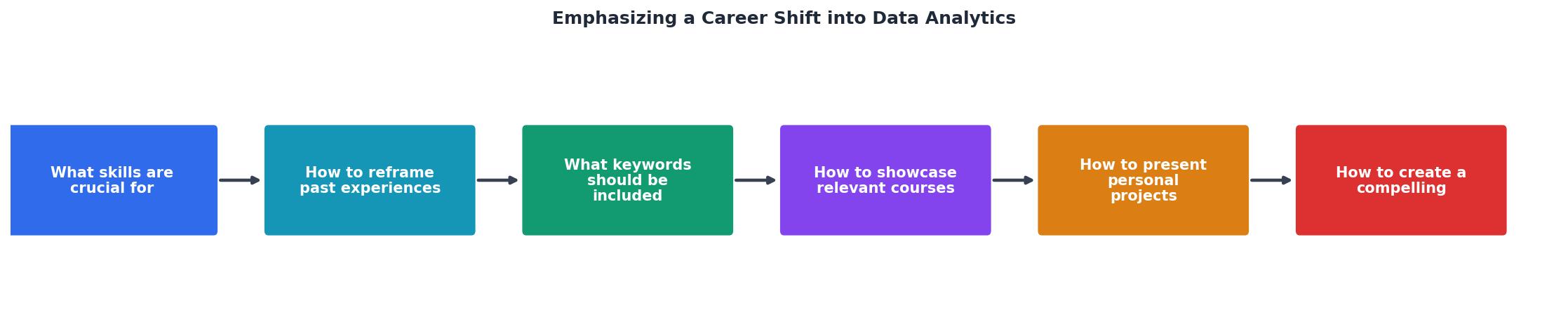
Recommended resume structure for career changers:
- Header - Name, contact info, LinkedIn, GitHub/portfolio link
- Professional Summary - 3-4 sentences positioning you as a data analytics professional, not your old title. Lead with your analytical strengths and domain expertise.
- Technical Skills - SQL, Python, Tableau, Excel, and any other tools from the job posting
- Certifications - Completed and in-progress credentials
- Projects - 2-3 data analytics projects with measurable outcomes
- Professional Experience - Reframed bullets emphasizing data, analysis, and results
- Education - Degrees, relevant coursework
| Generic Resume | Data Analytics Resume |
|---|---|
| "Led cross-functional team of 5 to implement data-driven KPI tracking" | |
| "Built automated weekly dashboards in Tableau for 3 departments" | |
| "Reduced data processing time by 40% through Python automation" | |
| "Analyzed $2.4M annual budget data, identifying $180K in cost savings" |
Your Professional Summary is the most important section for a career changer. It sets the frame. Here is an example:
"Data analyst with 6 years of operations experience and a Google Data Analytics Certificate. Skilled in SQL, Python, Tableau, and Excel. Combines deep supply chain domain knowledge with statistical analysis to deliver actionable business insights. Built 3 end-to-end analytics projects analyzing real-world datasets."
Notice: no mention of "career changer" or "transitioning professional." You are a data analyst who happens to bring domain expertise from operations.
Data Analytics Resume Rewrite Checklist
Your progress is saved automatically in your browser.
FAQ
Frequently Asked Questions
What part of your career change resume is giving you the most trouble? Share your biggest challenge below.
Additional Resources
- Transitioning to a Data Analytics Career: How to Leverage ... - Remember, breaking into a new field is challenging, but by leveraging your past experience strategically, you can make the transition smoother ...
- Data Analytics Career Change Guide for Working ... - Planning a data analytics career change? Learn the skills, portfolio steps and job search strategies working professionals need to ...
- Transitioning into Data Analytics as a Mid-Career ... - Switching careers into data analytics is possible. But it's not just about learning tools or finishing courses. It's about staying focused when ...
Get the 356 complete recruitment audit (free PDF)
Download the free PDF with 356 reasons hiring stalls, plus optional daily email tips. No credit card.
Get the free PDF 356 reasons · Free download