Choosing the Right Resume Format for Operations Jobs
Operations roles demand proof that you can keep complex systems running, cut costs, and deliver results on schedule. Yet most applicants send the same generic resume layout regardless of the job, and hiring managers notice. Picking the right resume format for an operations position is the difference between a document that screams "I optimize things" and one that gets filtered out before a human ever reads it. This guide walks through the three main formats, shows you which one fits your situation, and gives you a concrete checklist to build a resume that lands interviews.

Operations roles demand proof that you can keep complex systems running, cut costs, and deliver results on schedule. Yet most applicants send the same generic resume layout regardless of the job, and hiring managers notice. Picking the right resume format for an operations position is the difference between a document that screams "I optimize things" and one that gets filtered out before a human ever reads it. This guide walks through the three main formats, shows you which one fits your situation, and gives you a concrete checklist to build a resume that lands interviews.
Photo by Lukas Blazek from Pexels
TL;DR:- Chronological format works best for candidates with a steady operations career path and progressive responsibility.
- Functional format helps if you have gaps or are transitioning into operations from another field.
- Combination format is the strongest choice for mid-career operations professionals who need to showcase both skills and a solid work history.
- Tailor every resume to the specific operations role by mirroring the job posting's language and quantifying achievements.
Why format matters in operations
A recruiter scanning an operations resume looks for evidence of process improvement, cost reduction, and team leadership within the first six seconds. The format you choose controls where that evidence appears on the page.
Three out of four resumes never reach a hiring manager. Applicant tracking systems parse your document looking for keywords, job titles, and structured sections. A poorly formatted resume confuses the parser, and your experience disappears into a database no one searches. Operations roles are especially keyword-heavy: terms like supply chain management, lean manufacturing, KPI tracking, and vendor negotiation need to appear in scannable sections, not buried in dense paragraphs.
The right format puts your strongest selling points where both the ATS and the recruiter expect them.
Key skills for operations roles

Before choosing a format, identify the competencies that operations hiring managers actually screen for. These fall into three buckets:
- Process and systems skills - ERP platforms (SAP, Oracle, NetSuite), Six Sigma, Lean, Kaizen, workflow automation, quality assurance
- Financial and analytical skills - budgeting, forecasting, cost-benefit analysis, data visualization (Tableau, Power BI), inventory optimization
- Leadership and communication - cross-functional team management, vendor relations, stakeholder reporting, change management, conflict resolution
Quantified achievements beat vague descriptions every time. "Reduced order fulfillment time by 22% across three distribution centers" tells a story. "Responsible for order fulfillment" does not.
Comparing the three resume formats

Here is a quick visual comparison of how each format stacks up for operations candidates:
| Feature | Chronological | Functional | Combination |
|---|---|---|---|
| Best for | Steady career growth | Career changers, gaps | Mid-career with diverse skills |
| ATS compatibility | Excellent | Poor to moderate | Good |
| Skills visibility | Moderate | High | High |
| Work history clarity | High | Low | High |
| Recruiter preference | Most preferred | Least preferred | Strongly preferred |
Chronological format
Lists your work experience in reverse order, starting with the most recent role. This is the default for a reason: recruiters expect it, ATS systems parse it reliably, and it shows career progression at a glance.
Use it when: You have 3+ years of continuous operations experience with clear upward movement (coordinator to manager to director). No major gaps.
Skip it when: Your most recent role is unrelated to operations, or you have a gap longer than a year.
Functional format
Groups your experience by skill category rather than by employer. A functional resume might have sections like "Process Improvement," "Team Leadership," and "Budget Management," each with bullet points drawn from multiple jobs.
Use it when: You are entering operations from a different field and need to reframe transferable skills. Your chronological history would distract from your qualifications.
Skip it when: You are applying through an ATS. Many systems struggle to parse functional resumes, and some recruiters view the format with suspicion, assuming you are hiding something.
Combination format
Starts with a skills summary or core competencies section, then follows with a standard reverse-chronological work history. You get the keyword density of a functional resume and the timeline clarity of a chronological one.
Use it when: You have a solid operations background plus specialized skills that deserve top-of-page placement. This is the strongest format for most mid-career operations professionals.
Choosing your format step by step
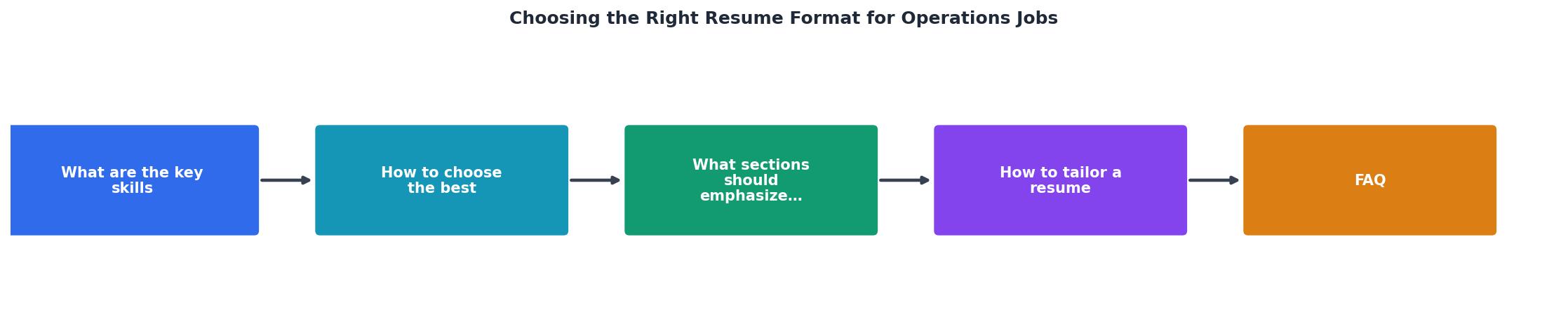
Follow these steps to land on the right format:
- Audit the job posting - List every required skill, certification, and software mentioned.
- Map your experience - Match your past roles and achievements to those requirements.
- Check your timeline - If your history is linear and gap-free, chronological works. If not, consider combination or functional.
- Pick your format - Use the comparison table above to confirm.
- Build your skills section - Mirror the exact phrasing from the posting.
- Quantify everything - Attach numbers to every achievement you can.
"Our guides are 100 percent free to use, so make sure to take advantage of them and share them with other job seekers!">, 500+ Free Resume Examples: Sample by Industry or Job (2026) · Resume.io
Structuring sections for impact

An operations resume needs specific sections arranged for maximum scannability:
- Professional summary (3-4 lines) - State your years of experience, your specialty area (logistics, supply chain, business ops), and one headline achievement.
- Core competencies - A two-column or three-column grid of 8-12 keywords pulled directly from the job posting. This is your ATS keyword block.
- Professional experience - Reverse chronological. Each role gets a one-line description of scope (team size, budget, geography) followed by 3-5 bullet points starting with action verbs.
- Education and certifications - Degrees, PMP, Six Sigma Green/Black Belt, APICS CPIM, CSCP. Operations hiring managers value certifications heavily.
- Technical skills - ERP systems, BI tools, project management software (Asana, Monday, Jira), and any industry-specific platforms.
Tailoring for specific operations roles
A generic "operations" resume does not exist. The field spans supply chain, manufacturing, healthcare operations, IT operations, business operations, and more. Each sub-field has its own vocabulary.
Here is how the emphasis shifts:
- Supply chain operations - Procurement, demand planning, logistics, warehouse management systems (WMS), freight optimization
- Manufacturing operations - Production scheduling, OEE, safety compliance, OSHA, preventive maintenance
- Business operations - SaaS metrics, cross-departmental workflows, vendor management, contract negotiation
- Healthcare operations - Patient throughput, regulatory compliance (HIPAA, Joint Commission), staffing models
Supply Chain
- Demand planning
- Logistics & WMS
- Procurement
- Freight optimization
Manufacturing
- Production scheduling
- OEE & quality
- Safety / OSHA
- Preventive maintenance
Business Ops
- SaaS metrics
- Vendor management
- Cross-dept workflows
- Contract negotiation
Healthcare Ops
- Patient throughput
- HIPAA compliance
- Staffing models
- Regulatory audits
When you apply for a specific sub-field, swap out generic terms for the precise language that field uses. A tool like Resume Hedgehog can match your resume's language to a specific job posting automatically, saving you the manual keyword research.
Operations Resume Format Checklist
Your progress is saved automatically in your browser.
FAQ
Frequently Asked Questions
What format are you currently using for your operations resume, and has it been getting you interviews? Share your experience below.
Additional Resources
- Resume Format Guide (With Examples and Tips) - In this article, we'll discuss the three most common resume formats, guide you through how to format your own resume and provide example resumes.
- 500+ Free Resume Examples by industry (+Writing Guides) - Choosing the right resume example format · Chronological resume format: · Functional resume format · Combination resume format.
- Operations Manager Resume Examples & Tips - Go for a reverse-chronological format. It shows your most recent activities at the top of the document. Plus, it's the format recruiters prefer ...

Get the 356 complete recruitment audit (free PDF)
Download the free PDF with 356 reasons hiring stalls, plus optional daily email tips. No credit card.
Get the free PDF 356 reasons · Free download