Crafting a Cohesive Story with Your Resume and Cover Letter
Your resume and cover letter are not separate documents. They're two chapters of the same story. When they contradict each other, reinvent you, or drift in different directions, hiring managers notice. They assume disorganization, lack of strategy, or worse, dishonesty.

Photo by RF._.studio _ from Pexels
Your resume and cover letter are not separate documents. They're two chapters of the same story. When they contradict each other, reinvent you, or drift in different directions, hiring managers notice. They assume disorganization, lack of strategy, or worse, dishonesty. But when they align, same themes, consistent language, unified narrative, you create a compelling case for why you're the right fit. That consistency is what moves you from the "maybe" pile into the interview room.
TL;DR:- Align your resume and cover letter around 2-3 core themes that match the job description
- Use consistent language, terminology, and examples across both documents
- Customize both documents for each role, not just the cover letter
- Reinforce your personal brand through unified messaging and specific achievements
- A cohesive application tells a story; a scattered one creates doubt
Why Alignment Matters

Recruiters spend an average of 6-7 seconds on a resume. Your cover letter gets a bit more time, maybe 30-45 seconds. In that compressed window, every signal counts. When your resume lists "managed cross-functional teams" and your cover letter pivots to "I'm a detail-oriented analyst," the disconnect creates cognitive friction. The hiring manager has to reconcile two versions of you. They shouldn't have to.
A cohesive application tells one story. It shows you've thought through how your background fits this specific role. It demonstrates that you're not sending the same generic materials to everyone (even if you're customizing strategically for each job). Most importantly, it makes you memorable. Consistency builds credibility.
When your resume and cover letter reinforce the same narrative, you're not doubling your effort, you're multiplying your impact. The hiring manager walks away with a clear picture of who you are and why you matter for their team.
How to Align Themes Between Documents
The foundation of a cohesive application is thematic alignment. You're not changing who you are for each job; you're highlighting the dimensions of yourself that matter for this specific role.
Identify 2-3 core themes from the job description and your background:- What problem does this role solve?
- What skills or experiences does it emphasize?
- What does the company's language and culture prioritize?
In your resume, you highlight projects where you tested ideas quickly, tracked metrics, and drove results autonomously. In your cover letter, you expand on one of those experiences and explain why your approach aligns with how the company operates. You're not inventing new accomplishments; you're presenting the same material through the job's priorities.
Match terminology exactly. If the job description says "product roadmap," use "product roadmap," not "feature pipeline" or "project timeline." If they emphasize "stakeholder management," don't describe it as "team coordination." This matters for ATS filtering and human readability alike. It signals that you speak the company's language and understand their context.
Mirror achievement structure. If your resume uses the format "Did X, measured by Y, resulting in Z," use the same format in your cover letter examples. If your resume emphasizes impact metrics (e.g., "increased revenue by 35%"), your cover letter should lead with quantifiable wins too. Consistency in structure makes the narrative feel intentional and polished.
Consistent Language and Narrative Structure

Language consistency doesn't mean repetition. It means using the same vocabulary, tone, and emphasis across both documents so the hiring manager sees one unified voice, not two different applicants.
If you describe yourself as someone who "leads with data" in your cover letter, your resume should show data-driven decisions, not hunches or soft descriptors. If your resume showcases your ability to "drive innovation," your cover letter should tell a story about how you identified a problem and built a novel solution. The words matter less than the coherence.
Adopt a consistent achievement narrative:- Describe your role or what you observed (context)
- Explain what you did (action)
- Show what changed as a result (outcome)
Same story, different depth. The reader hears reinforcement, not contradiction.
Customization for Specific Jobs
Don't tailor only your cover letter. Tailor your resume too.
This doesn't mean changing your job titles or fabricating experience. It means reordering bullets, adjusting emphasis, and selecting specific accomplishments that resonate with each job. If you're applying for a role that prioritizes cross-functional leadership, pull forward the bullet about collaborating with design, product, and sales. If the next role emphasizes technical depth, lead with your most technical achievement instead.
Your cover letter should reflect that same prioritization. If your resume emphasizes your cross-functional work, your cover letter should tell a detailed story about a cross-functional project. If the emphasis shifts to technical contributions, your cover letter should dig into a technical challenge you solved.
The hiring manager should never feel like your cover letter is overcompensating for gaps in your resume or claiming credit for things your resume doesn't substantiate.
Steps for aligned customization:- Extract the job's core requirements and language
- Review your resume and identify 3-5 bullets that align directly
- Reorder your resume to lead with those bullets
- Choose one or two to expand in your cover letter with context and reflection
- Use the same terminology and emphasis throughout
Creating a Unified Visual and Conceptual Brand
Your personal brand is the through-line that connects everything: your resume design, your word choices, the stories you tell, the metrics you emphasize.
If your brand is "data-driven operator," every achievement in both documents should involve numbers, trends, or measurable decisions. If your brand is "customer advocate," stories in your resume and cover letter should center on user research, feedback loops, or customer outcomes. If your brand is "builder of resilient systems," both documents should show you preventing failures, scaling, and designing for durability.
Hiring managers often review dozens of applications in a session. The candidates who stand out are those with a clear, consistent identity. You're not everything to everyone; you're exactly right for this specific thing.
This clarity also makes you easier to pitch internally. When your resume and cover letter tell a cohesive story, a recruiter can summarize you in one sentence to the hiring manager. That efficiency works in your favor.
Examples of Cohesive Pairs
Here's a practical example: Role: Senior Marketing Manager at a B2B SaaS Company
Resume bullet:
"Launched automated email nurture campaign for high-intent leads, resulting in 28% increase in qualified pipeline and reducing sales development rep time on outreach by 15 hours per week."
Cover letter paragraph:
"In my previous role, I owned lead nurturing strategy for our sales team. I identified that our sales development reps were spending too much time on initial outreach to marginally-qualified prospects. So I built an automated email sequence targeting high-intent behavior signals. The result was a 28% increase in qualified pipeline without adding headcount. This fits perfectly with your hiring goals around efficiency, you're growing revenue without bloating your operations. That's the kind of leverage thinking I'd bring to this role."
Notice: same metric (28% pipeline increase), same problem identification process, same outcome frame. The resume gives you the what and the impact; the cover letter gives you the why and the thinking. Together, they're convincing.
Conversely, a scattered pair would look like this:
Resume bullet:
"Marketing Manager overseeing multiple campaigns and managing team projects."
Cover letter:
"I am passionate about building brand awareness through creative storytelling and innovative marketing strategies. I believe in the power of authentic messaging to drive customer loyalty."
No specifics align. No metrics connect. No story emerges. The hiring manager has no idea what you actually achieved or how you think about problems.
Reinforcing Your Personal Brand

Your personal brand is built through repetition and consistency, not claims. Don't tell the hiring manager you're a "strategic thinker", show it by describing how you identified a problem before it became urgent, or how you connected three separate initiatives into one cohesive roadmap. Both your resume and cover letter should contain evidence of that strategic thinking.
Start with your strongest differentiator. What do people often thank you for? What problem are you known for solving? Build your resume and cover letter around that. If you're known as someone who unblocks people and clears obstacles, both documents should show examples of you removing barriers. If you're known for deep customer empathy, stories in both places should involve customer listening or advocacy.
"The cover letter is a complementary document to the resume where you have the opportunity to present yourself in a more personalized and direct way to the potential employer.">, How to create a coherent narrative in your cover letter
The cover letter is your chance to humanize the resume and explain your thinking. Use it to show dimension: why you care about the problems the role solves, how your background gives you unique insight, what drew you to the company. But anchor every claim in a resume achievement. Don't pivot to a new angle in the cover letter that your resume doesn't support.
The Process at a Glance
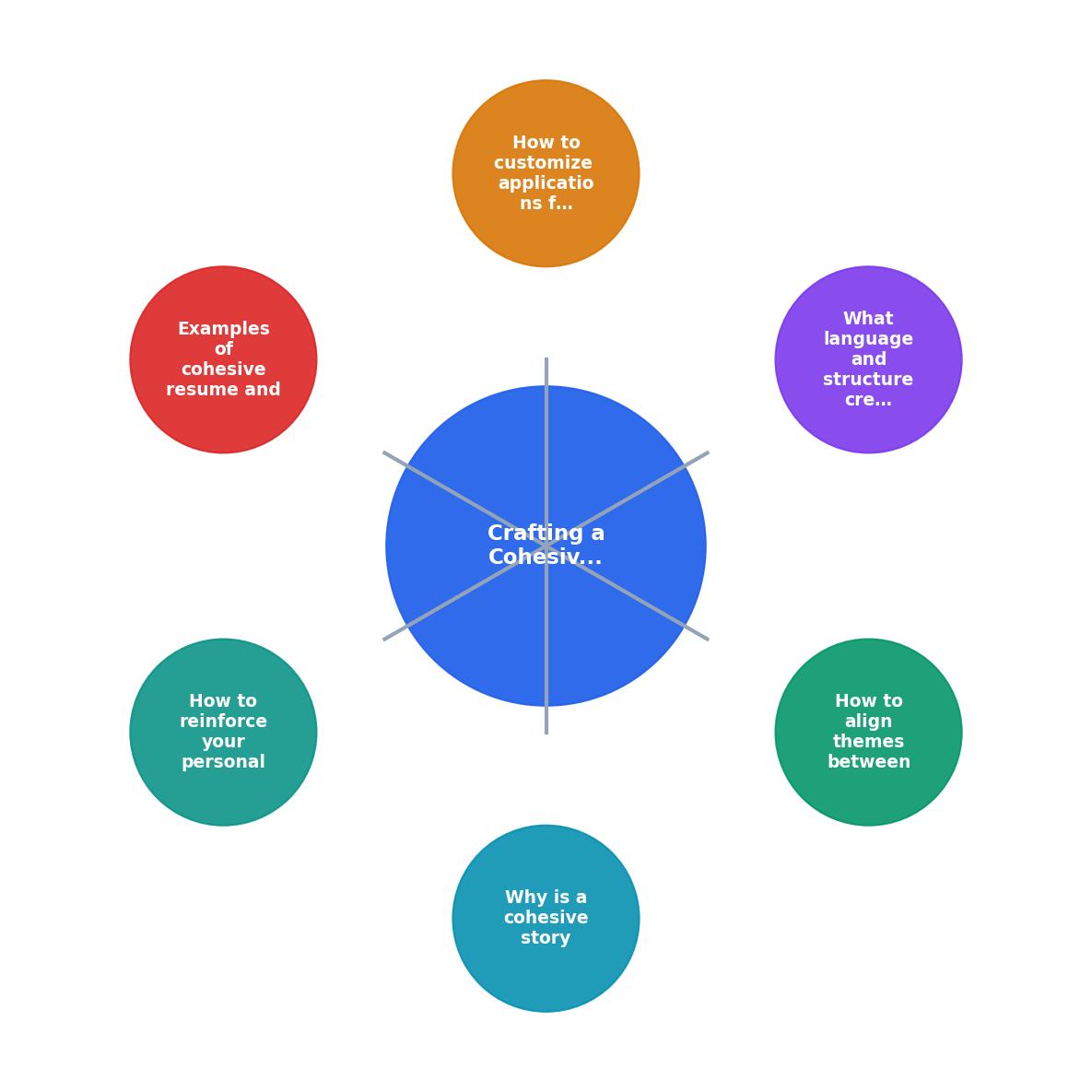
Here's an interactive view of how alignment flows from job analysis through application:
Alignment Process: Job to Resume to Cover Letter
Extract 2-3 core themes, key terms, and priorities from the job description and company website.
Identify resume bullets and stories that align with those themes. Reorder to lead with most relevant.
Use the job's terminology, metrics, and framing. Adjust emphasis to match priorities.
Expand one resume story with context and reflection. Use same terms, metrics, and narrative structure.
Read both documents back-to-back. Do they tell one story or two? Does language repeat? Do achievements align?
This process takes 30-45 minutes per application. It's an investment, but it compounds. Each customized, cohesive application increases your chance of moving past initial screening and into conversation.
Common Mistakes and How to Avoid Them
Mistake 1: Different accomplishments in each document. Your resume mentions managing a $2M budget while your cover letter highlights a product launch. The hiring manager wonders which is really your strength. Instead, choose one or two big achievements and let both documents reinforce them.
Mistake 2: Cover letter contradicts resume. Your resume says you led a project, but your cover letter describes it as a collaborative effort where you "assisted." Pick a lane. If you led it, own it in both documents. If it was truly collaborative, frame it that way in both.
Mistake 3: Tone mismatch. Your resume is stiff and formal; your cover letter is chatty and casual. Different audiences call for different formality, but both should feel like they came from the same person. Match tone broadly.
Mistake 4: Generic cover letter, specific resume. Your resume is tailored for the job, but your cover letter could apply to any role in your field. The cover letter should be just as customized. This is where you show that you care about this specific opportunity.
Mistake 5: Unexplained gaps. If your resume jumps from one industry to another and your cover letter doesn't address the transition, the hiring manager fills the gap themselves, usually with skepticism. Use the cover letter to bridge gaps and frame transitions intentionally.
Cohesive Application Audit Checklist
Your progress is saved automatically in your browser.
FAQ
Frequently Asked Questions
When you send a resume and cover letter that tell the same story, using the same language, reinforcing the same themes, you're not just doubling your effort, you're creating something hiring managers can't ignore: a clear, credible, compelling picture of why you're the right fit. That coherence is what separates applications that get interviews from ones that disappear into the inbox.
What's the biggest disconnect you've noticed between your resume and your cover letters? Use that as your starting point for alignment.
Additional Resources
- How to create a coherent narrative in your cover letter - Creating a coherent narrative · 1. Understand the vacancy and the company · 2. Structure your story · 3. Use specific examples · 4. Connect your experiences to the ...
- The Power of Storytelling in Your Cover Letter - Pick one story and stick with the highlights. It should be clear and concise—strip your sentences to their cleanest components and remove any words that don't ...
- Applying for your dream job? 5 tips for telling authentic ... - Here are my tips for crafting a strong cover letter or response to a behavioral interview question.

Get the 356 complete recruitment audit (free PDF)
Download the free PDF with 356 reasons hiring stalls, plus optional daily email tips. No credit card.
Get the free PDF 356 reasons · Free download