Downplaying Unrelated Experience in Career Switch Resumes
When you're switching careers, your resume tells the wrong story. Ten years as a teacher, a project manager, or a warehouse supervisor doesn't scream "hire me for this marketing coordinator role." The gap between what you've done and what you want to do feels enormous. But here's what most career changers miss: that unrelated experience isn't dead weight, it's just poorly positioned. The trick is not to hide it, but to reframe it, minimize its visual footprint, and redirect the hiring manager's attention to what actually matters: your transferable skills and your readiness for the new role.


Photo by Markus Winkler from Pexels
When you're switching careers, your resume tells the wrong story. Ten years as a teacher, a project manager, or a warehouse supervisor doesn't scream "hire me for this marketing coordinator role." The gap between what you've done and what you want to do feels enormous. But here's what most career changers miss: that unrelated experience isn't dead weight, it's just poorly positioned. The trick is not to hide it, but to reframe it, minimize its visual footprint, and redirect the hiring manager's attention to what actually matters: your transferable skills and your readiness for the new role.
TL;DR:- Restructure your resume to lead with skills, not chronological job history
- Use concise role descriptions (one line) that emphasize relevant outcomes, not duties
- Emphasize transferable skills like project management, communication, and leadership
- De-emphasize unrelated roles by grouping them or moving them below the fold
- Use achievement-focused language that matches the target industry's vocabulary
According to iHire's 2020 Talent Retention Report, 66 percent of survey respondents have recently considered changing careers. That's a lot of people with resumes that don't fit their next role. The good news: a hiring manager scrolling your resume for 6 seconds doesn't need to understand your full career arc. They need to see relevance, competence, and fit, fast. That means burying the irrelevant stuff, front-loading the transferable wins, and speaking their language from line one.
Why Downplay Unrelated Experience?

A resume is a marketing document. It's not your autobiography. When you're changing careers, every inch of space is precious. If a recruiter sees "5 years of retail management experience" at the top and you're applying for a UX design role, they'll already be halfway out the door, assuming you're a career-hop risk or that your background doesn't transfer.
Here's what happens: the human reader sees your old job titles first. Their brain immediately categorizes you as "that person" and builds a mental narrative. If that narrative contradicts the role you're applying for, you've lost their attention before they ever see your transferable wins. The ATS (Applicant Tracking System) has the same problem, it scans for keywords matching the job description, and if it finds "restaurant manager" instead of "project coordinator," it might filter you out before a human ever reads your resume.
The second reason: space and storytelling. A traditional chronological resume buries your most relevant experience and achievements under a stack of irrelevant jobs. When you downplay unrelated experience, you're not lying, you're curating. You're saying, "Here's what matters for this role," and you're backing it up with proof.
How to Restructure Your Resume for a Career Switch

The first move is format. Forget the chronological resume. A skills-based or hybrid resume format puts your relevant capabilities front and center, with experience supporting them rather than leading them. Here's the structure:
Header, Name, phone, email, LinkedIn, portfolio (if applicable).
Professional summary (2–3 sentences), Focused on the target role, not your whole career. "Data analyst transitioning from operations management with 6 years of experience building data-driven reporting systems and optimizing workflows" beats "Experienced professional with a background in operations and a passion for learning."
Skills section, 10–15 skills directly matched to the job description. Group them by category: Technical Skills, Core Competencies, Tools & Software. This is where you front-load your relevance.
Experience section, Reorganized and reprioritized. Put roles that involved transferable skills first, even if they're not your most recent job. Condense irrelevant roles into one-liners or group them under a "Additional Experience" subsection.
Education, Credentials, certifications, bootcamps, relevant coursework.
Effective Ways to Highlight Transferable Skills

Transferable skills are your secret weapon. These are abilities that apply across industries: communication, problem-solving, project management, data analysis, team leadership, customer service, budget management, and process improvement.
The key is to name them in the language of the target role. If you're moving from retail management to project management, you didn't "manage store schedules", you managed timelines, prioritized competing demands, and kept stakeholders aligned. Same skill, different vocabulary.
Example translation:
| Your Old Role | What You Actually Did | Target Language |
|---|---|---|
| Retail manager | Handled staff conflicts | Managed team dynamics and conflict resolution |
| Teacher | Explained concepts differently to different students | Adapted communication for diverse audiences |
| Warehouse supervisor | Fixed broken processes | Process optimization and continuous improvement |
| Small business owner | Juggled budgets, hiring, sales | Strategic planning and resource allocation |
"According to iHire's 2020 Talent Retention Report, 66 percent of survey respondents have recently considered changing careers.">, How to Write a Career Change Resume
Writing Concise Role Descriptions
Your role descriptions are where most career changers stumble. They write long, duty-heavy bullet points that scream "I was busy doing job duties" rather than "I delivered results."
Rule 1: One line per role minimum, max 3-4 bullets per role, only for relevant roles.
For irrelevant roles: one line. "Operations Coordinator, TechCorp (2016–2018), Managed scheduling, vendor communication, and office administration."
That's it. It acknowledges the role, shows you held a professional position, and moves on. Don't elaborate on the coffee budget or the supply ordering.
For relevant roles: 3-4 bullets, each starting with an action verb and focused on a measurable or meaningful outcome.
Before (duty-focused):- Managed a team of 8 people
- Oversaw daily operations
- Trained new employees
- Handled customer complaints
- Led cross-functional team of 8, reducing project cycle time by 30%
- Designed and implemented training program adopted company-wide
- Resolved escalated customer issues with 95% resolution rate on first contact
- Identified and eliminated three operational bottlenecks, saving 10 hours per week
Skills-Focused Resume Format
A skills-focused resume is your best defense against the "wrong background" objection. Here's why it works: it immediately answers the hiring manager's question, "Can this person do the job?" before they even think about your prior career.
Structure of a skills-focused resume:
- Header + Professional Summary (tailored to the target role)
- Core Competencies (6–8 skills directly from the job description)
- Technical Skills (tools, software, platforms)
- Relevant Experience (reorganized by transferable skill, not chronology)
- Additional Experience (older or unrelated roles, condensed)
- Education & Certifications
How to De-Emphasize Unrelated Roles
Several tactics work here, depending on how many irrelevant roles you have:
Tactic 1: Combine and condense. If you have multiple short roles in unrelated fields, group them under "Additional Professional Experience" with one-line descriptions:- Regional Sales Manager, RetailCo (2014–2016)
- Customer Service Supervisor, CallCenter Inc. (2012–2014)
- Additional Professional Experience: Regional Sales Manager at RetailCo (2014–2016), Customer Service Supervisor at CallCenter Inc. (2012–2014)
Tactic 2: Move them below the fold. In a hybrid or skills-based format, put irrelevant roles after relevant ones, even if they're more recent. A hiring manager scrolling through your resume will see the relevant experience first. Many won't scroll all the way down if they've already found what they're looking for.
Tactic 3: Minimize detail. For unrelated roles, list the title and company, dates, and one generic line. Don't include bullet points describing duties. No bullets = less visual emphasis = less attention drawn.
Tactic 4: Use neutral job titles. If your old job title is confusing or off-putting, use a broader category. "Operations Manager" instead of "Retail Operations Manager" if that matters. You're not lying, you're just being efficient.
Process at a Glance
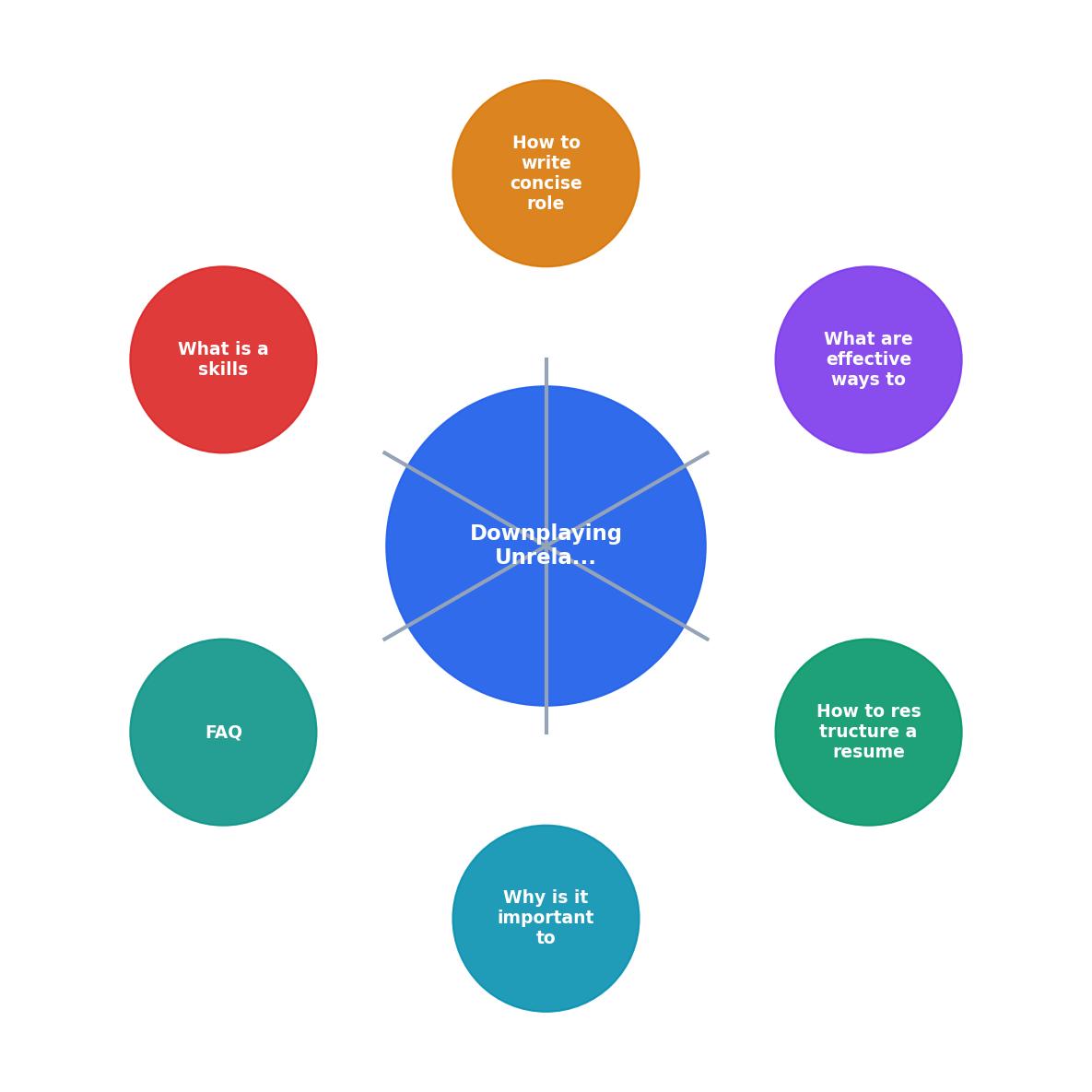
The steps to downplay unrelated experience aren't complicated, but they require strategy:
- Analyze the target job description. Extract the top 8–10 skills and keywords the role requires.
- Map your transferable skills. Which of your past roles involved those skills, even tangentially?
- Prioritize experience. Roles involving transferable skills go first or get more detail. Irrelevant roles get condensed.
- Rewrite job descriptions. Use the target industry's language. Emphasize outcomes, not duties.
- Choose your format. Skills-based or hybrid if you have significant career gaps or unrelated background. Keep layout clean.
- Test for relevance. Read your resume imagining you're a hiring manager. Does it answer "Can this person do this job?" in the first 10 seconds?
Resume Downplaying Strategy
Resume Restructuring Checklist for Career Switchers
Your progress is saved automatically in your browser.
FAQ
Frequently Asked Questions
Additional Resources
- How to Write a Career Change Resume - Template - Wharton - When you're changing careers, your resume needs to emphasize relevant skills. Learn how to write a career change resume & download our example template.
- How can I explain unrelated experience on my resume ... - I am switching careers, and all of my experience is real and professional although only a part of it is relevant to the new field to which I am ...
- The Best Resume Tips for a Career Change - Ready to make a career transition, but not sure how to start? The key is to focus on transferable strengths and experiences that make it ...

Get the 356 complete recruitment audit (free PDF)
Download the free PDF with 356 reasons hiring stalls, plus optional daily email tips. No credit card.
Get the free PDF 356 reasons · Free download