Discovering Effective Keywords for a Tech Industry Resume
You sent out 40 applications last month and heard back from exactly one. The resume looked solid to you, but the applicant tracking system filtering those submissions never agreed. The gap between what you wrote and what the ATS scanned for comes down to one thing: keywords. Get them right, and your resume actually reaches a recruiter.


You sent out 40 applications last month and heard back from exactly one. The resume looked solid to you, but the applicant tracking system filtering those submissions never agreed. The gap between what you wrote and what the ATS scanned for comes down to one thing: keywords. Get them right, and your resume actually reaches a recruiter. Get them wrong, and it vanishes into a database no human ever opens.
Photo by cottonbro studio from Pexels
TL;DR:- Effective tech resume keywords are the exact terms an ATS matches against the job posting: programming languages, frameworks, methodologies, certifications, and soft skills.
- Pull keywords directly from each job description rather than relying on a generic master list.
- Place them in your skills section, bullet-point achievements, and professional summary for maximum ATS scoring.
Why Keywords Decide Your Resume's Fate
Every major tech employer runs incoming resumes through an ATS before a recruiter sees them. The system parses your document, extracts text, and scores it against the job posting's requirements. A resume missing critical keywords scores low and drops out of the queue.
"Today, approximately 97.8 percent of Fortune 500 companies use an ATS and/or recruiting management system (RMS) to streamline their hiring processes [1].">, Resume Keywords: How to Find the Right Words to Beat the ATS
That statistic covers Fortune 500 companies, but mid-size tech firms and startups increasingly use the same tools. Greenhouse, Lever, Workday, and iCIMS all rely on keyword matching as a first-pass filter. Your resume is not competing against other candidates at this stage. It is competing against an algorithm that counts term frequency and relevance.
Keywords in this context are not buzzwords. They are specific, concrete terms: Python, AWS, CI/CD, Agile, Scrum, React, Kubernetes. The ATS treats them as data points. If the job posting says "experience with Terraform" and your resume says "infrastructure automation" without ever mentioning Terraform, you lose that match.
Identifying the Right Tech Keywords

The best keyword source is the job posting itself. Read it three times. On the first pass, highlight every technical skill mentioned. On the second, note soft skills and methodologies. On the third, look for repeated terms and phrases that signal priority requirements.
Here is a practical breakdown of keyword categories for tech roles:
- Programming languages: Python, Java, JavaScript, TypeScript, Go, Rust, C++, SQL
- Frameworks and libraries: React, Angular, Vue.js, Django, Spring Boot, .NET, Node.js
- Cloud platforms: AWS, Azure, Google Cloud Platform (GCP), DigitalOcean
- DevOps and infrastructure: Docker, Kubernetes, Terraform, Jenkins, GitHub Actions, CI/CD
- Methodologies: Agile, Scrum, Kanban, SAFe, Waterfall, Test-Driven Development (TDD)
- Data and analytics: SQL, PostgreSQL, MongoDB, Snowflake, Apache Spark, Tableau, Power BI
- Security: OWASP, SOC 2, penetration testing, IAM, zero trust
- Certifications: AWS Solutions Architect, Google Professional Cloud Engineer, PMP, CISSP, CompTIA Security+
- Soft skills: cross-functional collaboration, stakeholder communication, technical mentoring, code review
Roughly seven out of ten resumes never reach a human reviewer. The difference between those that do and those that don't is almost always keyword alignment with the specific posting.
Where to Place Keywords
Stuffing keywords into a single skills section is not enough. ATS algorithms check multiple resume sections and weigh contextual usage. A keyword embedded in an achievement bullet carries more weight than one sitting in a comma-separated list.
Professional summary: Include 3-5 top keywords naturally. Example: "Backend engineer with 5 years building scalable microservices in Python and Go, deployed on AWS using Kubernetes and Terraform."
Skills section: List hard skills in a clean, scannable format. Group them by category (Languages, Frameworks, Cloud, Tools). This section catches the ATS scan and gives recruiters a quick reference.
Experience bullets: Weave keywords into accomplishment statements. Instead of "Managed cloud infrastructure," write "Managed AWS infrastructure across 12 microservices using Terraform and CloudFormation, reducing deployment time by 40%."
Certifications and education: Include the full certification name and the acronym. Write "AWS Certified Solutions Architect (SAA-C03)" so the ATS matches both the long form and the short form.
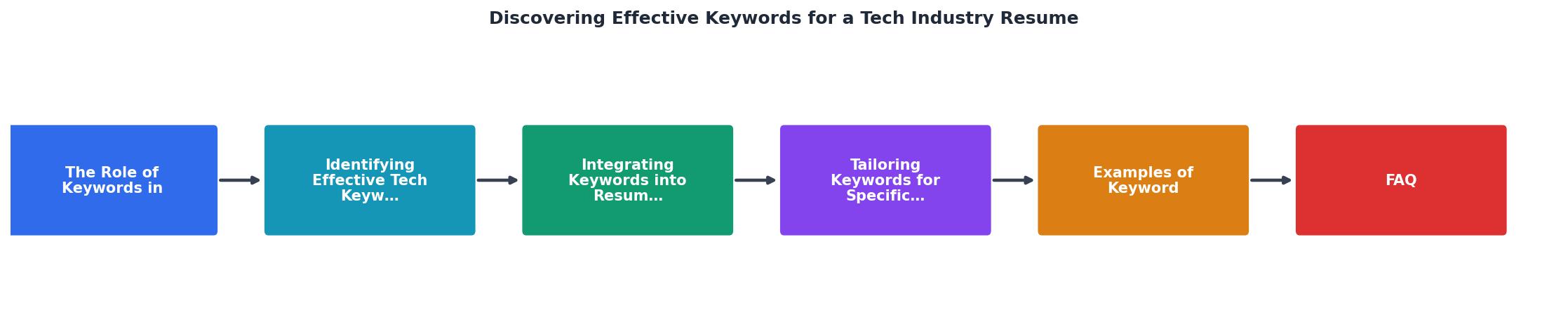
The diagram above shows the core flow: Read posting, Extract keywords, Map to resume sections, Tailor bullets, Review and submit. Each step feeds the next. Skipping "Extract keywords" means the rest of the process runs on guesswork.
Tailoring Keywords for Specific Roles

A frontend developer resume and a DevOps engineer resume share almost zero keyword overlap. Treating them the same is a guaranteed way to score low on both.
| Frontend Developer Keywords | DevOps Engineer Keywords |
|---|---|
| React, Vue.js, Angular | Docker, Kubernetes, Terraform |
| CSS, Tailwind, Sass | Jenkins, GitHub Actions, ArgoCD |
| Responsive design, accessibility | CI/CD pipelines, infrastructure as code |
| Jest, Cypress, Storybook | Prometheus, Grafana, ELK stack |
| Figma collaboration, design systems | AWS, GCP, Linux administration |
Data engineers need terms like ETL, Apache Airflow, dbt, Snowflake, and data modeling. Product managers in tech need roadmap planning, A/B testing, JIRA, user stories, and OKRs. Cybersecurity analysts need SIEM, incident response, vulnerability assessment, and compliance frameworks like NIST or ISO 27001.
The pattern is consistent: every role has its own vocabulary. A generic "tech resume" with broad terms like "problem-solving" and "team player" tells the ATS nothing specific. Those soft skills matter, but they supplement hard keywords rather than replace them.
If you are applying to multiple types of roles, maintain a separate base resume for each category. Adjust the keywords per posting from that base. Tools like Resume Hedgehog automate this by analyzing the job description and suggesting which keywords your resume is missing, saving you the manual comparison work.
Keyword-Optimized Resume Examples

Here is what a keyword-optimized experience bullet looks like for a full-stack developer:
"Built web applications using modern technologies"(vague, zero keyword matches)- "Developed and deployed 3 production React/Node.js applications on AWS ECS, implementing CI/CD pipelines with GitHub Actions and achieving 99.9% uptime" (specific, keyword-dense, measurable)
"Analyzed data and created reports for stakeholders"(generic)- "Built predictive models in Python using scikit-learn and TensorFlow, processing 2M+ records in Snowflake, and delivered insights via Tableau dashboards to C-suite stakeholders" (targeted, quantified)
The following interactive card shows how keyword density shifts your ATS match score in a typical scenario:
Example ATS Match Score by Keyword Strategy
The difference between a generic resume and one with full keyword integration is dramatic. Moving from 28% to 91% match score is the difference between silence and an interview invitation.
Tech Resume Keyword Optimization Checklist
Your progress is saved automatically in your browser.
FAQ
Frequently Asked Questions
What keyword strategy has worked best for your tech applications? Share what you have learned in the comments.
Additional Resources
- Resume Keywords: How to Find the Right Words to Beat ... - When reviewing job descriptions, look for keywords in the qualifications, skills, and experience sections that you can add to your resume.
- 9 Tech Keywords that Should Be on Your Resume - So without further adieu, here are nine resume keywords that can take your tech resume to the next level, starting right now: … Continue reading.
- How To Use Resume Keywords and Phrases (With Example) - In this article, we discuss what resume keywords and phrases are, how to incorporate them into your application and provide an example ...

Get the 356 complete recruitment audit (free PDF)
Download the free PDF with 356 reasons hiring stalls, plus optional daily email tips. No credit card.
Get the free PDF 356 reasons · Free download