Effective Phrases for an Entry-Level Sales Resume
Your resume has about six seconds to convince a recruiter you belong in sales. With zero or limited professional experience, the words you choose carry all the weight. The right phrases turn a thin resume into a compelling pitch, while generic filler gets filtered out before a human ever reads it. This guide gives you the exact action-oriented phrases, keywords, and structural tips that make entry-level sales resumes land interviews.

Your resume has about six seconds to convince a recruiter you belong in sales. With zero or limited professional experience, the words you choose carry all the weight. The right phrases turn a thin resume into a compelling pitch, while generic filler gets filtered out before a human ever reads it. This guide gives you the exact action-oriented phrases, keywords, and structural tips that make entry-level sales resumes land interviews.

- Use action verbs like "generated," "prospected," and "closed" instead of passive descriptions to show sales-ready initiative.
- Weave sales-specific keywords from the job posting into your skills, summary, and experience sections to pass ATS screening.
- Structure your resume with a strong summary, quantified achievements (even from coursework or internships), and a clean layout that recruiters can scan in seconds.
Why Phrasing Matters in Sales Resumes
Sales is a language-driven profession. Recruiters hiring for entry-level sales roles look for candidates who already sound like closers on paper. A resume that says "responsible for helping customers" reads like someone who stood behind a counter. A resume that says "converted 40+ walk-in prospects into paying customers weekly" reads like someone who sells.
Applicant Tracking Systems scan for specific keywords before a recruiter ever opens your file. If your resume lacks the terms the hiring manager entered into the ATS, it gets rejected automatically. For entry-level candidates, this is brutal: you already have limited experience, and now a robot is filtering you out because you wrote "helped with sales" instead of "generated leads."
The fix is straightforward. Replace vague descriptions with precise, action-oriented phrases that match what sales teams actually say. Every bullet point on your resume should start with a verb that implies initiative, results, or revenue.
Action-Oriented Phrases That Work

Here is a breakdown of phrases organized by the skill they demonstrate. Swap out the weak versions on your current resume for these stronger alternatives.
Lead Generation & Prospecting:- "Prospected and qualified 50+ leads per week through cold outreach"
- "Identified new business opportunities through market research and competitor analysis"
- "Generated a pipeline of 30 qualified prospects during a 3-month internship"
- "Closed $12,000 in sales during a semester-long fundraising campaign"
- "Exceeded monthly sales targets by 15% for three consecutive months"
- "Converted inbound inquiries into paid accounts at a 25% close rate"
- "Built and maintained relationships with 100+ client accounts"
- "Resolved customer objections to retain 95% of at-risk accounts"
- "Managed CRM data entry and follow-up sequences for a 200-contact database"
- "Delivered product presentations to groups of 10-50 attendees"
- "Collaborated with marketing to develop targeted outreach campaigns"
- "Trained 5 new team members on sales processes and CRM software"
"Initiated and led a cross-functional team to streamline the order fulfillment process, reducing delivery times by 30% and improving customer satisfaction scores from 7.5 to 9.2 out of 10.">, [8+ Entry Level Sales Rep Resume Examples [with Free Templates]](https://www.tealhq.com/resume-examples/entry-level-sales-rep)
Weaving Keywords Into Your Resume
Knowing good phrases is step one. Placing them correctly is step two. Sales keywords need to appear in three specific locations:
- Professional summary (top of resume): Include 2-3 core sales terms. Example: "Results-driven recent graduate with experience in lead generation, CRM management, and consultative selling."
- Skills section: List 8-12 keywords directly from the job posting. Common entry-level sales keywords include: prospecting, cold calling, pipeline management, Salesforce, HubSpot, upselling, B2B sales, account management, quota attainment, negotiation.
- Experience bullets: Embed keywords naturally into achievement statements. Do not just list them. "Managed a Salesforce pipeline of 150+ leads" beats "Salesforce" sitting alone in a skills list.
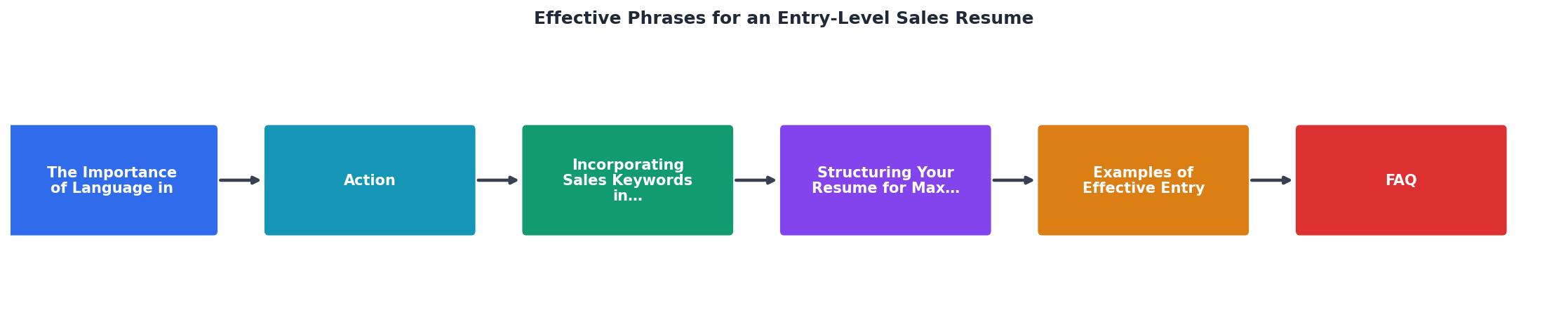
Follow these steps: Read the job posting, Extract keywords, Match to your experience, Write action-verb bullets, and Review for ATS alignment. Each step builds on the previous one, and skipping any of them weakens the final result.
A tool like Resume Hedgehog can speed this up significantly. Upload your current resume, paste the job description, and it highlights the keyword gaps and suggests optimized phrasing automatically.
Structuring Your Resume for Impact

With limited experience, structure does the heavy lifting. Here is what works for entry-level sales candidates:
Professional Summary (3-4 lines): Skip the objective statement. Write a summary that positions you as someone already thinking in sales terms. Mention your degree, one or two relevant skills, and a quantified result if you have one.
Skills Section (8-12 keywords): Two columns, clean formatting. Pull directly from the job posting. If the posting says "cold calling," your resume says "cold calling." Not "phone outreach." Not "telephone communication." The exact phrase.
Experience Section: This is where most entry-level candidates struggle. You do not need formal sales jobs. Reframe what you have:
- Retail job: "Upsold accessories and warranties, increasing average transaction value by 20%"
- Campus organization: "Recruited 45 new members through targeted outreach and event presentations"
- Internship: "Supported the sales team by qualifying inbound leads and scheduling 15+ demos per week"
- Freelance/side hustle: "Acquired 12 clients through direct outreach and referral networking"
The comparison below shows the difference between weak and strong phrasing for the same experience:
| Weak Phrasing | Strong Phrasing |
|---|---|
| Helped customers at the store | Converted 40+ walk-in prospects into paying customers weekly |
| Was responsible for phone calls | Conducted 60+ cold calls daily, generating 8 qualified leads per week |
| Worked on a team project | Collaborated with a 5-person team to develop a go-to-market strategy |
| Did data entry in CRM | Maintained Salesforce records for 200+ accounts with 98% data accuracy |
| Assisted with events | Organized 3 campus sales events attracting 150+ attendees each |
Real Phrases in Context
Here is a sample dashboard showing how a well-optimized entry-level sales resume scores across key areas. This represents a typical candidate who has rewritten their resume using the techniques in this guide:
Entry-Level Sales Resume Scorecard
Notice the "Quantified Achievements" score sits at 75%. That is common for entry-level candidates. You may not have revenue numbers from a sales job, but you can quantify club membership drives, event attendance, customer interactions per shift, or project outcomes. Every number you add pushes that score higher.
Entry-Level Sales Resume Phrase Checklist
Your progress is saved automatically in your browser.
FAQ
Frequently Asked Questions
What phrase on your current resume are you planning to rewrite first? Share it in the comments and let's workshop it together.
Additional Resources
- 8 Entry Level Sales Rep Resume Examples & Tips for 2025 - These Entry Level Sales Rep resume examples for 2025 show how to highlight what matters most, like relationship building, effective communication, and goal ...
- Sales resume examples and effective writing tips for 2026 - Check out these sales resume tips and examples—for all experience levels—to land your dream sales job.
- Entry-Level Sales Associate Resume Examples for 2026 - A recruiter-approved Entry-Level Sales Associate resume example in Google Docs and Word format, with insights from hiring managers in the industry.

Get the 356 complete recruitment audit (free PDF)
Download the free PDF with 356 reasons hiring stalls, plus optional daily email tips. No credit card.
Get the free PDF 356 reasons · Free download