Do Entry-Level Resumes Need a Summary Section?
You're staring at a blank resume, and the cursor blinks under your name and contact info. Do you add a summary section, or skip straight to your education and experience? For entry-level candidates, this decision can feel surprisingly high-stakes, and the answer isn't as simple as yes or no. A summary section can capture hiring managers' attention in seconds, but only if it's done right.

Photo by Artem Podrez from Pexels
You're staring at a blank resume, and the cursor blinks under your name and contact info. Do you add a summary section, or skip straight to your education and experience? For entry-level candidates, this decision can feel surprisingly high-stakes, and the answer isn't as simple as yes or no. A summary section can capture hiring managers' attention in seconds, but only if it's done right. A poorly written one wastes precious screen real estate and signals that you don't understand the role.
TL;DR
- A summary section is optional but can give entry-level resumes a competitive edge by highlighting your strongest skills and career focus upfront.
- Summaries work best when tailored to the specific job and kept to 2-3 sentences that speak directly to what the employer needs.
- Weak summaries filled with generic phrases or buzzwords hurt your chances more than no summary at all.
- Strong summaries help get past ATS screening and make a human reader want to dig deeper into your experience.
A summary section, also called a professional summary, objective, or headline, sits at the top of your resume just below your contact information. Unlike a generic template summary, a good entry-level summary is a targeted 2-3 sentence snapshot that tells hiring managers exactly who you are professionally and what you're looking for. The short answer: yes, a summary can help your resume stand out, but it's not required if you don't have much to say yet.
What Is a Resume Summary?

A resume summary is a brief introduction at the top of your resume that positions you as a candidate. It's different from a cover letter because it lives on the resume itself, appearing before your work history and skills. Think of it as your elevator pitch in written form.
There are three main types:
- Professional summary, A 2-3 sentence overview of your skills, experience, and career goals. Most relevant for entry-level candidates.
- Career objective, A statement about what role you're seeking and what you want to achieve. Older style, less favored today, but still used in some fields.
- Headline, A single bold line that summarizes your value in 5-10 words (e.g., "Recent graduate with strong Python skills and passion for fintech").
Why Entry-Level Summaries Matter
Hiring managers spend seconds, often fewer than six, scanning each resume. If your summary isn't compelling, they move on. A well-crafted summary tells them immediately why you're worth their time.
Summaries are especially valuable for entry-level candidates because you likely don't have years of experience to speak for you. A summary compensates by:
- Highlighting your best skills early, You name the tools, languages, or competencies the job description asks for before they even scroll.
- Showing clarity of purpose, You tell them what kind of role you want and why you're interested, not just that you're looking for "any job."
- Creating a hook, You give them a reason to keep reading, especially if your experience is thin or non-traditional (internships, freelance projects, coursework).
- Boosting ATS performance, A summary packed with job-relevant keywords can help your resume rank higher in applicant tracking systems.
How to Craft a Strong Entry-Level Summary

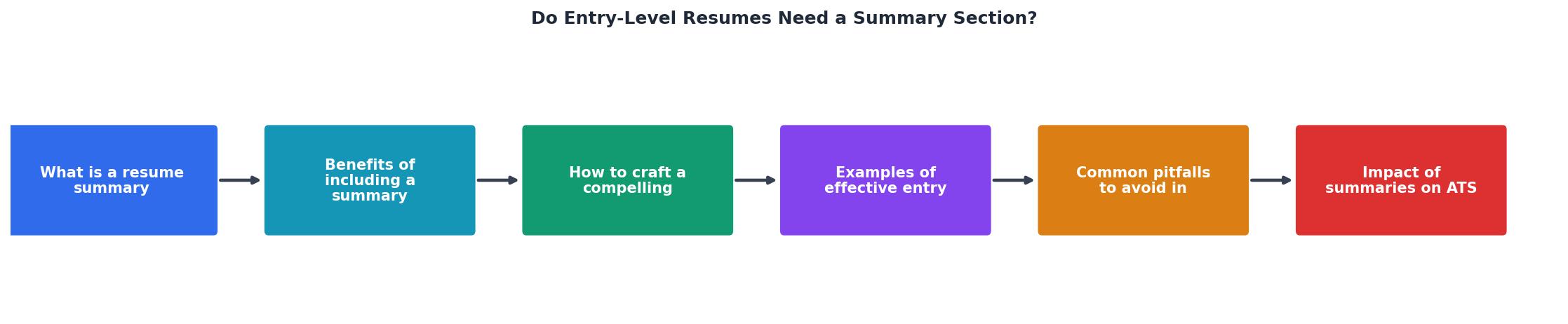
Writing an entry-level summary is a process. You start with understanding what the job needs, then translate what you have into their language. The process diagram below shows the main steps:
Here's how to do it step by step:
Step 1: Read the job description carefully. Mark 5-7 keywords or phrases that appear repeatedly. These are your signals for what matters to the employer.
Step 2: Identify your strongest relevant skills. Look at your internships, projects, courses, and volunteer work. What do you actually do well? Be specific: not "good at marketing" but "ran social media campaigns" or "analyzed customer engagement metrics."
Step 3: Connect your skills to the job. Use the employer's language. If they say "data-driven," use that phrase. If they list "Python and SQL," mention those tools if you have them.
Step 4: Add your goal or angle. Why are you interested in this field? What do you want to do? For entry-level candidates, this might be: "seeking to launch a career in UX design" or "building expertise in full-stack web development."
Step 5: Write 2-3 sentences. That's it. Keep it tight.
Step 6: Read it aloud. Does it sound like you, or like a template? Does it speak to the job at hand?
Real Examples of Strong Entry-Level Summaries
Let's look at concrete examples tailored to different roles:
Example 1: Recent Graduate Seeking a Data Analytics Role
"Recent statistics graduate with hands-on experience in Python, R, and Excel dashboarding. Completed capstone project analyzing customer churn for a retail client. Seeking a data analyst role where I can transform raw data into actionable insights."
Why this works: It's specific (Python, R, Excel, customer churn), shows real output (capstone project), and ties to the job. It avoids "hardworking" or "team player."
Example 2: Junior Developer with an Internship
"Full-stack web developer with 6 months of JavaScript, React, and Node.js experience from a summer internship. Built responsive front-ends and worked with RESTful APIs. Looking to contribute to a growth-stage startup's product engineering team."
Why this works: It leads with technical skills (JavaScript, React, Node.js), shows what they built, and names their target (growth-stage startup), which tells the employer what kind of culture and pace suits them.
Example 3: Recent Business Graduate Switching to Marketing
"Recent business graduate transitioning into digital marketing with a passion for content strategy and analytics. Managed Instagram and email campaigns for a small e-commerce brand during an internship. Fluent in Google Analytics and seeking a coordinator role in B2B SaaS marketing."
Why this works: It acknowledges the pivot ("transitioning into"), shows specific platforms and outcomes, and names a niche (B2B SaaS), which shows the candidate has done their homework.
Example 4: What NOT to Do
"Hardworking, detail-oriented recent graduate seeking an opportunity to grow with a dynamic company where I can apply my skills and contribute to a winning team."
Why this fails: Every word is generic. There's nothing here that differentiates this candidate from hundreds of others. A hiring manager reads this and forgets it instantly.
How Summaries Affect ATS and First Impressions
Your summary does two jobs: it passes the ATS filter and it hooks the human recruiter.
For ATS: Applicant tracking systems scan your resume for keywords that match the job posting. A summary stuffed with the right keywords (the ones from the job description) can boost your score. If the job requires "Python" and you mention it in your summary, you're already ahead. If you don't mention it until page two, the ATS might score you lower, or worse, filter you out if it's a strict system.
For human readers: Your summary is the first substantive thing they read. If it's boring, they skim your education and move on. If it's sharp and shows you know the role, they dig deeper. This is where a summary earns you extra seconds of attention.
"Most of us know that about resumes (and if you don't…surprise!">, Should you include a professional summary section at the top of your resume?
Common Pitfalls to Avoid
Pitfall 1: Using a template summary. Copying and pasting a generic summary from a template defeats the purpose. Hiring managers spot this instantly. Your summary should be specific to the job and your background.
Pitfall 2: Making it too long. A summary that's five sentences or longer isn't a summary, it's an intro paragraph. Keep it to 2-3 sentences maximum. Entry-level candidates especially need to be concise.
Pitfall 3: Listing generic skills. "Excellent communication and leadership" tells the employer nothing. Instead, say what you communicated or led: "Led a team of three in a semester-long project management capstone" is stronger.
Pitfall 4: Focusing on what you want instead of what you offer. A summary that reads "seeking a position where I can learn and grow" makes it about you. Flip it: "I bring Python and data analysis skills to drive product insights" makes it about the employer's needs.
Pitfall 5: Over-stuffing with keywords. Yes, include keywords from the job, but don't cram 10 tool names into two sentences. It looks desperate and reads awkwardly.
Pitfall 6: Including irrelevant skills. If the job is about marketing and you list C++ and database administration, you're confusing the reader. Stay focused.
When to Include vs. Skip a Summary
Include a summary if:
- You're applying to a specific job (not a general application).
- Your experience doesn't speak for itself yet (you're entry-level or changing careers).
- You have concrete skills and accomplishments to highlight.
- The job description uses specific keywords or terminology you can speak to.
- You have five-plus years of strong, relevant experience. Your work history speaks for itself.
- Your background is straightforward and your target is obvious (the job title matches your experience).
- You have nothing concrete to say yet, you're still figuring out your direction.
Interactive Summary Builder
To help you visualize how different summaries perform, here's an interactive comparison of strong vs. weak entry-level summaries for a sample UX design role:
✓ Strong Entry-Level Summary
✗ Weak Entry-Level Summary
The visualization above shows how a targeted, specific summary performs far better with both ATS systems and human readers than a generic template. The strong version includes 5 keywords from a typical UX role posting, while the weak version contains zero, and reads like any other entry-level candidate.
Step-by-Step Checklist for Your Entry-Level Summary
Use this checklist to build and refine your summary before you finalize your resume:
Build Your Entry-Level Summary
Your progress is saved automatically in your browser.
FAQ
Frequently Asked Questions
Getting your entry-level resume right is about making every word count. A strong summary does that by showing hiring managers exactly who you are and why you're a fit for their role, before they even scroll down. Whether you decide to include one depends on what you have to say, but if you do, make sure it's tailored, specific, and free of clichés.
Additional Resources
- Should you include a professional summary in your resume? - Should you include a professional summary section at the top of your resume? My honest thought is…maybe. Here's why: First of all, ...
- How to Write a Stellar Entry-Level Resume Summary - In general, a summary is the better choice if you have at least three years of relevant experience, while objectives are better for entry-level ...
- What Makes a Great Entry-Level Resume Summary in ... - Therefore, entry-level candidates must rely more heavily on the resume summary to highlight their skills and achievements. So, what should you ...

Get the 356 complete recruitment audit (free PDF)
Download the free PDF with 356 reasons hiring stalls, plus optional daily email tips. No credit card.
Get the free PDF 356 reasons · Free download